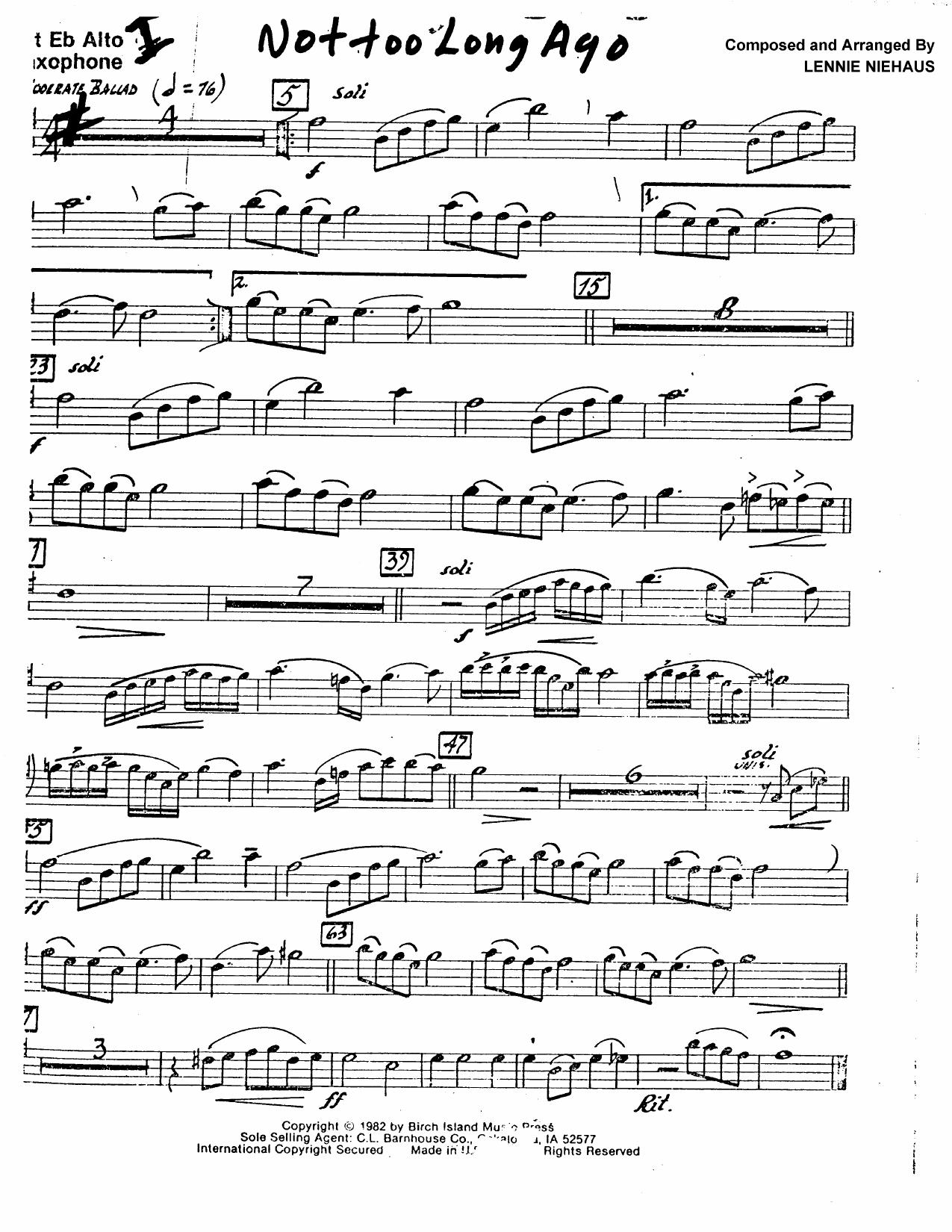
Not Too Long Ago (L.Niehaus)
Composed by Lennie Niehaus
Arranged by Lennie Niehaus
- Ensemble: Big Band
- Pages: 24
- Instruments (16): 1st Eb Alto Saxophone, 2nd Eb Alto Saxophone, 1st Bb Tenor Saxophone, Eb Baritone Saxophone, 1st Bb Trumpet, 2nd Bb Trumpet, 3rd Bb Trumpet, 4th Bb Trumpet, 1st Trombone, 2nd Trombone, 3rd Trombone, 4th Trombone, Piano, Bass, Drums, Guitar
- Difficulty: medium
- Content: Individual Parts
- Format: PDF Download (Instant)
- Price: $24.99
Lennie Niehaus carved out an indelible legacy as both a foundational architect of West Coast cool jazz and a prolific educator whose writing for big band remains a benchmark of clarity, linear drive, and sophisticated harmonic motion. Rising to prominence through his pivotal work as both an alto saxophonist and staff arranger for the Stan Kenton Orchestra in the 1950s, Niehaus mastered a style that bridged the intricate, labyrinthine language of bebop with a clean, transparent ensemble counterpoint. "Not Too Long Ago" encapsulates this brilliant synthesis, capturing the quintessential mid-century West Coast aesthetic where academic precision meets effortless, driving swing. Originally conceived during an era when modern jazz arrangers were fiercely exploring modal textures, extended tertian harmonies, and linear independence, this composition stands as a masterclass in economy of means and maximum rhythmic impact. From the downbeat, the arrangement establishes a polished, mid-tempo swing feel anchored in a sophisticated harmonic landscape. The mood is effortlessly cool yet intellectually engaging, evoking the smoky, sophisticated atmosphere of 1950s Los Angeles jazz clubs. Niehaus avoids dense, muddy chord clusters in favor of open-spaced voicings that let individual instrumental voices breathe, utilizing clever parallel motion and tight block-chord writing for the saxophones that recalls his classic writing style. The energy builds organically through tightly woven counter-melodies and crisp harmonic turnarounds, creating an engaging emotional arc that balances relaxed sophistication with moments of fiery, bop-infused intensity. Niehaus’s distinct arranging thumbprint is visible across every page of this 12-instrument manuscript, where sectional interplay takes precedence over gratuitous volume. The brass and reed sections engage in intelligent call-and-response patterns, peppered with signature Niehaus-style chromatic approaches and bebop-rooted enclosures. The melody is predominantly carried by the lead alto saxophone and trumpet sections, often doubled at the octave to achieve that bright, cutting West Coast sheen. Solo opportunities are integrated seamlessly into the form, designed to showcase linear improvisers who thrive on changes rooted in traditional bop vocabulary. The shout chorus serves as a structural high point, utilizing concise motivic development rather than sheer decibels to drive the ensemble to an exhilarating climax. Advanced high school, collegiate, and professional jazz ensembles will find this chart to be an exceptionally rewarding addition to their repertoire. While the technical demands require clean articulation, agile section blend, and a strong internal sense of swing rather than brute-force endurance, the rewards are immense. The 12-instrument configuration allows smaller professional or collegiate big bands to achieve a massive, balanced sound without getting lost in excessive counterpoint. Conductor and players alike will appreciate how efficiently Niehaus’s transparent scoring highlights every section, making it an ideal vehicle for teaching stylistic uniformity, dynamic control, and authentic West Coast jazz phrasing. Achieving an authentic rendition of "Not Too Long Ago" requires strict adherence to the classic West Coast style: clean articulation, a relaxed yet driving medium-swing feel, and absolute transparency in section balance. The tempo should remain steady and forward-moving, avoiding any tendency to rush the eighth-note lines. Rhythms must be interpreted with a light, articulate tongue—short notes should be clipped and punchy, while longer notes benefit from a warm, controlled vibrato reminiscent of the 1950s cool school. The brass section must exercise careful dynamic restraint during ensemble passages, ensuring that background figures never obscure the lead melodic voices. Pay close attention to the dynamic markings in the sax solis, where unified phrasing and intonation are paramount. The rhythm section should anchor the groove with a feather-light ride cymbal pattern and a walking bassline that prioritizes horizontal momentum over heavy percussive accents. Rehearsal should begin with sectional work to lock in the intricate chromatic lines before merging the ensemble for overall balance and stylistic cohesion. Q: What instruments and parts are included in this arrangement? A: This arrangement is scored for a 12-instrument ensemble featuring Alto Saxophone, four Trumpets (Trumpet 1 through 4), and supporting rhythm and horn parts across a comprehensive 24-page manuscript. Q: What is the difficulty level of this chart? A: It is ideally suited for advanced high school, collegiate, and professional jazz ensembles due to its requirement for strong sectional blend, agile bop-inflected phrasing, and precise articulation. Q: What style and historical era does this piece represent? A: The arrangement represents the West Coast cool jazz style of the 1950s, capturing the sophisticated, linear-driven bebop aesthetic popularized by arranger and saxophonist Lennie Niehaus. Q: What makes this specific Lennie Niehaus arrangement unique? A: Its uniqueness lies in Niehaus’s signature transparent voicings, economical yet brilliant counterpoint, and clever sectional interplay that achieves a massive big band sound without relying on dense, cluttered harmonies. Q: What is the performance duration and tempo feel of the piece? A: The arrangement is written in a classic 4/4 meter with a crisp, driving medium-swing tempo feel that sustains a high level of engagement from the opening downbeat to the final chord.
Questions and answers
- What is included in the Not Too Long Ago (L.Niehaus) PDF?
- The verified current file contains individual parts across 24 pages.
- How many instruments or parts are listed for Not Too Long Ago (L.Niehaus)?
- The verified instrumentation list contains 16 entries for this Big Band arrangement.
- Who is credited for Not Too Long Ago (L.Niehaus)?
- Composer: Lennie Niehaus. Arranger: Lennie Niehaus.
- What difficulty is listed for Not Too Long Ago (L.Niehaus)?
- The verified difficulty level is medium.
- Can I preview Not Too Long Ago (L.Niehaus) before buying?
- Yes. The product page provides a preview generated from the current PDF file.
- How is Not Too Long Ago (L.Niehaus) delivered?
- After successful payment, the digital PDF is made available for download. The displayed price is $24.99.
Musicians Also Search For
Not Too Long Ago Lennie Niehaus PDF • Not Too Long Ago Lennie Niehaus sheet music • Not Too Long Ago arranged by Lennie Niehaus • Lennie Niehaus big band charts • Lennie Niehaus jazz arrangements PDF • Not Too Long Ago Lennie Niehaus big band arrangements • Not Too Long Ago big band arrangements • Not Too Long Ago big band PDF download • Not Too Long Ago jazz sheet music • big band sheet music download • Not Too Long Ago individual parts download • Not Too Long Ago sheet music PDF • buy Not Too Long Ago sheet music • download Not Too Long Ago PDF • Not Too Long Ago jazz charts • best Lennie Niehaus big band arrangements • Not Too Long Ago printable sheet music • big band repertoire PDF