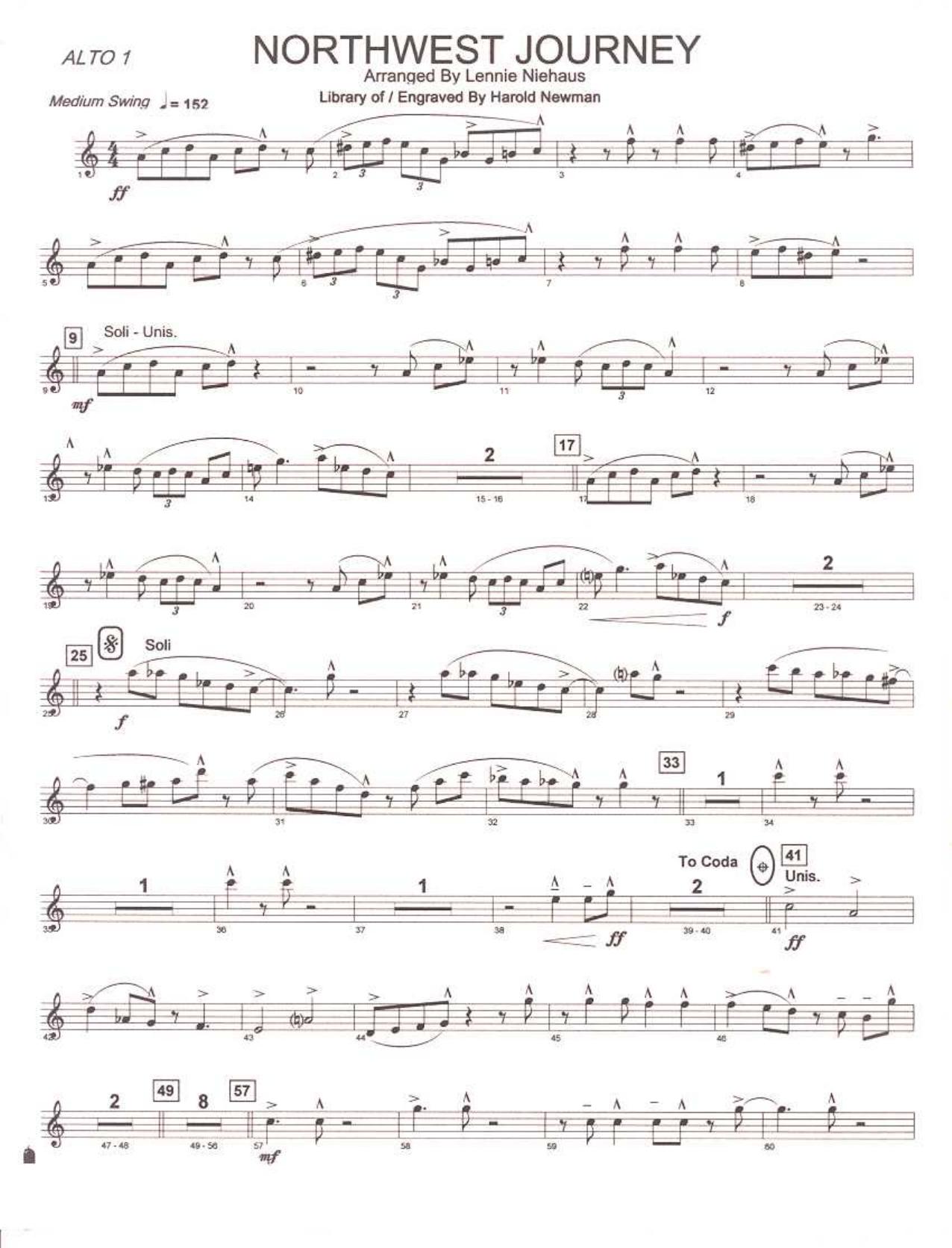
Northwest Journey (L.Niehaus)
Composed by Lennie Niehaus
Arranged by Lennie Niehaus
- Ensemble: Big Band
- Pages: 37
- Instruments (17): Alto 1, Alto 2, Tenor 1, Tenor 2, Bari, Bone 1, Bone 2, Bone 3, Bone 4, Trumpet 1, Trumpet 2, Trumpet 3, Trumpet 4, Piano, Drums, Bass, Guitar
- Difficulty: medium
- Content: Individual Parts
- Format: PDF Download (Instant)
- Price: $24.99
Lennie Niehaus carved an indelible legacy in West Coast jazz as both a brilliant alto saxophonist in the Stan Kenton Orchestra and a prolific, highly respected writer for film, television, and big band. "Northwest Journey" encapsulates the sophisticated harmonic language, linear clarity, and breezy, cinematic momentum that defined the Cool School of jazz during the 1950s and 60s. While drawing deeply upon the bebop vocabulary he mastered alongside Kenton and giants like Shorty Rogers, Niehaus infused his writing with a distinct compositional restraint, prioritizing transparent counterpoint, rich chordal textures, and an effortless, driving swing over sheer decibel output. This arrangement serves as a masterclass in West Coast orchestration, offering modern ensembles a brilliant window into an era where cerebral cool met infectious, toes-tapping rhythmic vitality. From the opening downbeat, "Northwest Journey" establishes a buoyant, medium-tempo swing feel anchored in a crisp, conversational groove. The harmonic landscape is sophisticated yet accessible, utilizing extended tertian chords, clever chromatic voice-leading, and signature Niehaus parallel harmonies that evoke wide-open spaces and kinetic motion. The mood shifts fluidly between introspective, harmonized horn lines and effervescent, high-energy outbursts. Rather than relying on bombastic, wall-of-sound shout choruses typical of East Coast powerhouse bands, Niehaus builds tension through intricate motivic development, section interplay, and linear momentum that keeps both performers and listeners completely engaged from the first measure to the final chord. Throughout the chart, the melodic weight is shared democratically across the ensemble, though the saxophone section frequently takes the lead, showcasing Niehaus's intimate understanding of woodwind capabilities. Lush soli passages highlight the blend of the two altos, two tenors, and baritone, demanding pristine intonation and light, articulate phrasing. The arrangement features designated solo space over accessible changes, allowing competent improvisers to stretch out without altering the structural integrity of the chart. Technical challenges lie primarily in the realm of articulation and rhythmic precision rather than extreme range; clean execution of syncopated figures, crisp swing eighth notes, and dynamic control are paramount. The rhythm section functions as the engine, with the piano and guitar laying down comping patterns that complement the horns' linear focus, while the bass and drums maintain a driving, unhurried pulse. Advanced high school, collegiate, and community jazz orchestras will find "Northwest Journey" to be an exceptionally rewarding addition to their repertoire. It provides an ideal vehicle for teaching stylistic authenticity, section balance, and the subtle art of playing with restraint and swing feel. Directors will appreciate how naturally the chart rehearses, as every voice is idiomatically written to lie comfortably within the instrument's optimal register. Ultimately, this arrangement offers a refreshing departure from standard heavy-hitting big band fare, rewarding precision and musicality with a timeless, sophisticated aesthetic that delights audiences of all backgrounds. Rehearsing "Northwest Journey" successfully requires a strict adherence to light, West Coast articulation styles. The tempo should remain steady and forward-moving, avoiding any tendency to rush the medium swing feel. Conductors should pay close attention to the dynamic markings, ensuring that the accompanying sections never overpower the melody, particularly during the intricate saxophone solis. Brass players should keep vibrato controlled and transparent, favoring a bright, clear tone over a fat, dark orchestral sound. Rhythmic figures demand absolute unison execution; spend dedicated rehearsal time isolating the syncopated background punches behind the soloists to lock in the groove. The drummer should maintain a feather-light ride cymbal pattern with a crisp hi-hat on beats two and four, keeping the ensemble buoyant rather than heavy-handed. Q: What instruments and parts are included in this big band arrangement? A: This 17-instrument arrangement includes standard big band instrumentation: Alto Saxophone 1, Alto Saxophone 2, Tenor Saxophone 1, Tenor Saxophone 2, Baritone Saxophone, four trumpets, four trombones, and a full rhythm section comprising piano, guitar, bass, and drums, spanning a total of 37 pages of score and parts. Q: What is the designated difficulty level of "Northwest Journey"? A: This arrangement is graded as medium-advanced, making it ideal for skilled high school groups, collegiate jazz ensembles, and professional community big bands looking to refine their stylistic versatility. Q: What style and historical era does this piece represent? A: Composed by West Coast jazz icon Lennie Niehaus, the piece firmly represents the Cool Jazz era of the 1950s and 1960s, blending bebop-derived harmonic sophistication with relaxed, linear momentum and sophisticated counterpoint. Q: What makes this specific Lennie Niehaus arrangement unique? A: It showcases Niehaus's signature approach to section writing, favoring transparent, parallel-voiced saxophone solis and linear counterpoint over traditional, heavy East Coast shout choruses, resulting in a uniquely breezy and cinematic jazz texture. Q: What is the recommended tempo and approximate performance duration? A: The arrangement is set at a comfortable medium-swing tempo, typically clocking in around 3.5 to 4.5 minutes, depending on the length of the improvised solos taken during the open section.
Questions and answers
- What is included in the Northwest Journey (L.Niehaus) PDF?
- The verified current file contains individual parts across 37 pages.
- How many instruments or parts are listed for Northwest Journey (L.Niehaus)?
- The verified instrumentation list contains 17 entries for this Big Band arrangement.
- Who is credited for Northwest Journey (L.Niehaus)?
- Composer: Lennie Niehaus. Arranger: Lennie Niehaus.
- What difficulty is listed for Northwest Journey (L.Niehaus)?
- The verified difficulty level is medium.
- Can I preview Northwest Journey (L.Niehaus) before buying?
- Yes. The product page provides a preview generated from the current PDF file.
- How is Northwest Journey (L.Niehaus) delivered?
- After successful payment, the digital PDF is made available for download. The displayed price is $24.99.
Musicians Also Search For
Northwest Journey Lennie Niehaus PDF • Northwest Journey Lennie Niehaus sheet music • Northwest Journey arranged by Lennie Niehaus • Lennie Niehaus big band charts • Lennie Niehaus jazz arrangements PDF • Northwest Journey Lennie Niehaus big band arrangements • Northwest Journey big band arrangements • Northwest Journey big band PDF download • Northwest Journey jazz sheet music • big band sheet music download • Northwest Journey individual parts download • Northwest Journey sheet music PDF • buy Northwest Journey sheet music • download Northwest Journey PDF • Northwest Journey jazz charts • best Lennie Niehaus big band arrangements • Northwest Journey printable sheet music • big band repertoire PDF