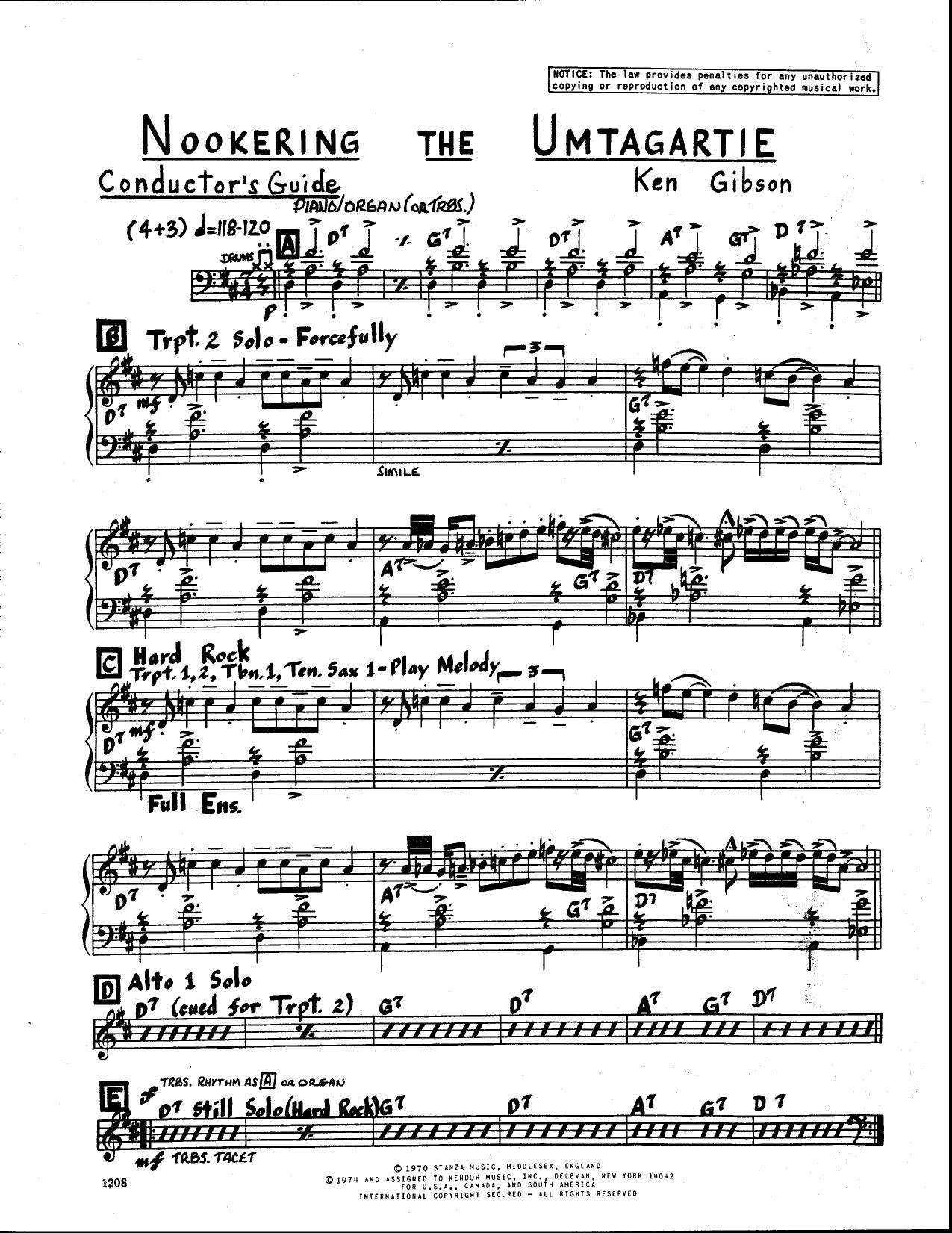
Nookering The Umtagartie (K.Gibson) sheet music preview

Nookering The Umtagartie (K.Gibson)

Composed by K. Gibson

Arranged by K.Gibson

  • Ensemble: Big Band
  • Style: Jazz Standard
  • Pages: 46
  • Instruments (22): Conductor's Guide, Flute (opt.), 1st Eb Alto Sax, 2nd Eb Alto Sax, 1st Bb Tenor Sax, 2nd Bb Tenor Sax, Eb Baritone Sax, 1st Bb Trumpet, 2nd Bb Trumpet, 3rd Bb Trumpet, 4th Bb Trumpet, 5th Bb Trumpet, F Horn (opt.), 1st Trombone, 2nd Trombone, 3rd Trombone, 4th Trombone, Tuba, Bass Guitar, Drums, Piano (Electric) or Organ, Guitar
  • Difficulty: advanced
  • Content: Individual Parts
  • Format: PDF Download (Instant)
  • Price: $24.99

Bebop innovation and post-war modernism converge in "Nookering The Umtagartie," a compelling contribution to the modern big band repertoire originally conceived by K. Gibson. Emerging from an era where composers sought to expand the harmonic boundaries of the standard 32-bar form while maintaining an undeniable groove, this composition bridges the gap between sophisticated harmonic exploration and high-octane ensemble drive. Though rooted in the mid-century modern jazz tradition, the piece has found renewed life among contemporary large ensembles looking for material that challenges traditional section roles and rewards intricate, dynamic interplay. A driving medium-up swing tempo anchors the piece, establishing an urgent yet relaxed momentum from the downbeat. The harmonic landscape is rich with extended alterations, secondary dominants, and chromatic mediant shifts that evoke the sophisticated cool of late-period West Coast writing coupled with the fiery urgency of East Coast bop. The mood shifts fluidly between tense, harmonically complex suspense during the verse structures and unbridled, celebratory release during the ensemble choruses. The rhythm section acts as the primary architectural engine, requiring a sophisticated ride cymbal pulse and crisp, interactive comping to keep the complex metric subdivisions floating effortlessly. K. Gibson’s arrangement treats the 20-instrument big band canvas with masterful textural variety, avoiding the trap of constant tutti writing. The chart opens with a moody, atmospheric intro featuring sparse counterpoint between the low reeds and muted brass, before exploding into a tightly voiced sax soli that showcases intricate bebop line-writing. The brass section is utilized for sharp, punchy stabs and sweeping harmonic blooms, while the woodwinds—anchored by a versatile doubling flute part—add crystalline color to the upper extensions of the chords. A massive, multi-tiered shout chorus serves as the structural climax, building tension through sequential modulation and rhythmic displacement before resolving into a triumphant final statement. Advanced collegiate, community, and professional big bands will find this arrangement an ideal centerpiece for festival programs or club performances. The technical demands are significant, requiring precise articulation matching across sections, agile execution of fast bebop lines in the saxophones, and dependable upper-register endurance from the lead trumpet. Solo opportunities are provided for tenor saxophone and piano, allowing featured improvisers to stretch out over sophisticated changes. Conductor and ensemble alike will relish the meticulous balancing of dense chordal voicings and sparse, linear counterpoint, making every rehearsal an exercise in musical listening and stylistic cohesion. Success with "Nookering The Umtagartie" hinges on achieving a weightless, forward-moving medium-up swing feel; avoid any tendency for the rhythm section to drag or lean too heavily on the downbeats. The primary technical challenge lies in the execution of fast, unison bebop lines between the saxophones and upper brass, which require meticulous attention to articulation markings, specifically short, detached eighth notes and smooth slurs over bar lines. Conductor focus should be directed toward balancing the dense, polychordal harmonies in the middle register, ensuring that inner-voice movement remains audible beneath the melody. Brass players should utilize cup and harmon mutes where indicated in the score to achieve the required textural contrast during the intro and transitional interludes. Rehearsals should begin with sectional work on the intricate soli passages at a reduced tempo, gradually building up metronomic speed while maintaining clean articulation and unified phrasing before integrating the rhythm section. Q: What instruments and parts are included in this big band arrangement? A: The 92-page publication includes a full conductor score and individual parts for 20 instruments, featuring a comprehensive line-up of Flute, Alto Saxophone 1, Alto Saxophone 2, Tenor Saxophone 1, Tenor Saxophone 2, a full complement of brass (trumpets and trombones), and a complete four-piece rhythm section. Q: What is the overall difficulty level of this chart? A: This arrangement is graded as advanced, making it best suited for collegiate, professional, and top-tier community big bands that possess strong section reading skills and experienced improvisers. Q: What is the musical style and historical background of the piece? A: Composed by K. Gibson, the piece is a sophisticated modern jazz standard that merges mid-century bebop harmonic complexity with contemporary big band arranging techniques and a driving swing feel. Q: What makes this specific arrangement unique compared to standard big band charts? A: K. Gibson’s treatment stands out through its inventive use of textural variety, including a prominent flute voice doubling within the woodwind section, intricate chromatic chord voicings, and a dynamic, multi-tiered shout chorus that drives the arrangement to an explosive climax. Q: What is the performance duration and recommended tempo for the piece? A: While performance time can vary based on the length of improvised solo choruses, the arrangement is designed for a medium-up swing tempo that maintains high energy and forward momentum throughout its duration.

Questions and answers

What is included in the Nookering The Umtagartie (K.Gibson) PDF?
The verified current file contains a conductor score and individual parts across 46 pages.
How many instruments or parts are listed for Nookering The Umtagartie (K.Gibson)?
The verified instrumentation list contains 22 entries for this Big Band arrangement.
Who is credited for Nookering The Umtagartie (K.Gibson)?
Composer: K. Gibson. Arranger: K.Gibson.
What difficulty is listed for Nookering The Umtagartie (K.Gibson)?
The verified difficulty level is advanced.
What style is listed for Nookering The Umtagartie (K.Gibson)?
The catalog lists the style as Jazz Standard.
Can I preview Nookering The Umtagartie (K.Gibson) before buying?
Yes. The product page provides a preview generated from the current PDF file.
How is Nookering The Umtagartie (K.Gibson) delivered?
After successful payment, the digital PDF is made available for download. The displayed price is $24.99.

Musicians Also Search For

Nookering The Umtagartie K.Gibson PDFNookering The Umtagartie K.Gibson sheet musicNookering The Umtagartie arranged by K.GibsonK.Gibson big band chartsK.Gibson jazz arrangements PDFNookering The Umtagartie K. Gibson sheet musicNookering The Umtagartie K. Gibson big band arrangementsK. Gibson big band chartsNookering The Umtagartie big band arrangementsNookering The Umtagartie big band PDF downloadNookering The Umtagartie jazz sheet musicbig band sheet music downloadNookering The Umtagartie conductor score PDFNookering The Umtagartie individual parts downloadNookering The Umtagartie sheet music PDFNookering The Umtagartie Jazz Standard chartsJazz Standard big band arrangementsbuy Nookering The Umtagartie sheet musicdownload Nookering The Umtagartie PDFNookering The Umtagartie jazz chartsbest K.Gibson big band arrangementsK. Gibson arranged by K.GibsonNookering The Umtagartie printable sheet musicbig band repertoire PDF

All arrangements by K.Gibson