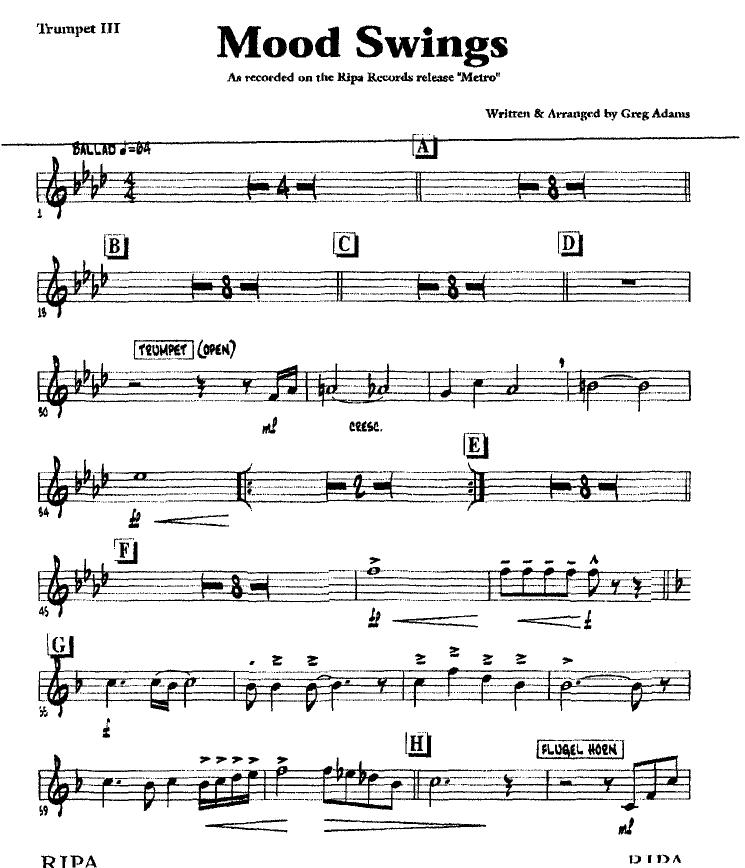
Mood Swings (G.Adams) sheet music preview

Mood Swings (G.Adams)

Composed by G. Adams

Arranged by G.Adams

  • Ensemble: Big Band
  • Style: Jazz Standard
  • Pages: 24
  • Instruments (7): Trumpet III, Trumpet IV, Trombone I, Trombone II, Trombone III, Trombone IV, Rhythm Section
  • Difficulty: medium
  • Content: Individual Parts
  • Format: PDF Download (Instant)
  • Price: $24.99

Composed and arranged by the prolific multi-instrumentalist and writer G. Adams, "Mood Swings" stands as a brilliant contemporary nod to the mid-century hard bop and modal jazz traditions. Rooted in the rich compositional ethos of 1960s Blue Note recordings, this chart captures the restless energy, harmonic sophistication, and driving momentum that defined an era of jazz innovation. Adams crafts a canvas where shifting emotional landscapes are translated directly into sudden harmonic pivots, angular melodic lines, and propulsive rhythmic undercurrents, making it an intellectually stimulating and viscerally exciting addition to the modern big band library. Driven by a relentless, infectious medium-up swing groove in 4/4 time, "Mood Swings" moves fluidly between tense, chromatic minor sections and expansive, triumphant major-mode releases. The mood shifts dynamically from brooding, mysterious unison lines in the lower brass to explosive, high-register brass statements that evoke the spirit of classic Wayne Shorter or Cedar Walton compositions. The harmonic language relies heavily on extended and altered chords—sharp-11s, flat-9s, and suspended dominants—creating a rich, modern-sounding sonic palette that challenges the ensemble's intonation and ear while remaining deeply satisfying to resolve. In this specific 7-instrument chamber big band configuration (featuring Trumpets III and IV alongside Trombones I, II, and III, complemented by standard rhythm section support), Adams demonstrates masterclass economy of scoring. Without a massive horn section, the arranger utilizes clever cross-section voicing, interleaving trumpet and trombone lines to create the acoustic illusion of a much larger ensemble. The melody is initially introduced by the upper trumpets with warm, muted trombone counter-melodies, before unfolding into a tightly knit horn soli. Solos are open for flexible instrumentation, allowing band directors to showcase their strongest improvisers over a sophisticated yet accessible modal blues-inflected chord progression. Advanced high school, collegiate, and professional freelance ensembles will find this arrangement an ideal vehicle for developing ensemble cohesion, dynamic control, and stylistic versatility. The primary technical challenges lie in executing crisp, uniform articulation during fast bebop-line unisons and maintaining accurate intonation through the complex chord extensions. Offering a brilliant balance of tight ensemble interplay and individual creative freedom, "Mood Swings" rewards meticulous rehearsal with a sophisticated, high-energy performance that will captivate any jazz audience. Conductors should approach "Mood Swings" with a strict focus on rhythmic precision and dynamic contrast. The target tempo is a driving medium-up swing (approx. quarter note = 208), where the underlying ride cymbal pulse must remain feather-light yet rock-solid. Ensure the brass players don't force their tone during the sharper chromatic passages; balance is critical when scoring for a streamlined 7-instrument horn section. Articulation is paramount: eighth notes should be played with a natural bebop swing feel—slurring up-beats to down-beats and keeping back-beats crisp. Rehearsals should begin section by section, isolating the tricky interval leaps in the trombone section before locking in the unison lines with Trumpets III and IV. Pay close attention to the dynamic hairpins written into the shout chorus; the sudden drops from forte to sub-tone piano create the titular "mood swing" effect and must be executed uniformly to achieve maximum dramatic impact. Mute choices are open, but standard cup or harmon mutes work exceptionally well for the intro textures if a drier, more intimate acoustic is desired. Q: What specific instruments and parts are included in this arrangement? A: This chart is scored for a specialized 7-instrument horn configuration consisting of Trumpet III, Trumpet IV, Trombone I, Trombone II, and Trombone III, alongside a standard rhythm section. Q: What is the overall difficulty level of this arrangement? A: It is graded as advanced-intermediate to advanced, making it best suited for collegiate ensembles, advanced high school jazz bands, and professional community groups with strong readers and soloists. Q: What is the musical style and historical context of "Mood Swings"? A: Written by G. Adams, the piece channels the sophisticated, high-energy hard bop and post-bop modal jazz traditions characteristic of classic 1960s Blue Note recordings. Q: What makes this particular G. Adams arrangement unique? A: It maximizes the acoustic footprint of a compact 7-horn ensemble through ingenious cross-section voicings and shifting modal harmonies that capture a massive big-band sound without requiring a full complement of reeds and brass. Q: What is the performance duration and recommended tempo for this piece? A: The arrangement runs approximately 4.5 to 5 minutes in duration when performed at the recommended medium-up swing tempo of around quarter note = 208.

Questions and answers

What is included in the Mood Swings (G.Adams) PDF?
The verified current file contains individual parts across 24 pages.
How many instruments or parts are listed for Mood Swings (G.Adams)?
The verified instrumentation list contains 7 entries for this Big Band arrangement.
Who is credited for Mood Swings (G.Adams)?
Composer: G. Adams. Arranger: G.Adams.
What difficulty is listed for Mood Swings (G.Adams)?
The verified difficulty level is medium.
What style is listed for Mood Swings (G.Adams)?
The catalog lists the style as Jazz Standard.
Can I preview Mood Swings (G.Adams) before buying?
Yes. The product page provides a preview generated from the current PDF file.
How is Mood Swings (G.Adams) delivered?
After successful payment, the digital PDF is made available for download. The displayed price is $24.99.

Musicians Also Search For

Mood Swings G.Adams PDFMood Swings G.Adams sheet musicMood Swings arranged by G.AdamsG.Adams big band chartsG.Adams jazz arrangements PDFMood Swings G. Adams sheet musicMood Swings G. Adams big band arrangementsG. Adams big band chartsMood Swings big band arrangementsMood Swings big band PDF downloadMood Swings jazz sheet musicbig band sheet music downloadMood Swings individual parts downloadMood Swings sheet music PDFMood Swings Jazz Standard chartsJazz Standard big band arrangementsbuy Mood Swings sheet musicdownload Mood Swings PDFMood Swings jazz chartsbest G.Adams big band arrangementsG. Adams arranged by G.AdamsMood Swings printable sheet musicbig band repertoire PDF

All arrangements by G.Adams All G. Adams sheet music