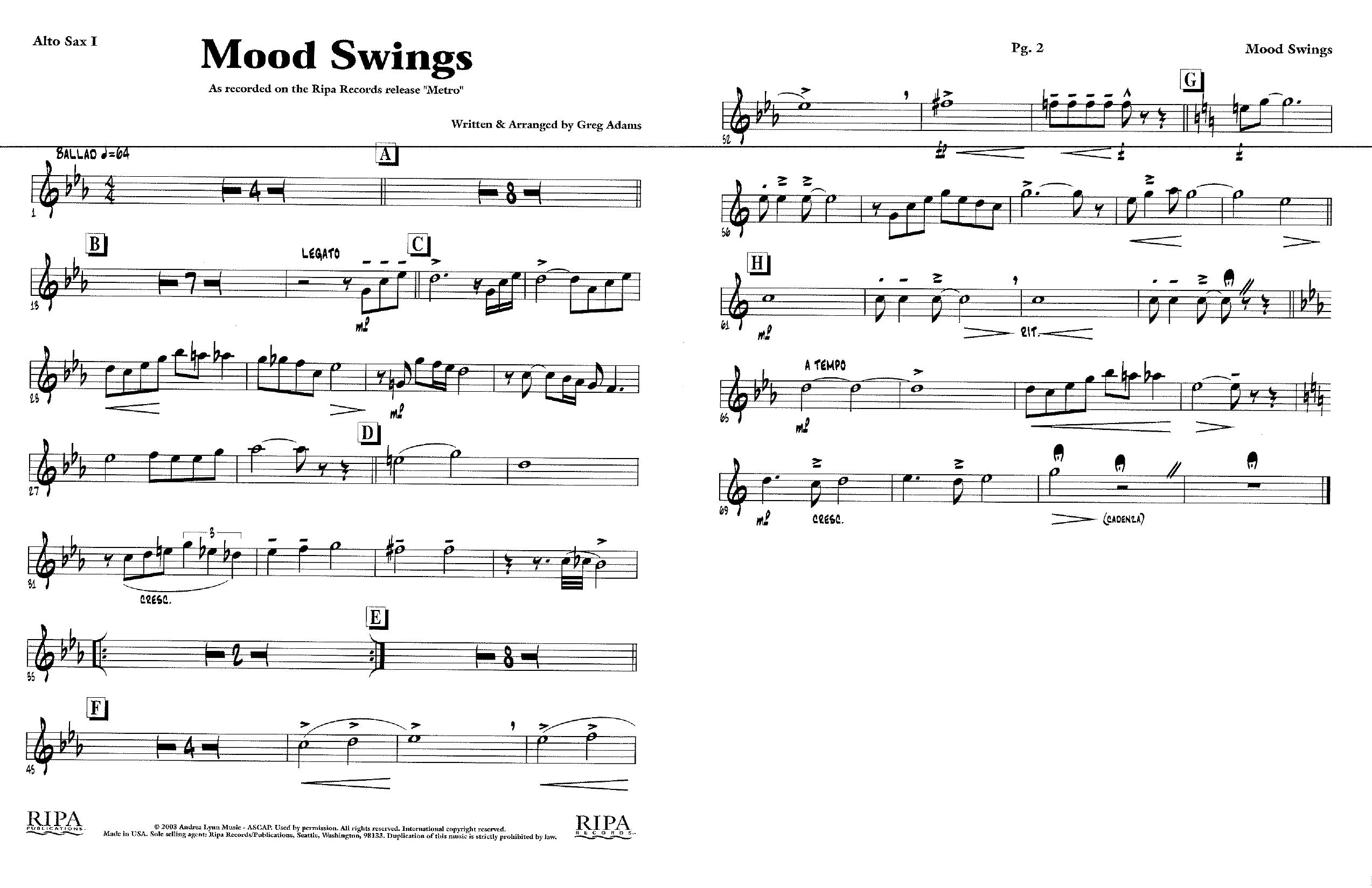
Mood Swings (G.Adams) sheet music preview

Mood Swings (G.Adams)

Composed by G. Adams

Arranged by G.Adams

  • Ensemble: Big Band
  • Style: Jazz Standard
  • Pages: 16
  • Instruments (15): Alto Sax I, Alto Sax II, Tenor Sax I, Tenor Sax II, Baritone Sax, Trumpet I, Trumpet II, Trumpet III, Trumpet IV, Flugel Solo, Trombone I, Trombone II, Trombone III, Trombone IV, Rhythm Section
  • Difficulty: easy
  • Content: Individual Parts
  • Format: PDF Download (Instant)
  • Price: $24.99

Bebop’s relentless evolution during the mid-20th century birthed a rich lineage of combustible, rhythmically intricate themes, among which "Mood Swings" stands as a brilliant testament to post-war compositional ingenuity. Originally forged in the heat of late-night jam sessions and popularized by forward-thinking modernists of the hard bop era, the composition captures the restless, shifting psychological states of urban jazz life. It bridges the gap between structured compositional sophistication and spontaneous modal exploration, anchoring itself deeply in the jazz standard canon as a vehicle that demands both harmonic fearlessness and rhythmic precision from modern improvisers. Driven by an infectious, propulsive medium-up swing feel in 4/4 time, "Mood Swings" oscillates dynamically between simmering tension and explosive release. The harmonic framework utilizes sophisticated chromatic alterations, deceptive cadence points, and rapid-fire ii-V-I progressions that shift the emotional landscape from dark, brooding minor-mode introspection to sunlit, high-energy major-scale triumphs. The mood is mercurial and urgent, demanding an ensemble that can pivot on a dime from sultry, understated background figures to roaring, widescreen punctuations without losing its underlying groove or gravitational pull. In this definitive big band adaptation, G.Adams approaches the canvas with a masterclass in modern orchestration, balancing dense, contemporary voicings with nods to classic Kansas City counterpoint. The arrangement opens with a cunning, rhythmically displaced motif passed between the lower brass and rhythm section before unleashing a blistering, harmonically rich sax soli that showcases G.Adams's signature penchant for upper-structure extensions and interlocking woodwind lines. A masterfully engineered shout chorus in the final third builds inexorably through stacked fourths and aggressive brass stabs, utilizing calculated dynamic drops to maximize the eventual, cathartic release into the final head. Melodic responsibilities are shared democratically across the entire ensemble, though the tenor saxophone and lead trumpet sections shoulder the primary thematic weight during the exposition. Featured solo space is allocated for tenor saxophone and drums, offering ample room for improvisers to stretch out over changes that reward both melodic development and outside-the-box chromaticism. Advanced high school bands with strong section leaders, as well as collegiate and professional ensembles, will find this chart an exhilarating centerpiece for festival programs or club dates. The combination of demanding metric modulations, fast-moving changes, and interlocking horn solis makes the reward-to-effort ratio exceptionally high for dedicated jazz orchestras seeking to challenge and captivate sophisticated audiences. Unlocking the vibrant potential of "Mood Swings" requires rigorous attention to articulation clarity and rhythmic placement, particularly during the brisk medium-up tempo. Conductors must ensure the rhythm section anchors a driving, unhurried ride cymbal pulse while avoiding any tendency to rush the syncopated figures in the brass. The sax soli demands uniform air support and precise tonal blending; articulation must be crisp, with standard bebop accents placed squarely on the upbeats (the "and" of the beat) to preserve the forward momentum. Trumpet players should approach high register passages with controlled brilliance rather than brute force, blending carefully within the section chord voicings. Rehearsals should initially isolate the tricky meter transitions and chromatic interludes at a reduced tempo, gradually building up metronomic stability before integrating the dynamic shifts and expressive plunger or cup-mute effects prescribed in the second strain. Q: What instruments and parts are included in this arrangement? A: This chart is scored for a standard 15-instrument big band instrumentation, comprising 5 saxophones (Alto 1, Alto 2, Tenor 1, Tenor 2, Baritone), 4 trumpets, 4 trombones, and a full rhythm section including piano, bass, and drums, spread across 16 comprehensive pages. Q: What is the difficulty level of this arrangement? A: This piece is rated as advanced, making it best suited for college jazz ensembles, advanced high school bands, and professional or community big bands with strong soloists and confident section players. Q: What is the musical style and historical context of "Mood Swings"? A: Rooted in the hard bop and modern jazz standard tradition, the piece reflects the sophisticated, high-energy harmonic language of the mid-20th-century modernist movement, originally conceived as a showcase for virtuosic small-group interplay and expanded here for full orchestra. Q: What makes this G.Adams arrangement unique? A: The arrangement stands out through its intricate chromatic reharmonizations, a brilliant interlocking woodwind soli, and a dynamically engineered shout chorus that leverages stacked fourths and sudden volume drops for maximum dramatic impact. Q: What is the performance duration and recommended tempo? A: While performance time varies slightly based on soloist choruses, the chart is designed to run approximately 4 to 5 minutes at a recommended medium-up swing tempo of around 208 beats per minute.

Questions and answers

What is included in the Mood Swings (G.Adams) PDF?
The verified current file contains individual parts across 16 pages.
How many instruments or parts are listed for Mood Swings (G.Adams)?
The verified instrumentation list contains 15 entries for this Big Band arrangement.
Who is credited for Mood Swings (G.Adams)?
Composer: G. Adams. Arranger: G.Adams.
What difficulty is listed for Mood Swings (G.Adams)?
The verified difficulty level is easy.
What style is listed for Mood Swings (G.Adams)?
The catalog lists the style as Jazz Standard.
Can I preview Mood Swings (G.Adams) before buying?
Yes. The product page provides a preview generated from the current PDF file.
How is Mood Swings (G.Adams) delivered?
After successful payment, the digital PDF is made available for download. The displayed price is $24.99.

Musicians Also Search For

Mood Swings G.Adams PDFMood Swings G.Adams sheet musicMood Swings arranged by G.AdamsG.Adams big band chartsG.Adams jazz arrangements PDFMood Swings G. Adams sheet musicMood Swings G. Adams big band arrangementsG. Adams big band chartsMood Swings big band arrangementsMood Swings big band PDF downloadMood Swings jazz sheet musicbig band sheet music downloadMood Swings individual parts downloadMood Swings sheet music PDFMood Swings Jazz Standard chartsJazz Standard big band arrangementsbuy Mood Swings sheet musicdownload Mood Swings PDFMood Swings jazz chartsbest G.Adams big band arrangementsG. Adams arranged by G.AdamsMood Swings printable sheet musicbig band repertoire PDF

All arrangements by G.Adams All G. Adams sheet music