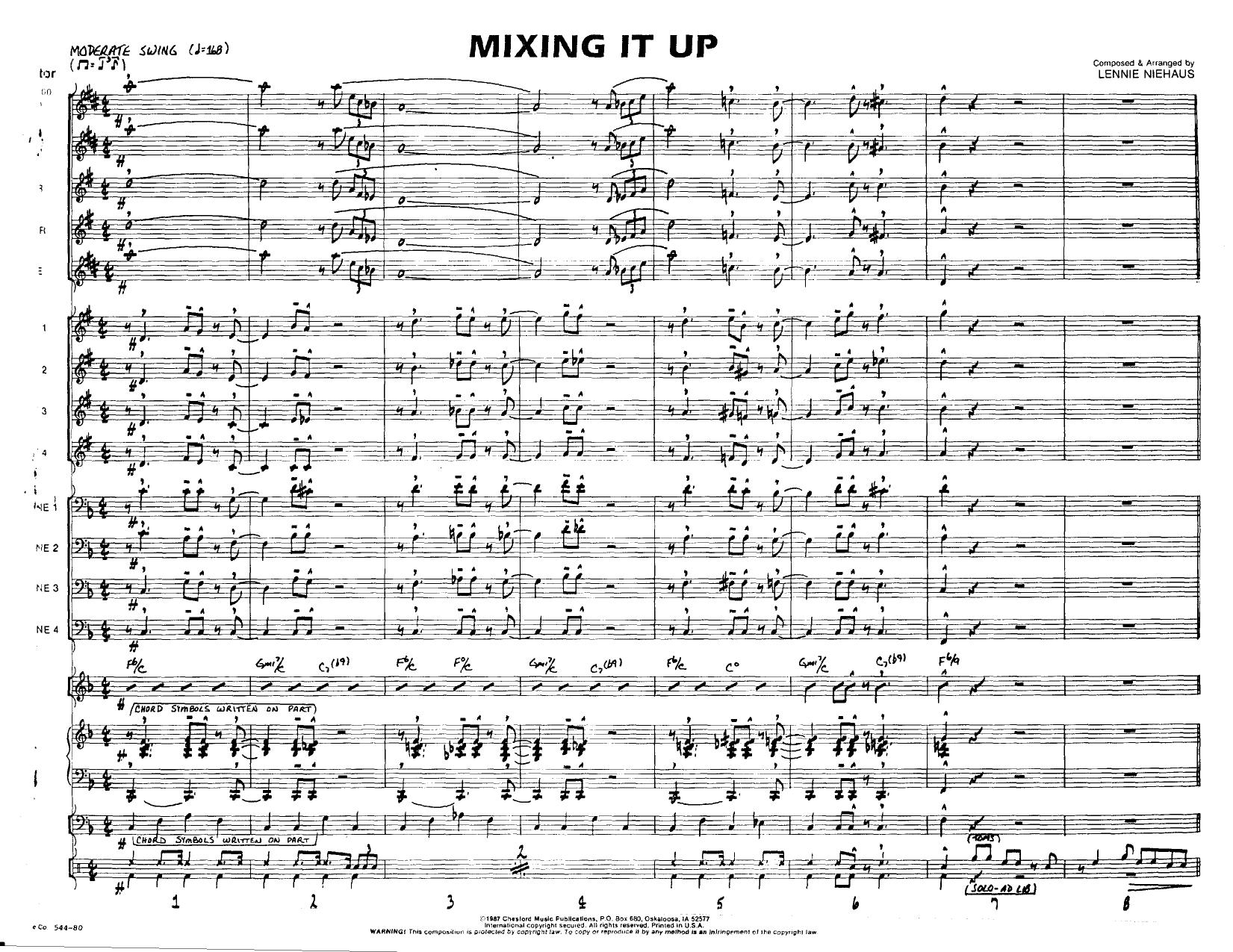
Mixing It Up (L.Niehaus) sheet music preview

Mixing It Up (L.Niehaus)

Composed by Lennie Niehaus

Arranged by Lennie Niehaus

  • Ensemble: Big Band
  • Pages: 49
  • Instruments (17): 1st Eb Alto Saxophone, 2nd Eb Alto Saxophone, 1st Bb Tenor Saxophone, 2nd Bb Tenor Saxophone, Eb Baritone Saxophone, 1st Bb Trumpet, 2nd Bb Trumpet, 3rd Bb Trumpet, 4th Bb Trumpet, 1st Trombone, 2nd Trombone, 3rd Trombone, 4th Trombone, Piano, Guitar, Bass, Drums
  • Difficulty: medium
  • Content: Individual Parts
  • Format: PDF Download (Instant)
  • Price: $24.99

Lennie Niehaus remains one of the definitive architects of West Coast cool jazz, bringing his extensive experience as both a bebop alto saxophonist in the Stan Kenton Orchestra and a prolific Hollywood film composer to every chart he penned. "Mixing It Up" captures the sophisticated harmonic language, litters of counterpoint, and crisp articulation that defined the 1950s Los Angeles modern jazz scene. While not a traditional pre-war standard, Niehaus’s original compositions function as modern educational and performance staples, prized for bridging the gap between small-group bebop counterpoint and full-ensemble big band textures. Propelled by a driving, medium-up swing groove in 4/4 time, the work radiates an energetic, urbane optimism characterized by bright brass punches and intertwining saxophone lines. The mood shifts fluidly between tightly coiled intensity and relaxed, swinging camaraderie. Harmonically rich yet transparent, the chart avoids dense, muddy voicings in favor of clean, linear writing that allows every section to project clearly. The underlying harmonic foundation relies on extended bebop alterations—sharp elevenths and thirteenths—that give the progression a modern edge without losing its swinging momentum. Niehaus’s signature arranging style shines through the meticulous voice-leading within the saxophone soli sections and the crisp, economic counterpoint between the brass and reeds. Rather than relying on heavy, wall-of-sound tutti passages for impact, Niehaus constructs his shout choruses through interlocking linear motifs and conversational call-and-response figures. The melody is shared fluidly across the ensemble, initiating with crisp unison lines in the alto saxophones before expanding into harmonized block-chord textures. Solos are open for exploration over accessible changes, allowing featured improvisers in the horn section to stretch out within a secure, well-crafted framework. Advanced high school ensembles, collegiate big bands, and professional community groups will find this chart an ideal vehicle for developing internal swing accuracy, section blend, and articulation precision. The technical challenges lie primarily in the lightweight, agile execution required for the up-tempo bebop figures rather than sheer brute volume. Performers must navigate nimble scalar passages and synchronized dynamic shifts with absolute clarity. The resulting performance offers a rewarding showcase of West Coast cool sophistication, guaranteeing an engaging experience for both audience and player alike. Success with "Mixing It Up" hinges on achieving an authentic, relaxed medium-up swing feel where eighth notes are characteristically interpreted with a lighter, more horizontal articulation than heavier Kansas City or East Coast styles. Conductors should emphasize that the underlying tempo must remain steady and driving, avoiding the tendency to rush during dynamic crescendos. The primary technical challenge involves the synchronized execution of intricate, fast-moving bebop lines across the saxophone and trumpet sections. Rehearsals should begin at a reduced tempo, isolating difficult scalar passages to ensure uniform articulation—particularly regarding standard jazz tongue-softening on off-beat accents. Brass players should keep mutes optional unless specific coloristic choices are desired, focusing instead on a warm, centered tone that blends rather than pierces. Pay close attention to dynamic markings: Niehaus often scores background figures significantly softer than the primary melodic voice to maintain transparent counterpoint. Balance is best achieved by having horn sections listen across the ensemble to internal voices rather than relying solely on the lead player. Q: What instruments and parts are included in this publication? A: The 49-page publication includes a full conductor score and individual parts for a standard 17-instrument big band lineup, featuring two alto saxophones, two tenor saxophones, baritone saxophone, four trumpets, four trombones, and a four-piece rhythm section consisting of piano, bass, drums, and guitar. Q: What is the difficulty level of this arrangement? A: This chart is graded as medium-advanced, making it exceptionally well-suited for proficient high school jazz bands, collegiate ensembles, and professional community big bands seeking to refine their West Coast swing style. Q: What is the musical style and historical context of "Mixing It Up"? A: Written by Lennie Niehaus, the piece exemplifies the West Coast cool jazz movement of the 1950s, blending sophisticated bebop harmonic concepts with transparent, linear counterpoint and a swinging, upbeat character. Q: What makes this particular Lennie Niehaus arrangement unique? A: It showcases Niehaus's signature compositional genius by utilizing conversational call-and-response figures and crisp saxophone solis instead of heavy, dense shout choruses, giving the entire 17-piece ensemble a nimble, small-group feel. Q: What is the performance duration and recommended tempo for this piece? A: While performance duration typically spans around 3 to 4 minutes depending on solo extensions, the arrangement is anchored by a brisk, driving medium-up swing tempo that demands precise time-keeping and clean rhythmic execution from the rhythm section.

Questions and answers

What is included in the Mixing It Up (L.Niehaus) PDF?
The verified current file contains a conductor score and individual parts across 49 pages.
How many instruments or parts are listed for Mixing It Up (L.Niehaus)?
The verified instrumentation list contains 17 entries for this Big Band arrangement.
Who is credited for Mixing It Up (L.Niehaus)?
Composer: Lennie Niehaus. Arranger: Lennie Niehaus.
What difficulty is listed for Mixing It Up (L.Niehaus)?
The verified difficulty level is medium.
Can I preview Mixing It Up (L.Niehaus) before buying?
Yes. The product page provides a preview generated from the current PDF file.
How is Mixing It Up (L.Niehaus) delivered?
After successful payment, the digital PDF is made available for download. The displayed price is $24.99.

Musicians Also Search For

Mixing It Up Lennie Niehaus PDFMixing It Up Lennie Niehaus sheet musicMixing It Up arranged by Lennie NiehausLennie Niehaus big band chartsLennie Niehaus jazz arrangements PDFMixing It Up Lennie Niehaus big band arrangementsMixing It Up big band arrangementsMixing It Up big band PDF downloadMixing It Up jazz sheet musicbig band sheet music downloadMixing It Up conductor score PDFMixing It Up individual parts downloadMixing It Up sheet music PDFbuy Mixing It Up sheet musicdownload Mixing It Up PDFMixing It Up jazz chartsbest Lennie Niehaus big band arrangementsMixing It Up printable sheet musicbig band repertoire PDF

All arrangements by Lennie Niehaus All Lennie Niehaus sheet music