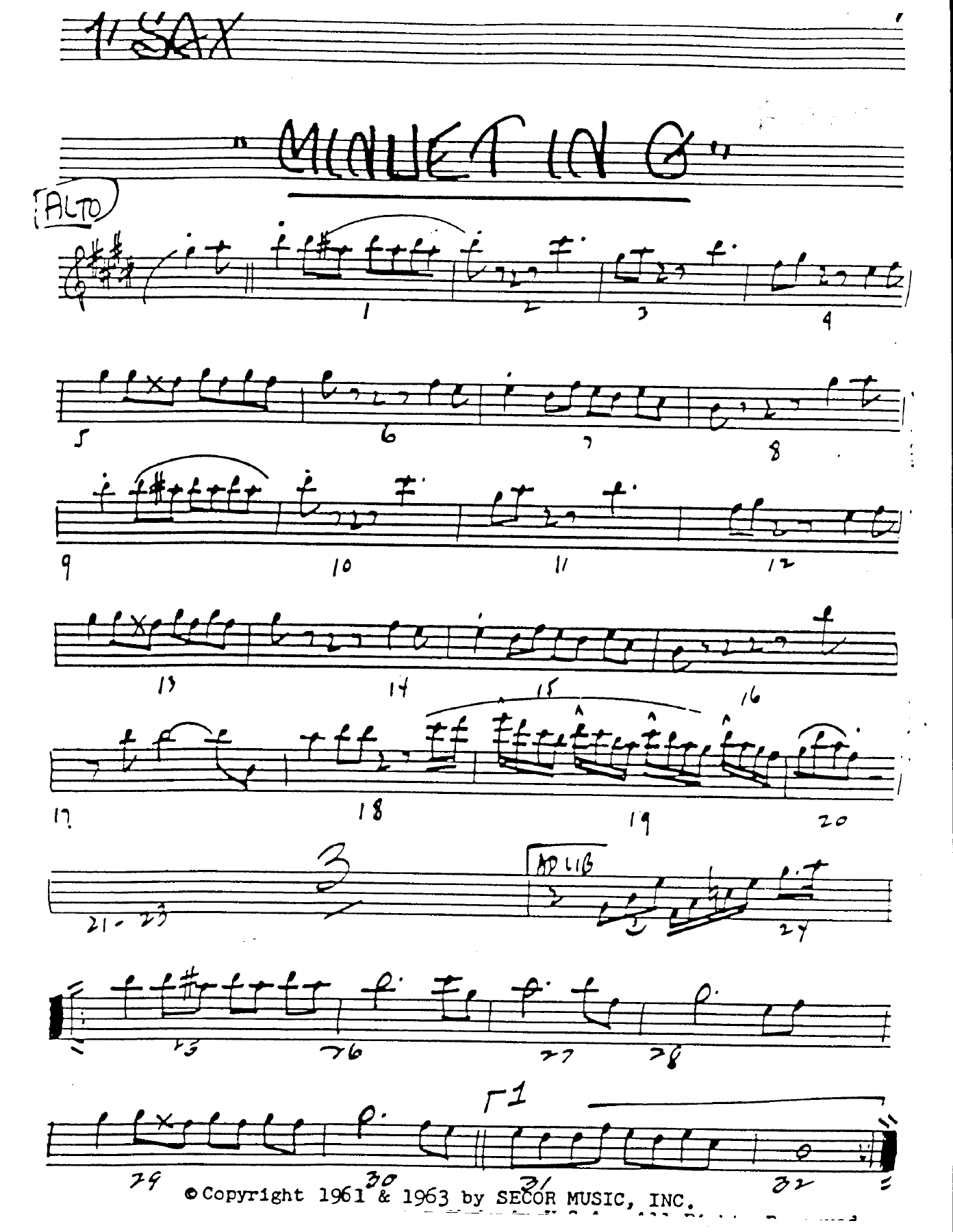
Minuet In G (B.May)
Composed by Johann Sebastian Bach
Arranged by B.May
- Ensemble: Big Band
- Style: Jazz Standard
- Pages: 33
- Instruments (17): 1st Alto Saxophone, 2nd Alto Saxophone, 3rd Tenor Saxophone, 4th Tenor Saxophone, 5th Baritone Saxophone, 1st Trumpet, 2nd Trumpet, 3rd Trumpet, 4th Trumpet, 1st Trombone, 2nd Trombone, 3rd Trombone, 4th Trombone, Piano, Guitar, Bass, Drums
- Difficulty: medium
- Content: Individual Parts
- Format: PDF Download (Instant)
- Price: $24.99
The beloved "Minuet in G," while widely attributed to Johann Sebastian Bach for centuries, is now understood by musicologists to have been composed by Christian Petzold around 1720. This charming Baroque-era piece was included in the 1725 Notebook for Anna Magdalena Bach, a collection of works compiled by Bach for his second wife, which contributed to its enduring popularity and misattribution. Originally a graceful court dance in triple meter, the minuet form itself signifies a small, delicate, and often stately character. Its simple yet elegant melodic and harmonic structure has made it a foundational piece for aspiring musicians and a frequent subject for creative reinterpretation across diverse genres, notably inspiring the 1965 pop hit "A Lover's Concerto." B.May's masterful big band arrangement transforms this classical gem into a vibrant jazz standard, reimagining its baroque elegance with a sophisticated medium swing feel. The original G major key is retained, providing a familiar anchor while the harmonic landscape is enriched with extended jazz voicings and subtle reharmonizations. This arrangement evokes a mood that is both nostalgic and freshly energetic, blending the timeless charm of Petzold's melody with the infectious rhythmic drive of a classic big band. Listeners and performers will appreciate the interplay between the original melodic contours and the new, compelling jazz vocabulary, creating a piece that feels both familiar and excitingly new. B.May, known for a distinctive arranging style characterized by mercurial brass writing and "swooping" saxophone riffs, brings a signature touch to this piece. The arrangement features lush saxophone soli sections that weave intricate counter-melodies around the primary theme, showcasing the section's blend and agility. Brass sections are utilized for their powerful impact, delivering punchy figures and dynamic accents that drive the swing feel. The melody is predominantly carried by the saxophone section in various voicings, with occasional melodic statements from the brass. Featured solo opportunities are provided for both Alto Saxophone 1 and Trumpet 2, allowing improvisers to explore the harmonic richness within the jazz context. Technical challenges include precise articulation in the swing rhythms, navigating the extended harmonies, and achieving a cohesive ensemble sound, particularly in the fast-paced soli passages. The rewarding aspect lies in the seamless fusion of classical beauty with jazz vitality, culminating in a powerful shout chorus that builds to an exhilarating climax. This arrangement is ideally suited for college, community, and professional big bands seeking to expand their repertoire with a piece that offers both artistic depth and audience appeal. Its blend of recognizable melody with sophisticated jazz treatment makes it an excellent choice for concert programs, providing a bridge between classical and jazz traditions. The detailed scoring and thoughtful orchestration allow intermediate to advanced ensembles to develop their ensemble precision, rhythmic accuracy, and improvisational skills, making it a valuable addition to any jazz program. To achieve the desired medium swing feel, conductors should emphasize a relaxed, yet propulsive rhythmic interpretation, ensuring that eighth notes are swung consistently throughout. The brass articulation should be crisp and precise, particularly in the fanfare-like figures, while the saxophone section should strive for a smooth, connected sound in the soli passages. Pay close attention to dynamic contrasts, which are crucial for shaping the musical phrases and building energy towards the shout chorus. Rehearsal time should be dedicated to balancing the intricate voicings, especially where the melody is passed between sections, ensuring clarity and projection. The soloists (Alto Saxophone 1 and Trumpet 2) should be encouraged to explore the provided chord changes with creativity, maintaining the overall stylistic integrity of the arrangement. No special techniques like plunger mutes or falls are explicitly required, allowing the ensemble to focus on fundamental big band execution. **Q: What instruments are included in this arrangement?** A: This big band arrangement is scored for 17 instruments, specifically Alto Saxophone 1, Alto Saxophone 2, Tenor Saxophone 1, Tenor Saxophone 2, Baritone Saxophone, Trumpet 1, Trumpet 2, Trumpet 3, Trumpet 4, Trombone 1, Trombone 2, Trombone 3, Trombone 4, Piano, Bass, Drums, and Guitar. **Q: What is the difficulty level of this arrangement?** A: This arrangement is suitable for intermediate to advanced big bands, including college, community, and professional ensembles, due to its sophisticated jazz harmonies, rhythmic demands, and featured solo sections. **Q: What is the musical style and historical context of the piece?** A: This is a jazz big band arrangement of Christian Petzold's "Minuet in G," a Baroque-era classical piece often attributed to J.S. Bach. It transforms the original triple-meter minuet into a vibrant medium swing jazz standard. **Q: What makes this arrangement unique?** A: B.May's arrangement uniquely blends Petzold's classic melody with modern jazz voicings, extended harmonies, and a compelling medium swing feel, featuring prominent saxophone soli sections and dynamic brass figures that culminate in an exciting shout chorus. **Q: What is the typical performance duration or tempo for this piece?** A: While specific duration can vary with interpretation and improvisation length, this arrangement is designed for a medium swing tempo, typically resulting in a performance duration of approximately 4-6 minutes.
Questions and answers
- What is included in the Minuet In G (B.May) PDF?
- The verified current file contains individual parts across 33 pages.
- How many instruments or parts are listed for Minuet In G (B.May)?
- The verified instrumentation list contains 17 entries for this Big Band arrangement.
- Who is credited for Minuet In G (B.May)?
- Composer: Johann Sebastian Bach. Arranger: B.May.
- What difficulty is listed for Minuet In G (B.May)?
- The verified difficulty level is medium.
- What style is listed for Minuet In G (B.May)?
- The catalog lists the style as Jazz Standard.
- Can I preview Minuet In G (B.May) before buying?
- Yes. The product page provides a preview generated from the current PDF file.
- How is Minuet In G (B.May) delivered?
- After successful payment, the digital PDF is made available for download. The displayed price is $24.99.
Musicians Also Search For
Minuet In G B.May PDF • Minuet In G B.May sheet music • Minuet In G arranged by B.May • B.May big band charts • B.May jazz arrangements PDF • Minuet In G Johann Sebastian Bach sheet music • Minuet In G Johann Sebastian Bach big band arrangements • Johann Sebastian Bach big band charts • Minuet In G big band arrangements • Minuet In G big band PDF download • Minuet In G jazz sheet music • big band sheet music download • Minuet In G individual parts download • Minuet In G sheet music PDF • Minuet In G Jazz Standard charts • Jazz Standard big band arrangements • buy Minuet In G sheet music • download Minuet In G PDF • Minuet In G jazz charts • best B.May big band arrangements • Johann Sebastian Bach arranged by B.May • Minuet In G printable sheet music • big band repertoire PDF