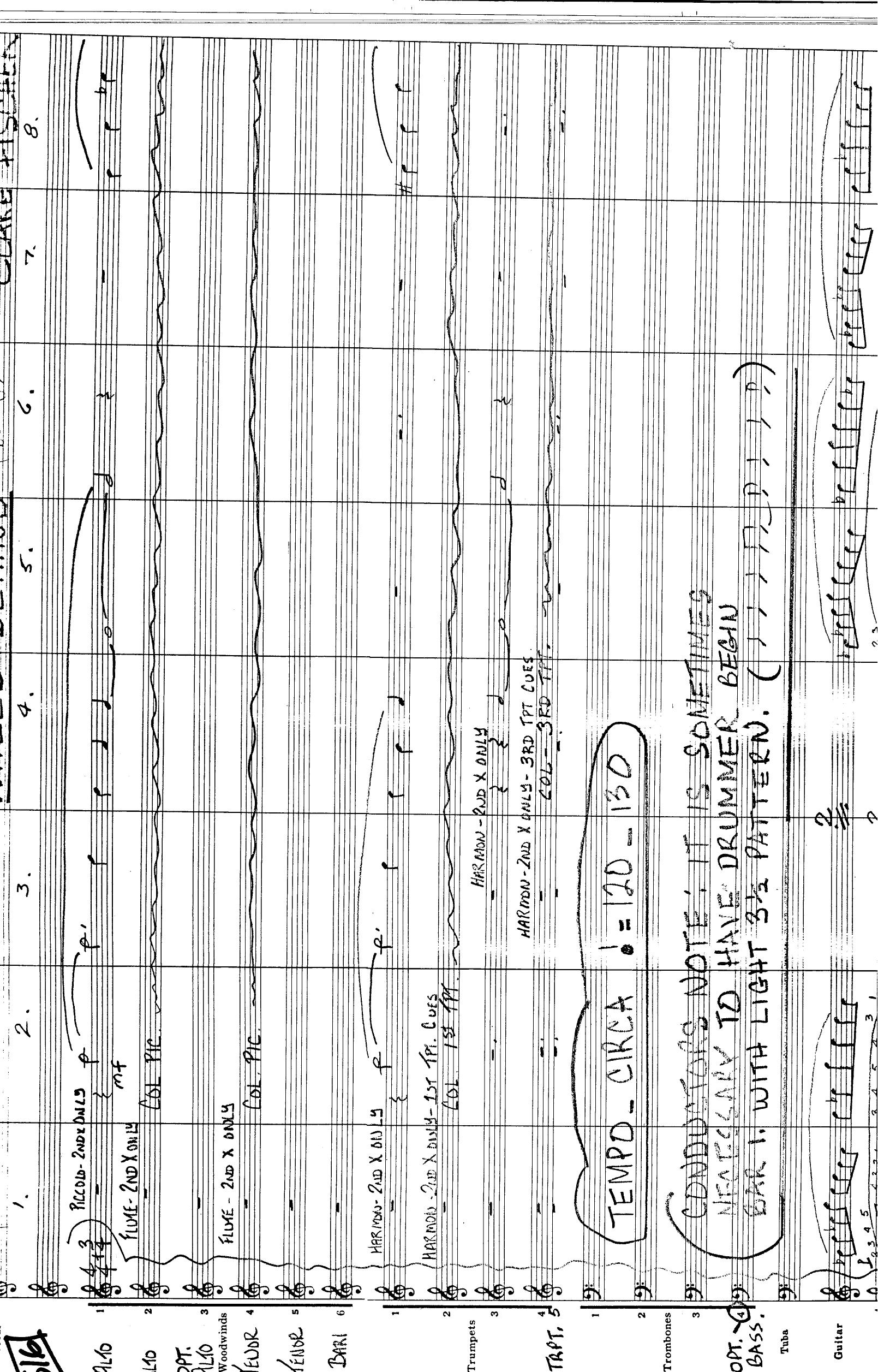
Miles Behind (C.Fischer)
Composed by Carl Fischer
Arranged by C.Fischer
- Ensemble: Big Band
- Style: Jazz Standard
- Pages: 76
- Instruments (21): I Alto Sax - Piccolo, II Alto Sax - Flute, III Alto Sax - Clarinet, I Tenor Sax - Flute, II Tenor Sax - Clarinet, Baritone Sax, Trumpet 1, Trumpet 2, Trumpet 3, Trumpet 4, Trumpet 5, Trombone 1, Trombone 2, Trombone 3, Trombone 4 (Opt.), Bass Trombone (V), Tuba, Guitar, Piano, Bass, Percussion
- Difficulty: advanced
- Content: Individual Parts
- Format: PDF Download (Instant)
- Price: $24.99
Carl Fischer’s timeless contribution to the modern jazz canon occupies a fascinating intersection between classic swing vitality and post-bop harmonic sophistication. Originally conceived during an era when big bands were expanding their palette to embrace richer modal textures and more adventurous chromaticism, "Miles Behind" channels the restless, exploratory energy of mid-century jazz innovation. While paying direct homage to the cool-jazz and hard-bop milestones associated with Miles Davis’s legendary groups, the composition stands firmly on its own as a masterclass in tension and release. It has steadily earned its reputation among discerning bandleaders as a sophisticated vehicle that pushes ensembles to look beyond standard blues and rhythm changes into more nuanced compositional terrain. Driven by an assertive, medium-up swing groove set at roughly 188 BPM, the arrangement opens with a sultry, understated modal vamp before expanding into a rich, full-ensemble statement. The emotional landscape shifts seamlessly from cool, urban introspection during the harmonically layered horn interludes to a high-octane, driving momentum in the rhythm section. C.Fischer constructs the charts with an exquisite eye for color, utilizing extended chord voicings—frequently incorporating sharp-elevenths and flat-thirtheenths—that give the brass and reed sections a distinctly contemporary bite. The arrangement avoids predictable parallel motion, favoring intricate counterpoint where the lower reeds weave independent, linear commentaries underneath the primary melodic statements. C.Fischer approaches the orchestration with a brilliant distribution of weight across the 24-instrument ensemble, ensuring that textural variety remains high throughout the 89-page score. The primary melody is initially introduced by a unison alto saxophone and muted trumpet pairing, creating a dry, focused timbre before the full saxophone soli takes over with dense, rich block voicings reminiscent of the classic West Coast school. A standout structural feature is the dynamic shout chorus, which builds organically from a whispered, rhythm-section-driven ostinato into a roaring, brass-heavy climax featuring sustained upper-register demands for the lead trumpet. Solo space is thoughtfully allocated, providing ample runway for an advanced tenor saxophone or piano improviser to stretch out over standard ii-V-I progressions that breathe new life into familiar harmonic territory. Advanced high school, collegiate, and professional big bands will find this arrangement an exceptionally rewarding centerpiece for festival performance or formal concert programming. Because of the sophisticated sectional interplay, tight rhythmic unisons, and the stamina required in the brass department—particularly for the lead trumpet and upper trombone chairs—the chart demands a mature ensemble with strong internal time and refined intonation. Conductor and players alike will appreciate the meticulous care evident in the full conductor score, making "Miles Behind" a premier showcase for modern jazz artistry. Achieving success with "Miles Behind" requires rigorous attention to articulation, balance, and stylistic unity across all 24 instruments. The underlying medium-up swing groove must remain relentlessly driving yet relaxed; conductors should caution the rhythm section against rushing the triplets, keeping the hi-hat crisp on beats two and four. The woodwind doublings—specifically the flute and piccolo parts—add crucial harmonic shimmer above the brass, so blend rehearsals should focus on keeping these upper-register counterlines clear without overpowering the core ensemble. Pay special attention to the dynamic markings in the sax soli; subtle crescendos and decrescendos are essential to prevent the dense block voicings from sounding muddy. Brass players should execute falls and doits with precision rather than exaggeration, maintaining a warm tone quality even during the high-energy shout chorus. Finally, ensure that the rhythm section treats the modal vamps with an open, conversational approach, leaving plenty of breathing room for the featured soloists. Q: What specific instrumentation and parts are included in this 24-instrument big band package? A: The arrangement is scored for a comprehensive 24-instrument configuration that includes Piccolo, Flute, Clarinet, Alto Saxophone 1, Alto Saxophone 2, plus standard big band brass and rhythm sections, accompanied by a comprehensive 89-page conductor score. Q: What is the official difficulty level of this arrangement, and is it suitable for high school bands? A: This chart is graded as advanced (Level 4.5 to 5), making it best suited for top-tier college ensembles, advanced high school jazz bands, and professional community big bands capable of handling complex harmonies and demanding brass ranges. Q: What is the historical style and background of "Miles Behind"? A: Written by Carl Fischer, the piece reflects the sophisticated post-bop and cool-jazz aesthetics of the mid-20th century, honoring the exploratory spirit of the Miles Davis era while maintaining a distinct, contemporary big band voice. Q: What makes C.Fischer's arrangement of "Miles Behind" unique compared to standard big band charts? A: Its uniqueness lies in the intricate counterpoint, extended chord voicings featuring sharp-elevenths and flat-thirteenths, and a dynamic structure that shifts from a cool, modal opening vamp to a roaring, brass-heavy shout chorus. Q: What is the performance duration and recommended tempo for this piece? A: The arrangement runs approximately 5 to 6 minutes when performed at the recommended medium-up swing tempo of roughly 188 BPM.
Questions and answers
- What is included in the Miles Behind (C.Fischer) PDF?
- The verified current file contains a conductor score and individual parts across 76 pages.
- How many instruments or parts are listed for Miles Behind (C.Fischer)?
- The verified instrumentation list contains 21 entries for this Big Band arrangement.
- Who is credited for Miles Behind (C.Fischer)?
- Composer: Carl Fischer. Arranger: C.Fischer.
- What difficulty is listed for Miles Behind (C.Fischer)?
- The verified difficulty level is advanced.
- What style is listed for Miles Behind (C.Fischer)?
- The catalog lists the style as Jazz Standard.
- Can I preview Miles Behind (C.Fischer) before buying?
- Yes. The product page provides a preview generated from the current PDF file.
- How is Miles Behind (C.Fischer) delivered?
- After successful payment, the digital PDF is made available for download. The displayed price is $24.99.
Musicians Also Search For
Miles Behind C.Fischer PDF • Miles Behind C.Fischer sheet music • Miles Behind arranged by C.Fischer • C.Fischer big band charts • C.Fischer jazz arrangements PDF • Miles Behind Carl Fischer sheet music • Miles Behind Carl Fischer big band arrangements • Carl Fischer big band charts • Miles Behind big band arrangements • Miles Behind big band PDF download • Miles Behind jazz sheet music • big band sheet music download • Miles Behind conductor score PDF • Miles Behind individual parts download • Miles Behind sheet music PDF • Miles Behind Jazz Standard charts • Jazz Standard big band arrangements • buy Miles Behind sheet music • download Miles Behind PDF • Miles Behind jazz charts • best C.Fischer big band arrangements • Carl Fischer arranged by C.Fischer • Miles Behind printable sheet music • big band repertoire PDF