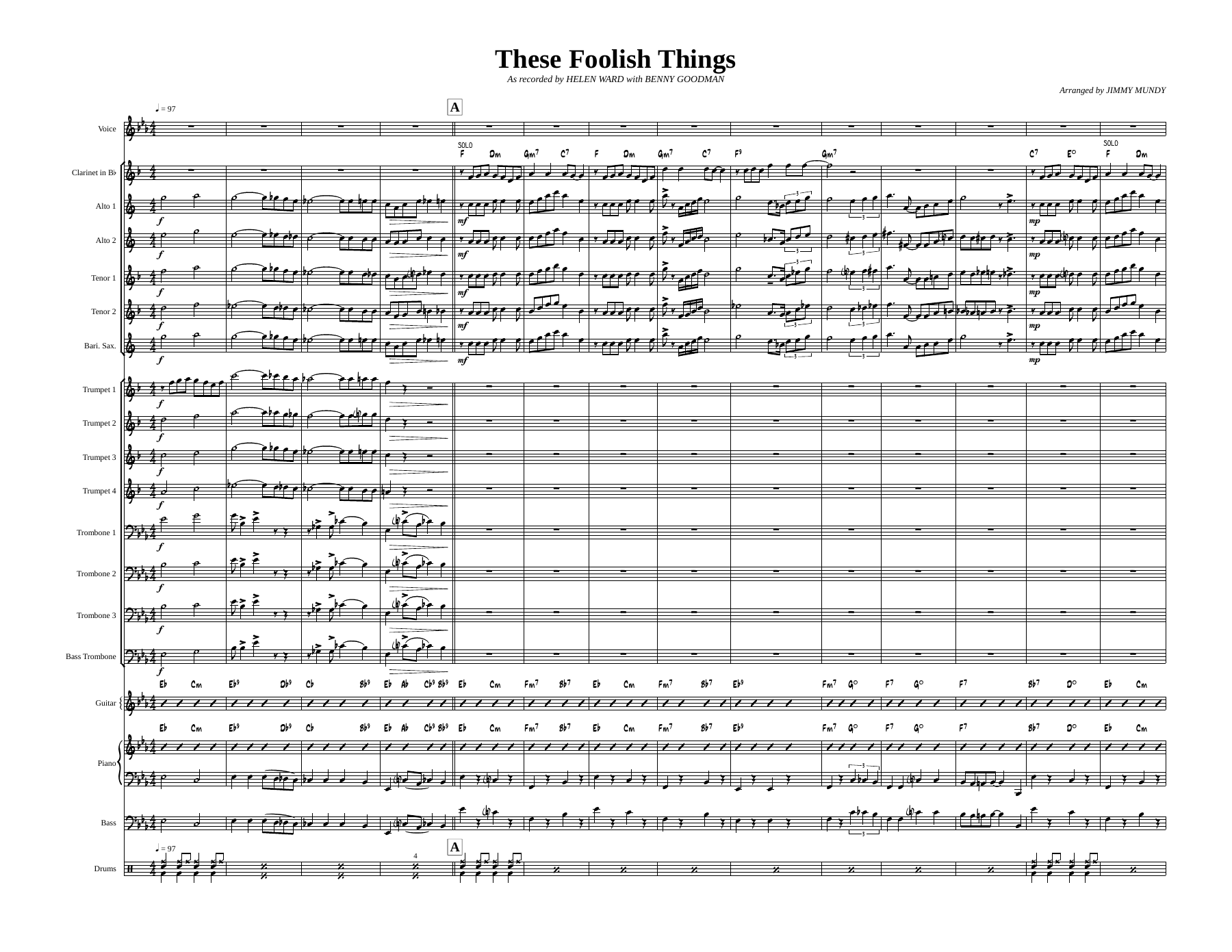
These Foolish Things (B.Goodman (H.BG) sheet music preview

These Foolish Things (B.Goodman (H.BG)

Composed by Jack Strachey

Arranged by HWArd - J.Mundy) as rec by HW with BG

  • Ensemble: Big Band
  • Style: Jazz Standard
  • Pages: 37
  • Instruments (19): Voice, Clarinet in Bb, Alto Saxophone 1, Alto Saxophone 2, Tenor Saxophone 1, Tenor Saxophone 2, Baritone Saxophone, Trumpet 1, Trumpet 2, Trumpet 3, Trumpet 4, Trombone 1, Trombone 2, Trombone 3, Bass Trombone, Guitar, Piano, Bass, Drum Set
  • Difficulty: medium
  • Content: Individual Parts
  • Format: PDF Download (Instant)
  • Price: $24.99

"These Foolish Things (Remind Me of You)," a timeless ballad penned by Jack Strachey with lyrics by Holt Marvell and Harry Link, emerged in 1936, quickly becoming a quintessential jazz standard of the Swing Era. Its melancholic yet romantic melody and evocative lyrics captured the hearts of audiences, making it an instant classic. While countless artists have interpreted this enduring tune, it was the iconic recording by Benny Goodman, featuring Helen Ward on vocals, that solidified its place in the jazz canon, showcasing the Goodman band's sophisticated arrangements and Ward's expressive delivery. The song embodies the bittersweet nostalgia characteristic of 1930s popular music, a period when big bands reigned supreme and sophisticated harmonies began to intertwine with accessible melodies, laying the groundwork for future jazz developments. This big band arrangement, meticulously transcribed and adapted from the seminal Helen Ward with Benny Goodman recording, captures the original's delicate balance of swing and sentimentality. Set in a medium-slow swing tempo, the arrangement retains the original key, allowing for a faithful recreation of the recording's mood and energy. The musical character is one of tender reflection, moving between moments of lush ensemble voicing and intimate solo passages. The arrangement opens with a characteristic Goodman-esque clarinet lead over a soft, harmonically rich brass and sax carpet, immediately establishing the nostalgic atmosphere. The overall feel is one of understated elegance, demanding precision and sensitivity from the ensemble rather than overt power. The arranger, HWArd - J.Mundy (as recorded by HW with BG), has masterfully preserved the distinctive voicings and stylistic nuances that defined the Benny Goodman Orchestra. Expect intricate saxophone soli sections that weave complex melodic lines, punctuated by the signature call-and-response figures between the brass and reeds. The arrangement features the melody predominantly carried by the lead alto saxophone or clarinet, often doubled or harmonized by other reeds, creating a warm, blended timbre. There are featured solo opportunities, notably for clarinet (emulating Goodman's style) and tenor saxophone, providing space for expressive improvisation within the harmonic framework. The technical challenges lie in achieving precise articulation, maintaining a consistent, flowing medium-slow swing feel, and executing the subtle dynamic shifts that give the piece its emotional depth. The rewarding aspect is performing a historically significant arrangement that resonates with the golden age of big band jazz, allowing musicians to inhabit the authentic sound of a legendary ensemble. This arrangement is ideally suited for college, university, and advanced community jazz ensembles, as well as professional big bands looking to perform classic Swing Era repertoire with authenticity. Its demands for nuanced interpretation, precise ensemble playing, and stylistic understanding make it an excellent educational tool for exploring the intricacies of 1930s big band arranging and performance practice. While not overly challenging technically for individual players, the ensemble cohesion and stylistic integrity required elevate its difficulty to an intermediate-advanced level. Conductors should prioritize establishing a consistent, relaxed medium-slow swing feel, emphasizing a legato approach in the melodic lines. Articulation is key: aim for smooth, connected phrases, avoiding overly aggressive attacks. Pay close attention to dynamic contrasts, particularly the subtle swells and diminuendos that contribute to the arrangement's emotional impact. The clarinet lead in the opening and throughout requires a warm, focused tone. Brass players should use straight mutes as indicated for specific sections, ensuring a unified, blended sound. Rehearsal time should be dedicated to balancing the intricate saxophone soli passages and ensuring precise rhythmic alignment between sections, especially during the call-and-response figures. Encourage soloists to embody the lyrical, melodic improvisation style of the era, focusing on storytelling rather than purely technical display. Q: What instruments are included in this arrangement? A: This big band arrangement includes parts for 17 instruments: Alto Saxophone 1, Alto Saxophone 2, Tenor Saxophone 1, Tenor Saxophone 2, Baritone Saxophone, Trumpet 1, Trumpet 2, Trumpet 3, Trumpet 4, Trombone 1, Trombone 2, Trombone 3, Trombone 4, Piano, Bass, Drums, and Guitar. Q: What is the difficulty level of "These Foolish Things (B.Goodman (H.BG)"? A: This arrangement is rated as intermediate-advanced. While individual parts are not excessively difficult, it requires a high level of ensemble precision, stylistic authenticity, and nuanced musicality to perform effectively, making it suitable for college, university, and advanced community big bands. Q: What musical style and historical context does this arrangement represent? A: This arrangement is a classic jazz standard from the Swing Era (1930s), specifically transcribed from the iconic Benny Goodman Orchestra recording featuring Helen Ward. It embodies the sophisticated, melodic big band sound of that period. Q: What makes this particular arrangement unique or distinctive? A: This arrangement is a faithful transcription of the original Helen Ward with Benny Goodman recording, preserving the precise voicings, melodic contours, and stylistic nuances that defined Goodman's legendary orchestra, offering an authentic historical performance experience. Q: What is the typical performance duration and tempo for this piece? A: Performed at a medium-slow swing tempo, this arrangement typically lasts approximately 3 to 4 minutes, depending on the length of improvised solos and any optional repeats.

Musicians Also Search For

These Foolish Things HWArd - J.Mundy) as rec by HW with BG PDFThese Foolish Things HWArd - J.Mundy) as rec by HW with BG sheet musicThese Foolish Things arranged by HWArd - J.Mundy) as rec by HW with BGHWArd - J.Mundy) as rec by HW with BG big band chartsHWArd - J.Mundy) as rec by HW with BG jazz arrangements PDFThese Foolish Things Jack Strachey sheet musicThese Foolish Things Jack Strachey big band arrangementJack Strachey big band chartsThese Foolish Things big band arrangementThese Foolish Things big band PDF downloadThese Foolish Things jazz ensemble sheet musicbig band sheet music instant downloadThese Foolish Things conductor score PDFThese Foolish Things individual parts downloadThese Foolish Things sheet music with partsThese Foolish Things Jazz Standard chartJazz Standard big band arrangementsbuy These Foolish Things sheet music onlinedownload These Foolish Things PDFThese Foolish Things jazz chartbest HWArd - J.Mundy) as rec by HW with BG big band arrangementsJack Strachey songs arranged by HWArd - J.Mundy) as rec by HW with BGThese Foolish Things printable sheet musicbig band repertoire PDF

All arrangements by HWArd - J.Mundy) as rec by HW with BG All Jack Strachey sheet music