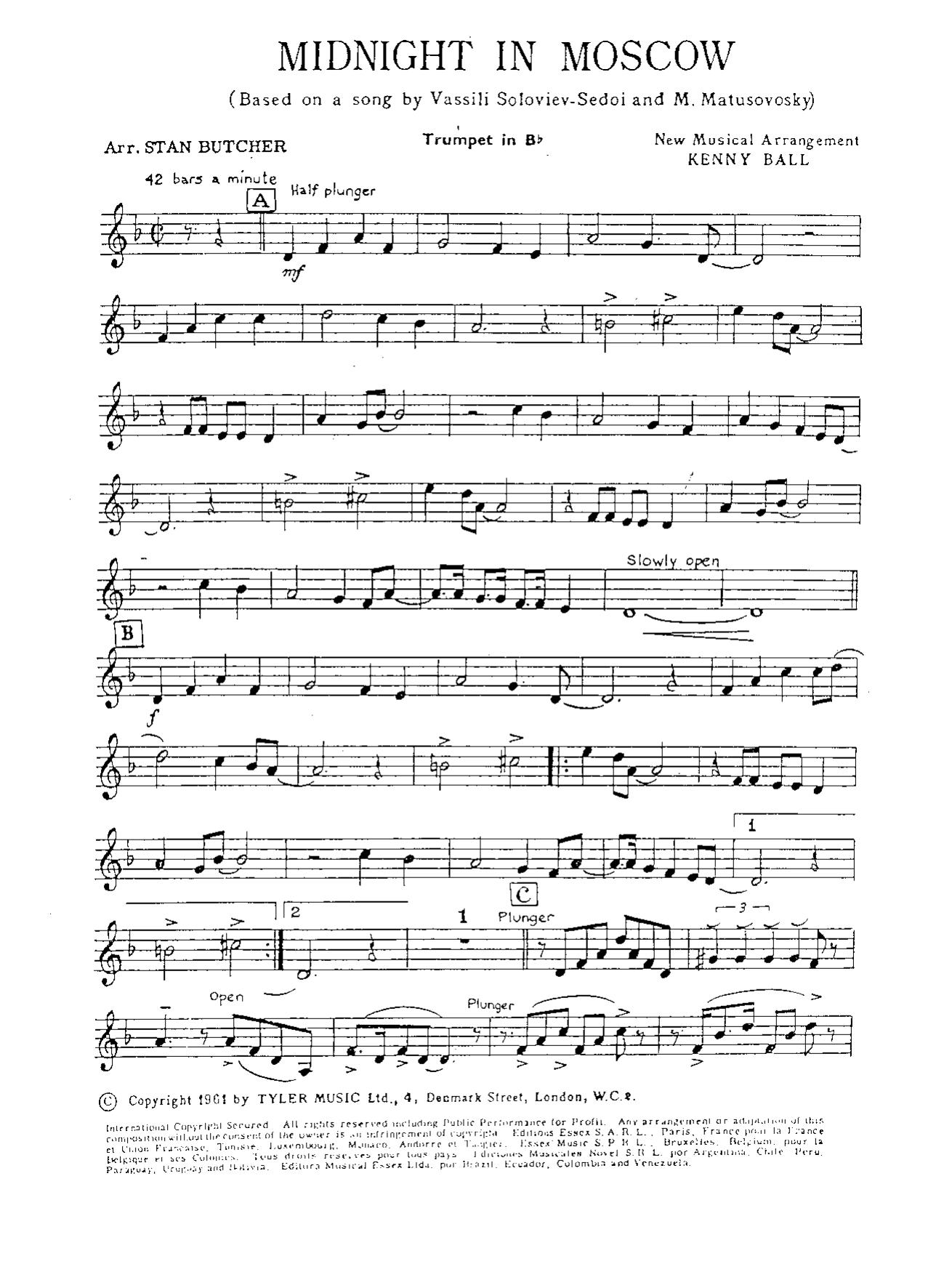
Midnight in Moscow K.Ball (S.Butcher)
Composed by Vassili Soloviev-Sedoi and M. Matusovosky
Arranged by Stan Butcher
- Ensemble: Dixieland Band
- Style: Dixieland
- Pages: 16
- Instruments (8): Trumpet in Bb, Bb Clarinet, Bb Tenor Saxophone, Trombone, Banjo and Guitar, Piano Conductor, Bass, Drums
- Difficulty: easy
- Content: Individual Parts
- Format: PDF Download (Instant)
- Price: $18.99
Vassili Soloviev-Sedoi and M. Matusovosky's "Midnight in Moscow" (Подмосковные Вечера), originally composed in 1955, rapidly transcended its Soviet origins to become a global phenomenon, particularly after its instrumental rendition gained popularity in the late 1950s and early 1960s. While not a traditional "jazz standard" in its inception, its memorable, melancholic melody and waltz-like structure (often adapted to 4/4 time) made it ripe for interpretation across various genres, including pop, folk, and jazz. Its enduring appeal lies in its evocative melody, which conjures images of quiet contemplation and romantic evenings, universally understood despite its specific cultural roots. The piece gained significant traction in the West through various recordings, solidifying its place in the popular music lexicon and paving the way for diverse instrumental treatments. Stan Butcher's arrangement of "Midnight in Moscow," specifically tailored for a Dixieland band, transforms the original's reflective character into a spirited, swinging showcase of traditional jazz exuberance. Butcher reimagines the piece with a medium-up Dixieland swing feel in 4/4 time, typically set in a bright, accessible key like C or F major, ensuring both clarity and buoyancy. The mood shifts from the original's pensive romanticism to an infectious, joyful romp, characteristic of the Dixieland style's emphasis on collective improvisation and buoyant rhythms. The arrangement maintains the core melodic integrity but infuses it with the driving energy and distinctive instrumental textures of a classic New Orleans ensemble, evoking a sense of nostalgic revelry. Butcher's distinctive approach to this Dixieland setting is evident in his masterful use of counterpoint and ensemble interplay. The arrangement features the melody prominently in the cornet or trumpet, often supported by clarinet obligatos that weave intricate, high-flying lines around the main theme. The trombone provides a robust harmonic foundation and rhythmic propulsion, often employing glissandos and tailgate effects characteristic of the style. Butcher skillfully employs call-and-response sections between the front line and rhythm section, building dynamic interest. While specific shout choruses are less common in traditional Dixieland than in big band, Butcher creates moments of collective improvisation (known as "Dixieland ensemble") where all instruments contribute simultaneously, creating a rich, polyphonic texture that is both challenging and exhilarating. Performance of this arrangement is a rewarding experience for any Dixieland ensemble. The melody is initially carried by the lead cornet/trumpet, then often passed to the clarinet for a contrasting interpretation, and finally presented in a full ensemble "Dixieland chorus." Featured solo sections are typically open for improvisation over the chord changes, allowing individual musicians to showcase their stylistic prowess. Technical challenges include maintaining a consistent, driving swing feel, executing precise articulations and stylistic nuances (such as falls, scoops, and growls), and navigating the collective improvisation sections with clarity and balance. The interplay between instruments, the joyous energy, and the opportunity for individual expression make this arrangement particularly suitable for experienced high school bands, college ensembles, community groups, and professional Dixieland bands seeking an engaging and historically informed rendition of a beloved melody. To capture the authentic Dixieland spirit of "Midnight in Moscow," aim for a medium-up tempo (approximately 160-180 bpm) with a buoyant, two-beat swing feel in the rhythm section, emphasizing the upbeat. The primary technical challenge lies in achieving a cohesive collective improvisation during the ensemble sections; encourage musicians to listen intently to each other, maintaining clear melodic lines while contributing to the overall texture. The cornet/trumpet should articulate the melody with a bright, confident tone, while the clarinet should focus on fluid, lyrical obligato lines. Trombone players should utilize plunger mutes for expressive growls and falls where indicated, and embrace the characteristic tailgate glissandos. Rehearsal should focus on developing a unified sense of rhythmic drive and ensuring dynamic contrast between solo features and full ensemble passages. Emphasize crisp, short articulations in the front line to maintain the characteristic Dixieland punch. Q: What instruments are included in this arrangement? A: This arrangement is scored for a standard Dixieland band, typically including Cornet/Trumpet, Clarinet, Trombone, Piano, Bass, and Drums. Specific parts for each of these instruments are provided. Q: What is the difficulty level of this arrangement? A: This arrangement is rated as medium to medium-difficult, making it appropriate for experienced high school, college, community, and professional Dixieland ensembles. It requires proficiency in traditional jazz articulation and ensemble playing. Q: What musical style and historical context does this arrangement represent? A: This arrangement reimagines the popular Russian melody "Midnight in Moscow" in the Dixieland style, a form of traditional jazz originating in New Orleans in the early 20th century. It captures the energetic, polyphonic character of classic Dixieland. Q: What makes Stan Butcher's arrangement of "Midnight in Moscow" unique? A: Butcher's arrangement uniquely transforms the original's melancholic waltz into a vibrant, medium-up Dixieland swing. It features classic Dixieland ensemble interplay, prominent clarinet obligatos, and opportunities for authentic stylistic improvisation, showcasing his expertise in the genre. Q: What is the typical performance duration and tempo for this piece? A: The typical performance duration for this arrangement is approximately 3-4 minutes, depending on the number and length of improvised solos. It is designed to be played at a medium-up Dixieland swing tempo, around 160-180 beats per minute.
Questions and answers
- What is included in the Midnight in Moscow K.Ball (S.Butcher) PDF?
- The verified current file contains a conductor score and individual parts across 16 pages.
- How many instruments or parts are listed for Midnight in Moscow K.Ball (S.Butcher)?
- The verified instrumentation list contains 8 entries for this Dixieland Band arrangement.
- Who is credited for Midnight in Moscow K.Ball (S.Butcher)?
- Composer: Vassili Soloviev-Sedoi and M. Matusovosky. Arranger: Stan Butcher.
- What difficulty is listed for Midnight in Moscow K.Ball (S.Butcher)?
- The verified difficulty level is easy.
- What style is listed for Midnight in Moscow K.Ball (S.Butcher)?
- The catalog lists the style as Dixieland.
- Can I preview Midnight in Moscow K.Ball (S.Butcher) before buying?
- Yes. The product page provides a preview generated from the current PDF file.
- How is Midnight in Moscow K.Ball (S.Butcher) delivered?
- After successful payment, the digital PDF is made available for download. The displayed price is $18.99.
Musicians Also Search For
Midnight in Moscow K.Ball Stan Butcher PDF • Midnight in Moscow K.Ball Stan Butcher sheet music • Midnight in Moscow K.Ball arranged by Stan Butcher • Stan Butcher dixieland band charts • Stan Butcher jazz arrangements PDF • Midnight in Moscow K.Ball Vassili Soloviev-Sedoi and M. Matusovosky sheet music • Midnight in Moscow K.Ball Vassili Soloviev-Sedoi and M. Matusovosky dixieland band arrangements • Vassili Soloviev-Sedoi and M. Matusovosky dixieland band charts • Midnight in Moscow K.Ball dixieland band arrangements • Midnight in Moscow K.Ball dixieland band PDF download • Midnight in Moscow K.Ball jazz sheet music • dixieland band sheet music download • Midnight in Moscow K.Ball conductor score PDF • Midnight in Moscow K.Ball individual parts download • Midnight in Moscow K.Ball sheet music PDF • Midnight in Moscow K.Ball Dixieland charts • Dixieland dixieland band arrangements • buy Midnight in Moscow K.Ball sheet music • download Midnight in Moscow K.Ball PDF • Midnight in Moscow K.Ball jazz charts • best Stan Butcher dixieland band arrangements • Vassili Soloviev-Sedoi and M. Matusovosky arranged by Stan Butcher • Midnight in Moscow K.Ball printable sheet music • dixieland band repertoire PDF