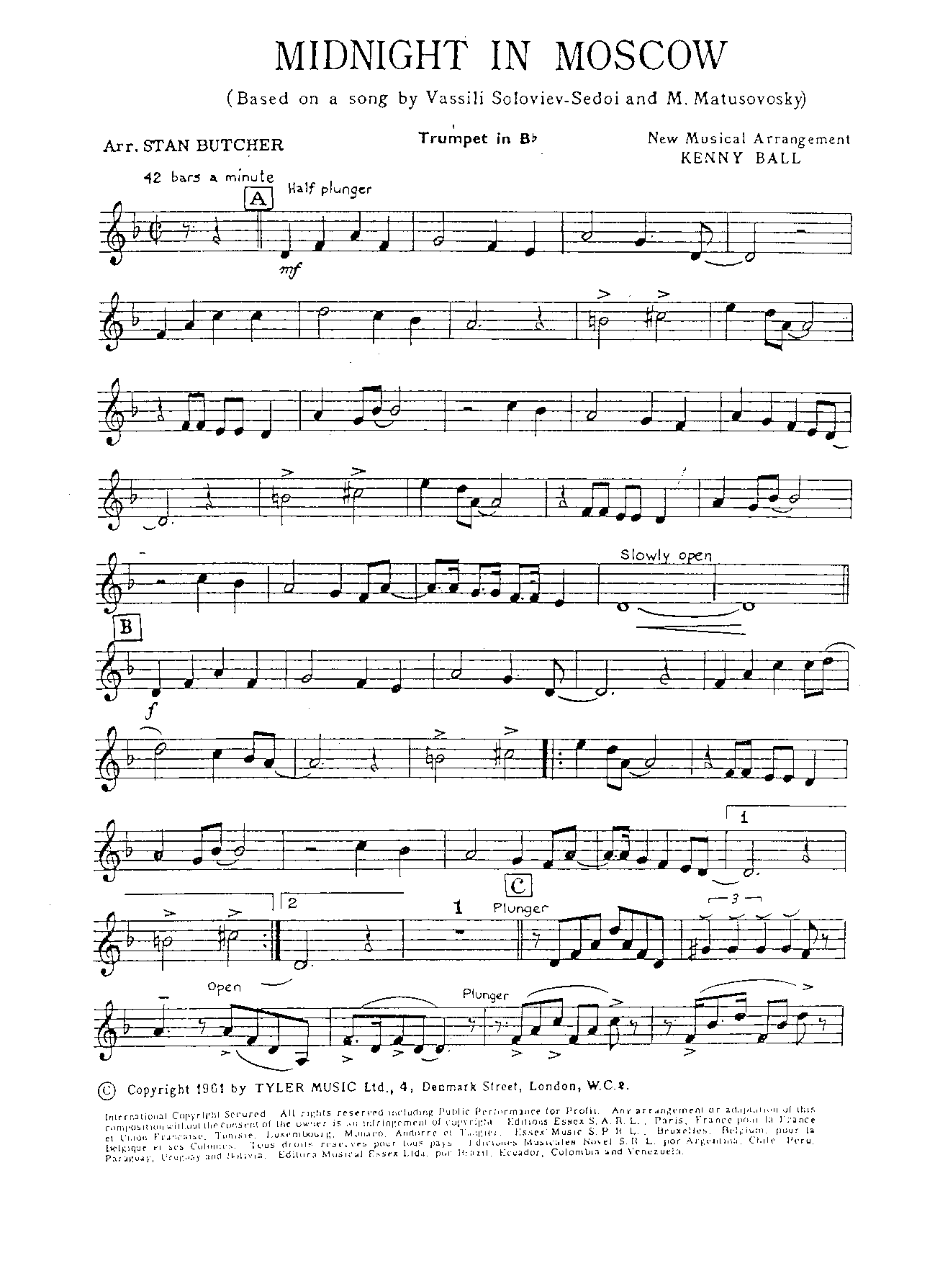
Midnight in Moscow (S.Butcher)
Composed by Vassili Soloviev-Sedoi and M. Matusovosky
Arranged by Stan Butcher
- Ensemble: Small Ensemble
- Style: Jazz Standard
- Pages: 16
- Difficulty: easy
- Content: Sheet Music
- Format: PDF Download (Instant)
- Price: $12.99
"Midnight in Moscow," originally titled "Moscow Nights" (Подмосковные Вечера), is a captivating melody composed by Vassili Soloviev-Sedoi with lyrics by M. Matusovosky in 1955. Initially conceived as a folk-style song for a documentary film, its melancholic beauty and memorable theme quickly transcended its origins, becoming a global phenomenon. It gained significant international recognition and became a jazz standard through various interpretations, particularly in the late 1950s and early 1960s, embodying the era's fascination with global melodies and their adaptation into the burgeoning jazz idiom. The piece’s enduring appeal lies in its simple yet profound melodic contour, which lends itself beautifully to harmonic reinterpretation and improvisation, cementing its place in the jazz repertoire as a beloved standard that evokes a sense of nostalgic reflection and lyrical grace. Stan Butcher's arrangement of "Midnight in Moscow" transforms this iconic tune into a sophisticated small ensemble jazz piece, characterized by a medium swing feel that perfectly balances its inherent lyricism with an infectious rhythmic drive. Butcher, known for his refined harmonic palette and intelligent scoring, approaches this standard with a keen ear for texture and nuance. The arrangement typically features lush, close voicings that provide a warm, inviting backdrop for the melody, often presented initially by a lead instrument, such as a trumpet or alto saxophone, before being passed through the ensemble. His signature techniques include subtle counter-melodies that weave through the primary theme, enriching the harmonic landscape without overshadowing the original melody. The key is thoughtfully chosen to allow for both comfortable playing and a bright, yet mellow, sonic character. Performing this arrangement offers a rewarding experience for musicians. The melody is predominantly carried by the lead voices, often with tasteful harmonized sections that showcase the ensemble's blend. While there are opportunities for featured solos, typically over the well-known chord changes, Butcher’s focus is often on the collective sound, with carefully crafted soli passages that demand precision and tight articulation. Technical challenges include maintaining a consistent, relaxed medium swing feel, achieving impeccable balance within the close voicings, and navigating the dynamic contrasts that Butcher meticulously notates to enhance the emotional arc of the piece. The arrangement culminates in a satisfying, often understated, finish that leaves the audience with the melody lingering in their minds. This arrangement is ideally suited for college-level jazz ensembles, community bands with experienced players, or professional small groups looking for a polished, accessible, yet musically rich addition to their repertoire. Its blend of familiar melody and sophisticated jazz treatment makes it an audience favorite and a valuable learning tool for ensemble playing. Conductors should emphasize a relaxed, yet precise, medium swing feel from the outset, ensuring that the eighth notes are swung consistently without rushing. The piece is typically set in a comfortable tempo around quarter note = 120-130 bpm. Key technical challenges include achieving impeccable balance and blend within Stan Butcher’s characteristic close voicings, particularly in the harmonized melody sections. Encourage musicians to listen across the ensemble, adjusting dynamics to allow the lead voice to project while maintaining harmonic integrity. Phrasing should be lyrical and legato, especially during the main melodic statements, contrasting with crisper articulation in any accompanying rhythmic figures. While no special techniques like plungers or falls are explicitly required, musicians should be prepared for nuanced dynamic changes and expressive shaping of phrases. Rehearsal time should focus on intonation within the voicings, rhythmic precision in the swing feel, and developing a unified ensemble sound that captures the piece's melancholic beauty and gentle swing. Q: What instruments and parts are included in the "Midnight in Moscow (S.Butcher)" arrangement? A: This small ensemble arrangement typically includes parts for a standard jazz combo or small big band instrumentation, such as lead alto saxophone, tenor saxophone, trumpet, trombone, piano, bass, and drums. Specific instrumentation may vary slightly, but it is designed for a compact, versatile group. Q: What is the difficulty level of this arrangement? A: Stan Butcher's "Midnight in Moscow" is considered an intermediate to advanced-intermediate level arrangement. It requires proficient sight-reading skills, a solid understanding of jazz articulation and swing feel, and good ensemble blend and balance from all musicians. Q: What musical style does this arrangement represent, and what is its historical context? A: This is a jazz standard arrangement of "Midnight in Moscow," originally a Russian folk-style song from 1955. Stan Butcher's treatment places it firmly within the post-bop, small ensemble jazz tradition, characterized by sophisticated harmonies and a medium swing feel, reflecting its popularity as a jazz standard in the mid-20th century. Q: What makes Stan Butcher's arrangement of "Midnight in Moscow" unique? A: Butcher's arrangement is distinguished by its elegant, close voicings, intelligent counter-melodies, and a refined medium swing feel that honors the original melody while infusing it with sophisticated jazz harmonies and textures. It focuses on collective ensemble sound rather than extensive individual solos. Q: What is the typical performance duration and tempo for this arrangement? A: The typical performance duration for this arrangement is approximately 3 to 4 minutes, depending on any improvised solos. It is designed to be performed at a medium swing tempo, generally around 120-130 beats per minute.
Musicians Also Search For
Midnight in Moscow Stan Butcher PDF • Midnight in Moscow Stan Butcher sheet music • Midnight in Moscow arranged by Stan Butcher • Stan Butcher small ensemble charts • Stan Butcher jazz arrangements PDF • Midnight in Moscow Vassili Soloviev-Sedoi and M. Matusovosky sheet music • Midnight in Moscow Vassili Soloviev-Sedoi and M. Matusovosky small ensemble arrangement • Vassili Soloviev-Sedoi and M. Matusovosky small ensemble charts • Midnight in Moscow small ensemble arrangement • Midnight in Moscow small ensemble PDF download • Midnight in Moscow jazz ensemble sheet music • small ensemble sheet music instant download • Midnight in Moscow sheet music with parts • Midnight in Moscow Jazz Standard chart • Jazz Standard small ensemble arrangements • buy Midnight in Moscow sheet music online • download Midnight in Moscow PDF • Midnight in Moscow jazz chart • best Stan Butcher small ensemble arrangements • Vassili Soloviev-Sedoi and M. Matusovosky songs arranged by Stan Butcher • Midnight in Moscow printable sheet music • small ensemble repertoire PDF