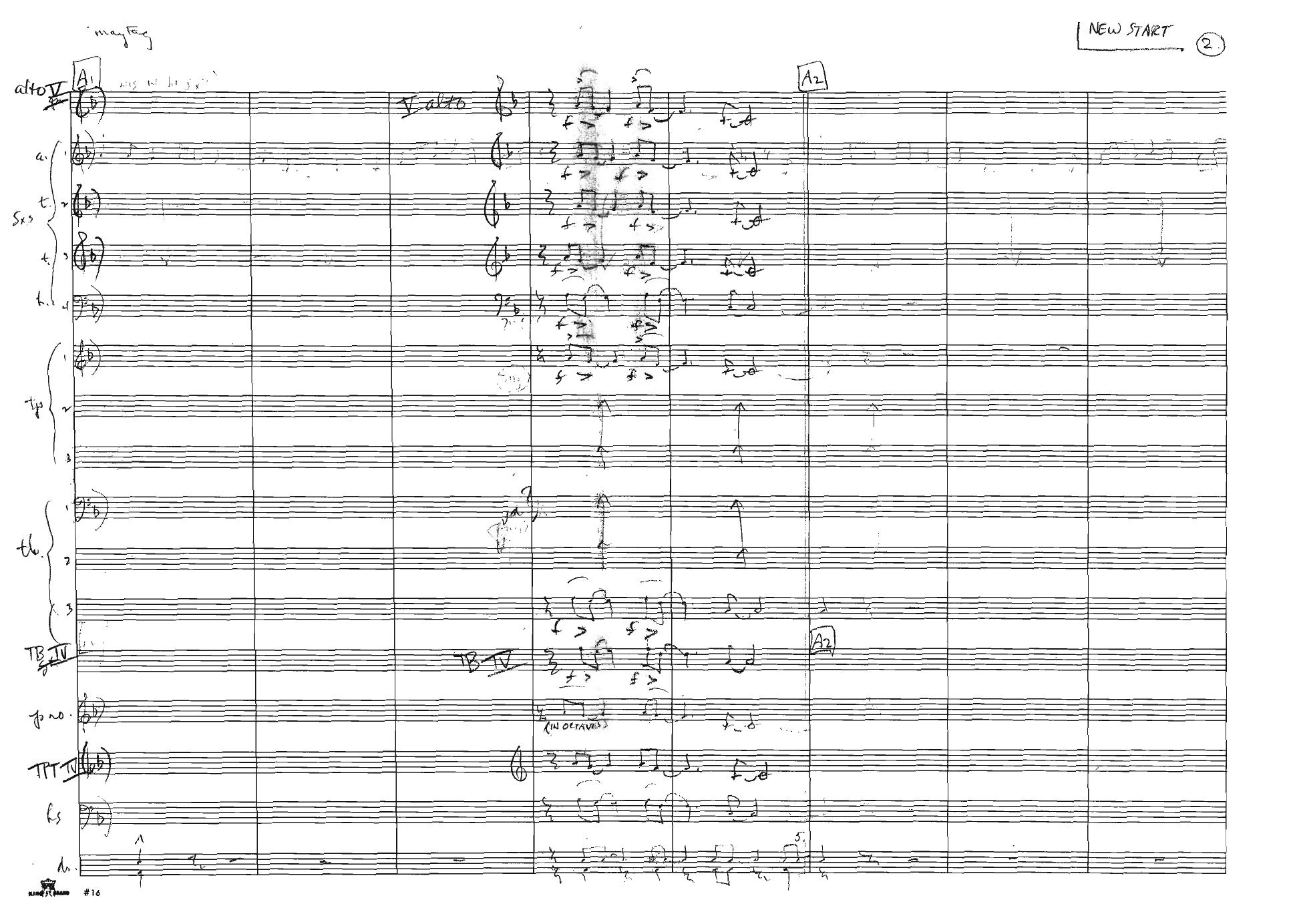
Maytag (G.Mulligan)
Composed by Gerry Mulligan
Arranged by Gerry Mulligan
- Ensemble: Big Band
- Pages: 93
- Instruments (15): Reed I (Alto Saxophone), Reed II (Tenor Saxophone 1), Reed III (Tenor Saxophone 2), Reed IV (Baritone Saxophone), Trumpet I, Trumpet II, Trumpet III, Trumpet IV, Trombone I, Trombone II, Trombone III, Trombone IV, Piano, Bass, Drums
- Difficulty: advanced
- Content: Individual Parts
- Format: PDF Download (Instant)
- Price: $24.99
Gerry Mulligan’s distinctive compositional and arranging voice defined the cool jazz movement of the 1950s, establishing a sophisticated counterpoint-driven aesthetic that minimized the heavy brass block-chords of the swing era in favor of transparent, linear textures. "Maytag," originally conceived and performed by the legendary baritone saxophonist and arranger, encapsulates the breezy, swinging intimacy and razor-sharp wit of Mulligan’s writing for smaller-to-medium-sized jazz ensembles. Emerging from an era where West Coast jazz was gaining international acclaim for its intellectual depth and relaxed yet driving swing feel, this composition highlights Mulligan's uncanny ability to make complex polyphonic lines sound effortless, breezy, and deeply swinging. Built upon a sleek, mid-tempo swing framework, "Maytag" opens with an infectious, conversational melodic line that immediately establishes the cool, understated mood characteristic of Mulligan's seminal working bands. The arrangement thrives on a buoyant 4/4 swing pulse, driven by an unhurried yet relentless momentum rather than sheer volume or aggressive brass bombast. The harmonic language is rich with sophisticated extensions, featuring signature Mulligan voicings that utilize tight intervals in the upper woodwinds offset by wide, open-spaced counter-lines in the low brass. Emotional tension is built through clever chromatic voice-leading and playful harmonic detours rather than thunderous dynamic swells, evoking the sophisticated atmosphere of late-night West Coast jazz clubs. Operating with a streamlined 8-instrument lineup (featuring Alto Saxophone, Tenor Saxophone, Baritone Saxophone, Trumpet, Trombone, and a tight rhythm section core), Mulligan’s scoring treats every chair as a vital, independent voice. The melodic weight is shared fluidly across the front line, relying heavily on contrapuntal interplay—often pitting the baritone saxophone against the trumpet or trombone in intricate, interwoven dialogues. Solos are seamlessly integrated into the structural fabric of the arrangement, providing designated blowing space that maintains the underlying harmonic and rhythmic momentum. Technical challenges for the ensemble center on articulation, intonation, and stylistic cohesion; players must master a lightweight, detached swing articulation (often referred to as a "doo-dah" tongue) to prevent the delicate counterpoint from sounding muddy. The reward for the ensemble lies in experiencing the unique transparency of Mulligan’s writing, where every player functions simultaneously as a soloist and an accompanist. Advanced high school, collegiate, and professional jazz ensembles will find this arrangement an exceptional vehicle for developing stylistic versatility, section balance, and linear independence. Because the scoring is concise yet texturally dense—spanning 93 pages of meticulously copied manuscript and parts—it demands a mature level of listening across the band, making it an ideal showcase for groups looking to move beyond standard big band roar into the refined, brainy elegance of cool jazz counterpoint. Conductors approaching "Maytag" must prioritize horizontal linear flow over vertical chordal weight. The designated medium-swing tempo should remain steady and relaxed; rushing the groove will destroy the characteristic West Coast "cool" aesthetic. Intonation is the primary technical hurdle, particularly during passages featuring tight counterpoint between the saxophones and brass. Players should practice their individual lines with a metronome, focusing on uniform articulation and short, crisp releases. Dynamics must be strictly managed; the ensemble should rarely exceed a strong mezzo-forte, ensuring that inner-voice counter-melodies remain audible beneath the primary thematic material. Rhythm section players should study Mulligan’s original recordings to capture the sparse, supportive comping style—pianists should avoid heavy, full-handed rootless voicings in favor of transparent, shell-voiced chords, while drummers should maintain a feather-light ride cymbal pattern with crisp hi-hat chokes on beats two and four. No special mute effects are required, allowing the natural acoustic blend of the 8-piece instrumentation to shine through cleanly. Q: What instruments and parts are included in this arrangement? A: This arrangement is scored for an 8-instrument ensemble featuring Alto Saxophone, Tenor Saxophone, Baritone Saxophone, Trumpet, Trombone, and a standard rhythm section (Piano, Bass, Drums), encompassing 93 pages of comprehensive performance materials. Q: What is the difficulty level of this piece? A: It is ideally suited for advanced high school, collegiate, and professional jazz ensembles due to its heavy reliance on tight counterpoint, linear independence, and stylistic precision. Q: What style and historical era does "Maytag" represent? A: Composed and arranged by Gerry Mulligan, the piece epitomizes the West Coast cool jazz movement of the 1950s, emphasizing relaxed swing feels, transparent textures, and sophisticated polyphony. Q: What makes this specific arrangement unique? A: Unlike traditional big band charts that rely on heavy brass shout choruses, Mulligan’s writing distributes melodic and counter-melodic weight equally across a streamlined 8-piece instrumentation, highlighting intricate conversational interplay. Q: What is the performance tempo and duration of the arrangement? A: The piece is set at a comfortable, driving medium-swing tempo, typically clocking in around 3 to 4 minutes depending on the length of the improvised solo sections.
Questions and answers
- What is included in the Maytag (G.Mulligan) PDF?
- The verified current file contains a conductor score and individual parts across 93 pages.
- How many instruments or parts are listed for Maytag (G.Mulligan)?
- The verified instrumentation list contains 15 entries for this Big Band arrangement.
- Who is credited for Maytag (G.Mulligan)?
- Composer: Gerry Mulligan. Arranger: Gerry Mulligan.
- What difficulty is listed for Maytag (G.Mulligan)?
- The verified difficulty level is advanced.
- Can I preview Maytag (G.Mulligan) before buying?
- Yes. The product page provides a preview generated from the current PDF file.
- How is Maytag (G.Mulligan) delivered?
- After successful payment, the digital PDF is made available for download. The displayed price is $24.99.
Musicians Also Search For
Maytag Gerry Mulligan PDF • Maytag Gerry Mulligan sheet music • Maytag arranged by Gerry Mulligan • Gerry Mulligan big band charts • Gerry Mulligan jazz arrangements PDF • Maytag Gerry Mulligan big band arrangements • Maytag big band arrangements • Maytag big band PDF download • Maytag jazz sheet music • big band sheet music download • Maytag conductor score PDF • Maytag individual parts download • Maytag sheet music PDF • buy Maytag sheet music • download Maytag PDF • Maytag jazz charts • best Gerry Mulligan big band arrangements • Maytag printable sheet music • big band repertoire PDF