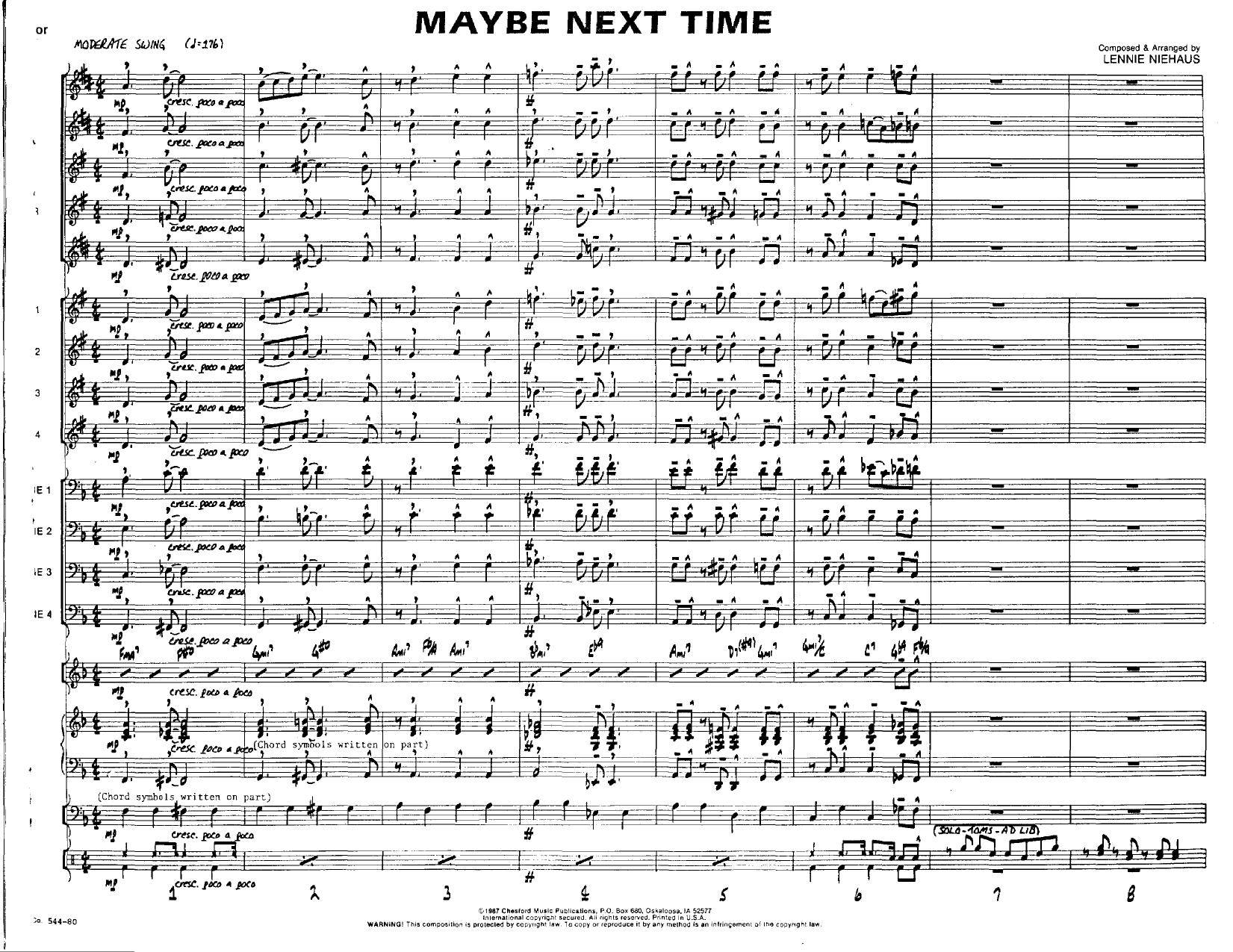
Maybe Next Time (L.Niehaus) sheet music preview

Maybe Next Time (L.Niehaus)

Composed by Lennie Niehaus

Arranged by Lennie Niehaus

  • Ensemble: Big Band
  • Pages: 51
  • Instruments (17): 1st Eb Alto Saxophone, 2nd Eb Alto Saxophone, 1st Bb Tenor Saxophone, 2nd Bb Tenor Saxophone, Eb Baritone Saxophone, 1st Bb Trumpet, 2nd Bb Trumpet, 3rd Bb Trumpet, 4th Bb Trumpet, 1st Trombone, 2nd Trombone, 3rd Trombone, 4th Trombone, Piano, Bass, Drums, Guitar
  • Difficulty: advanced
  • Content: Individual Parts
  • Format: PDF Download (Instant)
  • Price: $24.99

Lennie Niehaus remains one of the most distinctive architects of West Coast cool jazz, bringing his extensive experience as both a stellar alto saxophonist in the Stan Kenton Orchestra and a prolific Hollywood film composer to his writing. "Maybe Next Time" encapsulates the sophisticated harmonic language, linear counterpoint, and effortless swing that defined the California modern jazz scene of the 1950s and 60s. While drawing deep inspiration from the bebop tradition, Niehaus infuses his charts with a relaxed yet intellectually stimulating clarity, favoring transparent ensemble textures, clever chromatic voice-leading, and infectious, understated groove over sheer volume and bombast. A vibrant medium swing tempo drives the arrangement, establishing a cool, confident mood that balances sophisticated harmonic tension with an accessible, head-nodding pulse. The foundational groove is anchored by a crisp rhythm section style reminiscent of the Lighthouse All-Stars, demanding a light, articulate touch rather than heavy, pounding accents. Harmonically rich yet transparent, the chart avoids dense, muddy block chords in favor of open-voiced horn writing that allows individual countermelodies to breathe. The emotional landscape shifts gracefully between playful sophistication and moments of genuine warmth, evoking the cinematic cool of a late-night West Coast jazz club. Niehaus constructs the arrangement with a masterclass in section writing, utilizing tight, interlocking sax solis and crisp, conversational call-and-response figures between the brass and reeds. The melody is introduced with characteristic economy and elegance, steadily building momentum through clever modulatory transitions and a tightly wound shout chorus that reinterprets the main thematic material without resorting to overblown clichés. Solo opportunities are thoughtfully integrated into the framework, providing featured improvisers ample space to stretch out over changes that are harmonically stimulating yet lay exceptionally well on standard jazz instruments. Advanced high school ensembles, collegiate big bands, and professional repertory groups will find an ideal vehicle here for developing clean articulation, dynamic control, and stylistic nuance. Because the technical difficulties lie less in extreme velocity and more in stylistic unity, intonation, and light swing phrasing, it serves as an exceptional educational tool for teaching the language of West Coast modernism. Working musicians and ambitious students alike will relish the intelligent craftsmanship embedded in every measure, making it a standout selection for festival performance or formal concert programming. Achieving the authentic West Coast cool aesthetic in "Maybe Next Time" requires strict attention to a lighter, more horizontal swing feel where eighth notes are played with less bite than standard Kansas City or East Coast swing styles. The conductor should emphasize a relaxed, conversational articulation across all sections, ensuring that dynamic swells never overpower the rhythm section’s foundational groove. Technically, the primary challenges reside in the intricate horn solis, which demand immaculate intonation and uniform breath support to execute the chromatic passing tones cleanly. Brass players should keep mutes optional unless specified, favoring a warm, open tone over aggressive brassy stabs. During rehearsals, isolate the sax section first to lock in the nimble unison and harmonized lines without pressure from the full ensemble. Pay close attention to the rhythm section: the drummer should keep the ride cymbal prominent and crisp, using light hi-hat chokes on beats two and four, while the bass player maintains a steady, walking quarter-note pulse that underpins Niehaus’s sophisticated harmonic shifts without crowding the texture. Q: What instruments and parts are included in this big band arrangement? A: This 17-instrument arrangement includes a complete standard big band instrumentation featuring Alto Saxophone 1, Alto Saxophone 2, Tenor Saxophone 1, Tenor Saxophone 2, Baritone Saxophone, 4 Trumpets, 4 Trombones, piano, guitar, bass, and drums, along with a comprehensive conductor score. Q: What is the difficulty level of this chart? A: This arrangement is well-suited for advanced high school, collegiate, and professional big bands, presenting moderate technical demands centered around stylistic precision, intonation, and clean articulation rather than extreme tempo or range extremes. Q: What musical style and historical context does "Maybe Next Time" represent? A: Written by Lennie Niehaus, the piece firmly represents the West Coast cool jazz tradition of the 1950s, prioritizing transparent harmonies, linear counterpoint, and a relaxed, swinging pocket over aggressive bebop bombast. Q: What makes this particular arrangement by Lennie Niehaus unique? A: The chart stands out due to Niehaus's signature film-composer sensibility, utilizing clever voice-leading, interlocking reed solis, and open-voiced countermelodies that give each section an equal, conversational voice. Q: What is the recommended performance tempo and duration for this piece? A: The arrangement is set in a comfortable medium swing tempo (approximately 120–132 BPM) in 4/4 time, making for an engaging, well-paced performance lasting roughly 3 to 4 minutes depending on solo extensions.

Questions and answers

What is included in the Maybe Next Time (L.Niehaus) PDF?
The verified current file contains a conductor score and individual parts across 51 pages.
How many instruments or parts are listed for Maybe Next Time (L.Niehaus)?
The verified instrumentation list contains 17 entries for this Big Band arrangement.
Who is credited for Maybe Next Time (L.Niehaus)?
Composer: Lennie Niehaus. Arranger: Lennie Niehaus.
What difficulty is listed for Maybe Next Time (L.Niehaus)?
The verified difficulty level is advanced.
Can I preview Maybe Next Time (L.Niehaus) before buying?
Yes. The product page provides a preview generated from the current PDF file.
How is Maybe Next Time (L.Niehaus) delivered?
After successful payment, the digital PDF is made available for download. The displayed price is $24.99.

Musicians Also Search For

Maybe Next Time Lennie Niehaus PDFMaybe Next Time Lennie Niehaus sheet musicMaybe Next Time arranged by Lennie NiehausLennie Niehaus big band chartsLennie Niehaus jazz arrangements PDFMaybe Next Time Lennie Niehaus big band arrangementsMaybe Next Time big band arrangementsMaybe Next Time big band PDF downloadMaybe Next Time jazz sheet musicbig band sheet music downloadMaybe Next Time conductor score PDFMaybe Next Time individual parts downloadMaybe Next Time sheet music PDFbuy Maybe Next Time sheet musicdownload Maybe Next Time PDFMaybe Next Time jazz chartsbest Lennie Niehaus big band arrangementsMaybe Next Time printable sheet musicbig band repertoire PDF

All arrangements by Lennie Niehaus All Lennie Niehaus sheet music