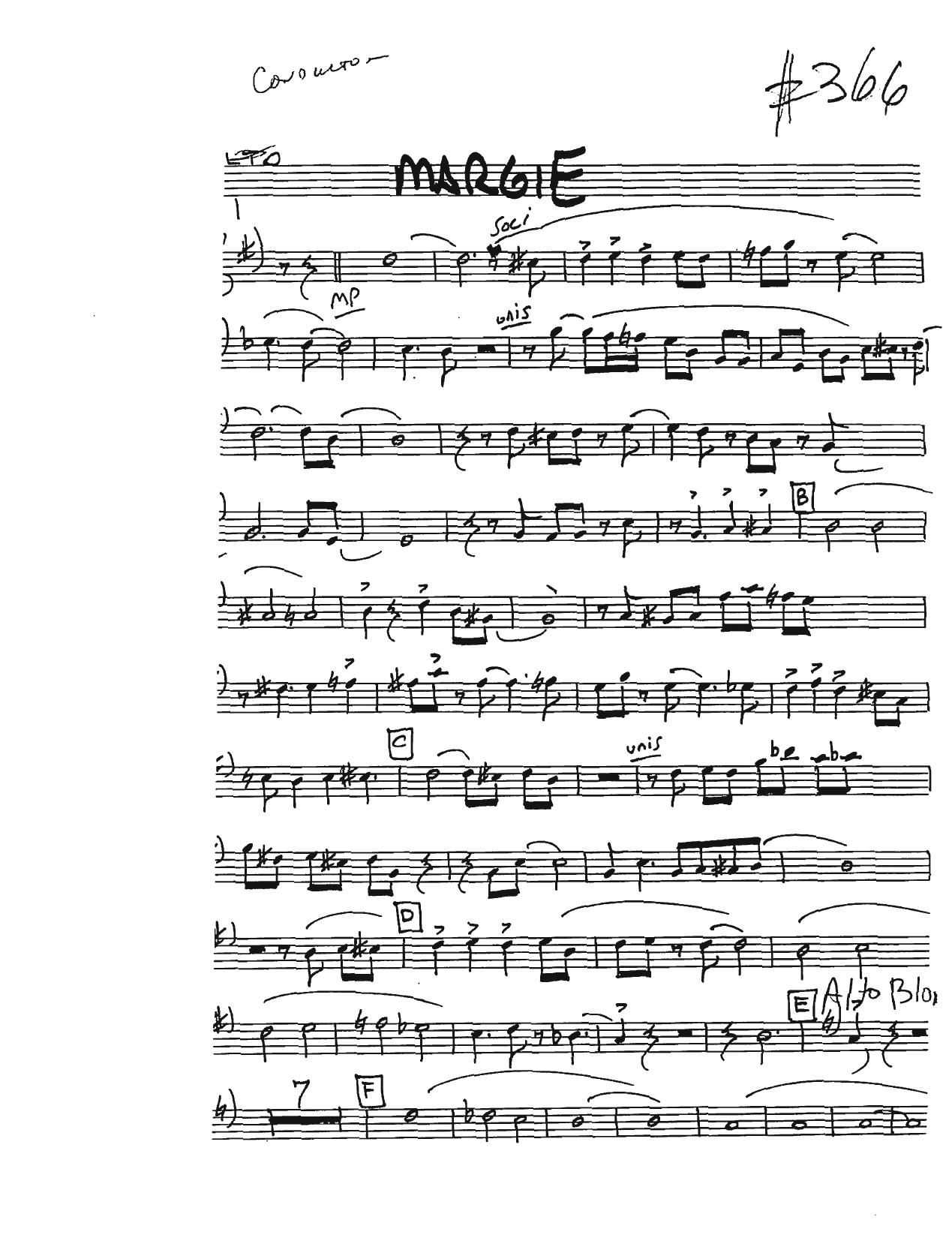
Margie (Marion Evans)
Composed by Con Conrad
Arranged by Marion Evans
- Ensemble: Big Band
- Style: Jazz Standard
- Pages: 36
- Instruments (16): Alto Sax I, Alto Sax II, Tenor Sax I, Tenor Sax II, Baritone Sax, Trumpet I, Trumpet II, Trumpet III, Trumpet IV, Trombone I, Trombone II, Trombone III, Trombone IV, Piano, Bass, Drums
- Difficulty: medium
- Content: Individual Parts
- Format: PDF Download (Instant)
- Price: $24.99
Originally introduced to the American public in 1920 with music by Con Conrad and J. Russel Robinson and lyrics by Benny Davis, "Margie" quickly ascended as a quintessential Tin Pan Alley smash, cemented in early jazz history through classic recordings by the Original Dixieland Jazz Band and later immortalized by swing icons like Cab Calloway and Fats Waller. The tune embodies the buoyant optimism and infectious danceability of the early jazz era, transitioning seamlessly from a roaring twenties novelty into a robust, swinging vehicle for mid-century big bands. Its enduring appeal lies in its deceptively simple, highly memorable recurring refrain, which invites imaginative reharmonization and rhythmic reinvention by master arrangers. Conceived by legendary arranger Marion Evans, this definitive big band setting transforms the traditional vaudeville-era tune into a sophisticated, high-energy swing tour de force. Operating at a brisk, driving medium-up swing tempo, the chart opens with an anticipatory brass setup before launching into crisp, interlocking woodwind and brass lines that drip with classic mid-century sophistication. Evans infuses the harmonic framework with rich, extended chord voicings, clever secondary dominants, and signature dynamic swells that elevate the jovial melody into a masterclass of swinging propulsion. The mood shifts effortlessly between playful, swaggering ensemble passages and thunderous, brass-heavy peaks, evoking the electric atmosphere of a premier Manhattan supper club at the height of the big band era. Evans structures the arrangement to showcase the entire ensemble's dynamic range, deploying tight, harmonized sax solis that demand absolute rhythmic precision and a unified articulation style. The brass section acts as both a rhythmic punctuation machine and a soaring melodic counter-force, leading up to a classic, high-octane shout chorus that brilliantly reworks the primary themes into a climactic texture. Solo opportunities are strategically integrated, allowing a standout horn player to stretch out over changes that honor the traditional harmonic movement while offering modern melodic freedom. Technical demands lean heavily on clean articulation, agile fingerwork in the woodwinds, and dependable endurance in the upper brass registers, making the chart exceptionally rewarding for players who relish crisp swing phrasing and intricate ensemble interplay. Advanced high school ensembles with strong section leaders, collegiate jazz orchestras, and professional community big bands will find this chart an ideal centerpiece for festival programs or formal concert sets. While the technical thresholds require mature section balance and confident soloists, the sheer infectious energy and masterclass craftsmanship embedded in every measure ensure that the investment of rehearsal time pays off exponentially on the bandstand. Navigating this arrangement successfully demands absolute precision in the rhythm section, which must anchor the driving medium-up swing feel without rushing the tempo. The drummer should utilize a crisp, feather-light ride cymbal pattern with consistent hi-hat chicks on beats two and four, keeping fills tasteful and supportive of the horn lines. Horn players must pay strict attention to short, articulated notes (staccatos) versus connected scalar passages, ensuring that all written fall-offs and doits are executed uniformly across sections rather than as isolated flourishes. In the saxophone soli, blend and intonation are paramount; encourage players to match the lead alto's vibrato width and phrasing shape precisely. During the shout chorus, brass players should balance their volume so that the underlying chordal tension cuts through without forcing their tone or sacrificing intonation. Conductors should rehearse the ensemble in sections first, paying close attention to the dynamic contrasts written into the transition bars, as these sudden shifts in volume are critical to capturing Marion Evans's signature dramatic flair. Q: What instruments and parts are included in this arrangement? A: The chart is scored for a standard 16-instrument big band instrumentation, featuring Alto Saxophone 1, Alto Saxophone 2, Tenor Saxophone 1, Tenor Saxophone 2, Baritone Saxophone, four trumpets, four trombones, and a full four-piece rhythm section consisting of piano, guitar, bass, and drums, spanning a comprehensive 36-page score and parts set. Q: What is the difficulty level of this Marion Evans chart? A: This arrangement is graded as advanced, making it best suited for collegiate jazz ensembles, advanced high school bands, and professional community big bands that possess strong section cohesion and experienced soloists. Q: What is the historical style and context of this piece? A: Based on the 1920 Tin Pan Alley standard by Con Conrad, J. Russel Robinson, and Benny Davis, this arrangement reframes the historical tune within a sophisticated, mid-century swing aesthetic popularized by the golden era of big band arranging. Q: What makes this specific arrangement unique? A: Marion Evans brings his trademark harmonic sophistication and brilliant dynamic pacing to the chart, blending tight, intricate saxophone solis with a powerful, multi-tiered shout chorus that completely revitalizes the vintage melody. Q: What is the approximate performance duration and tempo feel? A: The arrangement runs for approximately 3 to 4 minutes and is designed to be performed at a brisk, energetic medium-up swing tempo that keeps both the band and the audience thoroughly engaged from start to finish.
Questions and answers
- What is included in the Margie (Marion Evans) PDF?
- The verified current file contains individual parts across 36 pages.
- How many instruments or parts are listed for Margie (Marion Evans)?
- The verified instrumentation list contains 16 entries for this Big Band arrangement.
- Who is credited for Margie (Marion Evans)?
- Composer: Con Conrad. Arranger: Marion Evans.
- What difficulty is listed for Margie (Marion Evans)?
- The verified difficulty level is medium.
- What style is listed for Margie (Marion Evans)?
- The catalog lists the style as Jazz Standard.
- Can I preview Margie (Marion Evans) before buying?
- Yes. The product page provides a preview generated from the current PDF file.
- How is Margie (Marion Evans) delivered?
- After successful payment, the digital PDF is made available for download. The displayed price is $24.99.
Musicians Also Search For
Margie Marion Evans PDF • Margie Marion Evans sheet music • Margie arranged by Marion Evans • Marion Evans big band charts • Marion Evans jazz arrangements PDF • Margie Con Conrad sheet music • Margie Con Conrad big band arrangements • Con Conrad big band charts • Margie big band arrangements • Margie big band PDF download • Margie jazz sheet music • big band sheet music download • Margie individual parts download • Margie sheet music PDF • Margie Jazz Standard charts • Jazz Standard big band arrangements • buy Margie sheet music • download Margie PDF • Margie jazz charts • best Marion Evans big band arrangements • Con Conrad arranged by Marion Evans • Margie printable sheet music • big band repertoire PDF