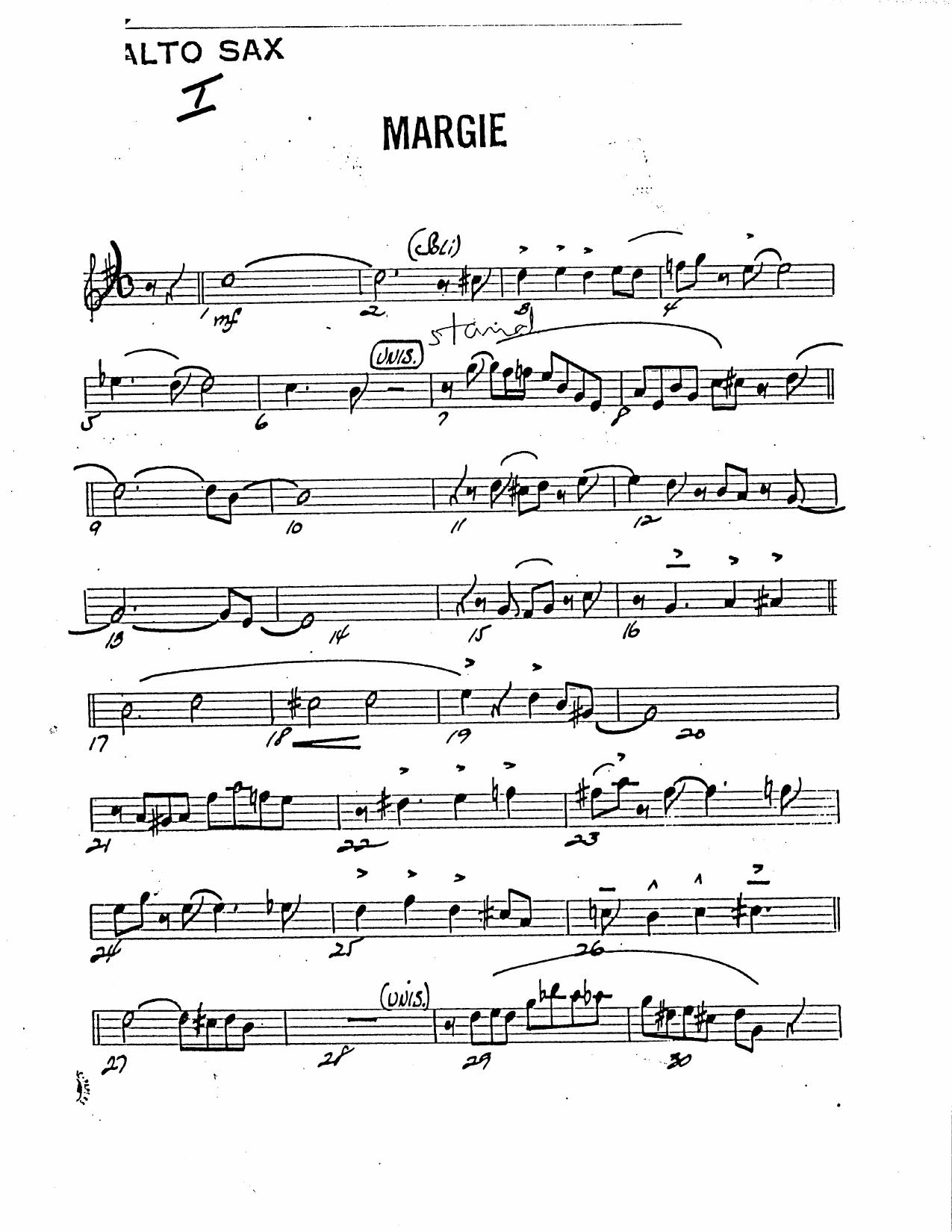
Margie (M.Evans)
Composed by Con Conrad
Arranged by Marion Evans
- Ensemble: Big Band
- Pages: 52
- Instruments (17): 1st Alto Saxophone, 2nd Alto Saxophone, 3rd Tenor Saxophone, 4th Tenor Saxophone, Baritone Saxophone, 1st Trumpet, 2nd Trumpet, 3rd Trumpet, 4th Trumpet, 1st Trombone, 2nd Trombone, 3rd Trombone, 4th Trombone, Guitar, Piano, Bass, Drums
- Difficulty: advanced
- Content: Individual Parts
- Format: PDF Download (Instant)
- Price: $24.99
Con Conrad, J. Russel Robinson, and Benny Davis originally penned "Margie" in 1920, transforming it into a roaring twenties quintessential pop-standard that was subsequently embraced by the jazz pantheon through landmark recordings by icons like Fats Domino, Dave Brubeck, and Don Redman. Steeped in early jazz and swing history, the tune relies on an inherently infectious, singable melody and a jaunty harmonic framework that invites reinvention. In the hands of legendary arranger Marion Evans—whose sophisticated, brass-forward writing defined the sound of mid-century vocal accompaniment and big band swing—"Margie" sheds its strictly Dixieland origins and undergoes a brilliant metamorphosis into a high-octane, swinging powerhouse tailored for the modern jazz orchestra. Blasting off at a brisk, driving medium-up swing tempo, this Marion Evans arrangement captures a buoyant, high-energy mood defined by sparkling brass counterlines and tight, punchy reed solis. Evans exploits the full dynamic and tonal spectrum of the 17-piece big band, contrasting shimmering, muted trumpet statements with roaring, full-ensemble shout choruses that push the harmonic envelope just enough while remaining tethered to the joyful spirit of the original melody. The arrangement opens with an anticipation-building vamp before handing the primary thematic material to the saxophone section, who deliver the head with crisp articulation and lithe phrasing. As the chart unfolds, conversational call-and-response figures between the trumpets and trombones generate an irresistible forward momentum, leading into strategically placed modulations and dynamic drop-outs that highlight Evans's masterclass understanding of big band pacing. The score features wide-ranging textural shifts, moving seamlessly from delicate, rhythm-section-driven comping behind featured soloists to thunderous tutti climaxes where the lead trumpet soars effortlessly over a thick wall of stacked, modern-swing voicings. Technical demands lean heavily on the brass and sax sections: trumpet players will need reliable endurance and command of the upper register for punchy accents and sustained high notes, while the saxophones navigate fleet-fingered, bebop-infused scalar passages that demand absolute unanimity in articulation. Rhythm section players, particularly the drummer and bassist, are tasked with maintaining an unwavering, pulsing swing groove that anchors the shifting harmonic colors and stylistic turns engineered by the arranger. Advanced high school ensembles with strong section leaders, collegiate jazz orchestras, and professional big bands will find this chart an absolute triumph on any concert or festival program. Because of its structural clarity, brilliant orchestration, and inherent crowd-pleasing charm, it serves as an ideal festival opener or a high-energy centerpiece for a standard jazz set. Audiences and performers alike will revel in the sophisticated yet utterly accessible celebration of swing history that Marion Evans has expertly crafted within these 52 pages. Conductors should establish a crisp, driving medium-up swing feel right from the downbeat, ensuring the quarter-note pulse remains rock-solid without rushing. The primary technical hurdle lies in the precise execution of short, staccato articulations across the full ensemble; use the "da-dit" syllable concept to keep the syncopated figures light and swinging rather than heavy or squared-off. Saxophones must blend meticulously during unison and harmonized soli sections, paying close attention to dynamic contours that mirror the brass responses. Trumpets and trombones should utilize cup or harmon mutes where indicated to achieve the authentic, transparent mid-century coloration Evans intended, reserving open-bell playing for the explosive shout choruses. Rehearsal strategy should focus first on isolating the intricate rhythm section interplay before layering in the horns, ensuring the bassist and drummer lock in a buoyant groove that supports the rapid-fire ensemble hits. Q: What instruments and parts are included in this arrangement? A: This 52-page big band chart is scored for a standard 17-instrument ensemble, consisting of five saxophones (Alto Sax 1, Alto Sax 2, Tenor Sax 3, Tenor Sax 4, Baritone Sax), four trumpets, four trombones, and a standard four-piece rhythm section (piano, bass, drums, and guitar). Q: What is the difficulty level of this Marion Evans arrangement? A: This arrangement is graded as advanced, making it best suited for college jazz orchestras, professional big bands, and elite high school ensembles with strong lead players and experienced section rhythm sections. Q: What is the historical style and context of this piece? A: Originally written in 1920 as a Tin Pan Alley standard, this chart reimagines the tune through the sophisticated, brass-forward lens of arranger Marion Evans, translating early jazz traditions into a high-energy mid-century swing style. Q: What makes this specific arrangement unique? A: Marion Evans distinguishes this chart through his brilliant use of dynamic contrast, shifting textures between muted brass and roaring tutti sections, and clever bebop-infused harmonic updates that elevate a traditional tune into a modern big band showcase. Q: What is the recommended tempo and performance duration? A: The arrangement is set at a brisk, driving medium-up swing tempo (typically around quarter note = 160–172 BPM) and generally runs for approximately 3 to 4 minutes depending on the length of the improvised solo choruses.
Questions and answers
- What is included in the Margie (M.Evans) PDF?
- The verified current file contains individual parts across 52 pages.
- How many instruments or parts are listed for Margie (M.Evans)?
- The verified instrumentation list contains 17 entries for this Big Band arrangement.
- Who is credited for Margie (M.Evans)?
- Composer: Con Conrad. Arranger: Marion Evans.
- What difficulty is listed for Margie (M.Evans)?
- The verified difficulty level is advanced.
- Can I preview Margie (M.Evans) before buying?
- Yes. The product page provides a preview generated from the current PDF file.
- How is Margie (M.Evans) delivered?
- After successful payment, the digital PDF is made available for download. The displayed price is $24.99.
Musicians Also Search For
Margie Marion Evans PDF • Margie Marion Evans sheet music • Margie arranged by Marion Evans • Marion Evans big band charts • Marion Evans jazz arrangements PDF • Margie Con Conrad sheet music • Margie Con Conrad big band arrangements • Con Conrad big band charts • Margie big band arrangements • Margie big band PDF download • Margie jazz sheet music • big band sheet music download • Margie individual parts download • Margie sheet music PDF • buy Margie sheet music • download Margie PDF • Margie jazz charts • best Marion Evans big band arrangements • Con Conrad arranged by Marion Evans • Margie printable sheet music • big band repertoire PDF