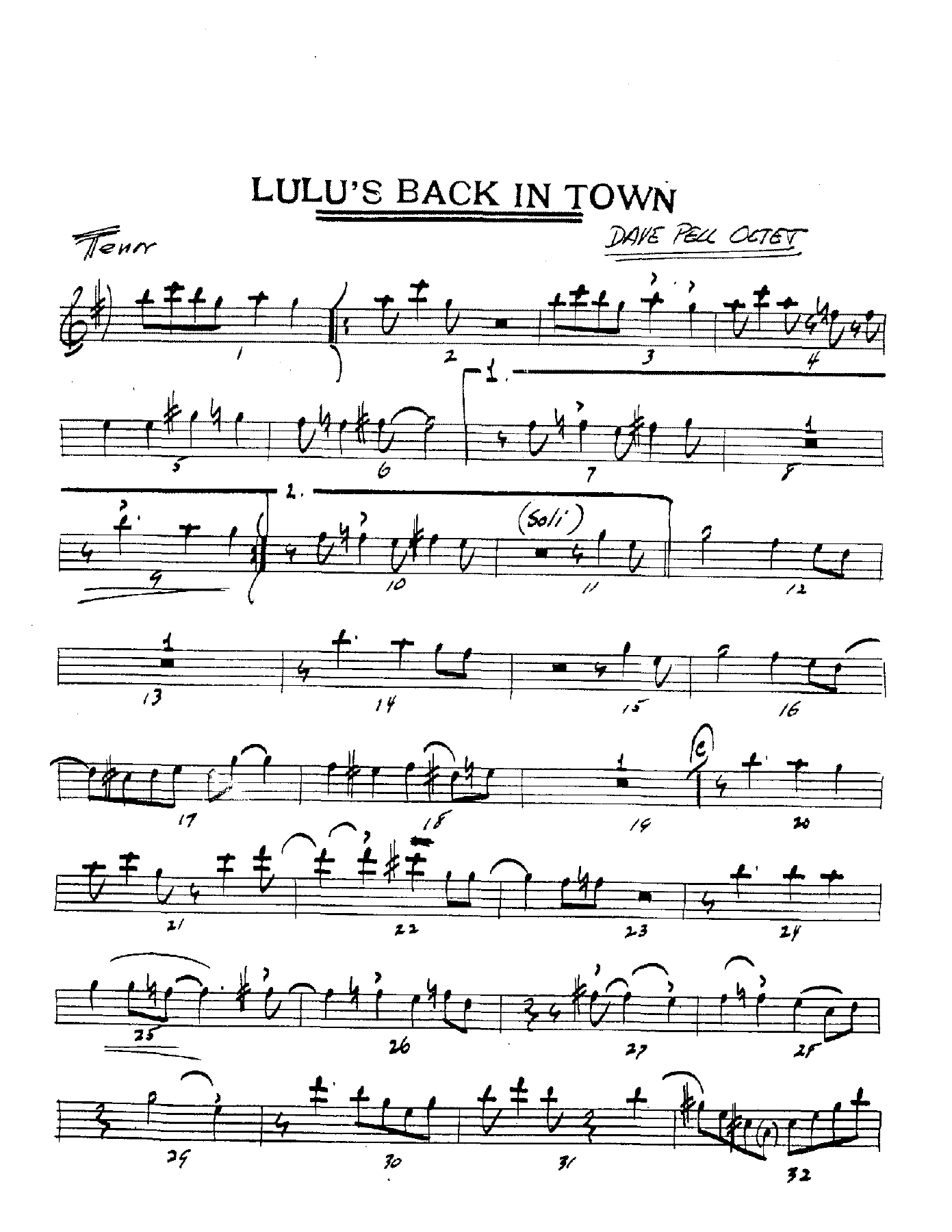
Lulu's Back In Town (M.Ts,Bs,Trp,Trb+Rhythm)
Composed by Harry Warren, Al Dubin
Arranged by Med Flory - Dave Pell Octet - Ts,Bs,Trp,Trb+Rhythm
- Ensemble: Small Ensemble
- Style: Jazz Standard
- Pages: 33
- Difficulty: easy
- Content: Sheet Music
- Format: PDF Download (Instant)
- Price: $12.99
"Lulu's Back In Town," originally penned by the prolific songwriting duo Harry Warren and Al Dubin in 1935, emerged from the golden age of Hollywood musicals, first appearing in the film "Broadway Gondolier." This effervescent tune quickly transcended its cinematic origins to become a cornerstone of the jazz repertoire, celebrated for its infectious melody and optimistic spirit. Its enduring popularity is a testament to its perfectly balanced blend of Tin Pan Alley craftsmanship and an inherent swing sensibility, making it a favorite for improvisation and arrangement across decades. The piece embodies the vibrant, pre-WWII big band era, capturing the buoyant energy and sophisticated charm characteristic of the period's dance halls and radio broadcasts. Its status as a jazz standard was cemented by countless recordings from luminaries such as Fats Waller, Benny Goodman, and later, Mel Tormé and the Dave Pell Octet, whose interpretation significantly influenced this particular arrangement. This arrangement of "Lulu's Back In Town" is an exhilarating up-tempo swing, typically performed around a brisk 200-220 beats per minute, radiating an undeniable sense of joy and playful sophistication. The primary key center is typically C major, allowing for bright brass and saxophone voicings, though the arrangement skillfully navigates through harmonic variations that keep both performers and listeners engaged. The overall mood is one of celebratory exuberance, evoking images of bustling city nights and carefree dancing. The energy is consistently high, driven by a propulsive rhythm section that lays a solid foundation for the intricate horn lines. Med Flory's masterful arrangement, inspired by the Dave Pell Octet's iconic sound, showcases a distinctive West Coast jazz aesthetic. Flory's genius lies in his ability to craft tightly integrated voicings for the specific instrumentation of tenor saxophone, baritone saxophone, trumpet, and trombone. Expect sophisticated counterpoint, harmonically rich soli sections that feature the saxophones and brass in close-knit harmony, and a dynamic interplay between the melodic lines. The arrangement frequently employs call-and-response patterns, with the brass often answering the saxophones, creating a vibrant conversational texture. While there may not be a traditional "shout chorus" in the big band sense, the ensemble passages build to thrilling climaxes through rhythmic intensity and harmonic density, characteristic of Flory's meticulous scoring. The melody is primarily carried by the full horn section in unison or octaves, creating a powerful and cohesive sound, with specific soli sections highlighting the saxophones or brass. Feature solo opportunities are typically provided for trumpet, tenor saxophone, and trombone, offering ample space for improvisation over the standard AABA form. Technical challenges include maintaining precise articulation at a fast tempo, executing tight ensemble figures with rhythmic accuracy, and navigating the harmonic intricacies of the solo changes. The reward lies in performing a classic jazz standard with a unique, polished sound that is both challenging and incredibly satisfying. This arrangement is ideally suited for college jazz ensembles, advanced community bands, and professional small groups looking to add a sophisticated, high-energy chart to their repertoire, demanding a strong command of swing feel and ensemble precision. Approaching this arrangement of "Lulu's Back In Town" requires a keen focus on rhythmic precision and articulation at its brisk tempo of approximately 200-220 bpm. The primary technical challenge lies in executing the tight ensemble figures and soli sections cleanly and with unified phrasing. Conductors should emphasize a light, driving swing feel, ensuring the rhythm section provides a buoyant foundation without becoming heavy. Encourage horn players to articulate short notes crisply and long notes with a sustained, singing quality, particularly in the melodic passages. Special attention should be paid to dynamic contrasts, using them to build excitement and shape phrases, rather than relying on a constant forte. Rehearsal tips include isolating challenging soli passages at a slower tempo, gradually increasing speed, and using a metronome to reinforce rhythmic accuracy across the ensemble. While no specific mutes or extended techniques like plunger mutes or doits are explicitly required, a bright, clear tone from all instruments is paramount to achieving the intended West Coast jazz sound. **Q: What instruments are included in this arrangement?** A: This arrangement is scored for a small ensemble featuring Tenor Saxophone, Baritone Saxophone, Trumpet, Trombone, and a standard Rhythm Section (Piano, Bass, Drums, Guitar). **Q: What is the difficulty level of this arrangement?** A: This arrangement is considered advanced, suitable for college-level jazz ensembles, advanced community bands, or professional small groups due to its fast tempo, intricate voicings, and demands for precise ensemble playing and improvisation. **Q: What is the musical style and historical context of "Lulu's Back In Town"?** A: "Lulu's Back In Town" is a classic jazz standard from 1935, embodying the up-tempo swing and sophisticated charm of the pre-WWII big band era, and is presented here in a West Coast jazz small ensemble style. **Q: What makes Med Flory's arrangement of "Lulu's Back In Town" unique?** A: Med Flory's arrangement, inspired by the Dave Pell Octet, is unique for its sophisticated West Coast jazz voicings, intricate counterpoint, and dynamic interplay between the saxophones and brass, creating a polished and energetic sound for a small ensemble. **Q: What is the typical performance duration or tempo for this piece?** A: This arrangement is an up-tempo swing, typically performed at a brisk 200-220 beats per minute, resulting in a performance duration of approximately 3-4 minutes, depending on the length of improvised solos.
Musicians Also Search For
Lulu's Back In Town Med Flory - Dave Pell Octet - Ts,Bs,Trp,Trb+Rhythm PDF • Lulu's Back In Town Med Flory - Dave Pell Octet - Ts,Bs,Trp,Trb+Rhythm sheet music • Lulu's Back In Town arranged by Med Flory - Dave Pell Octet - Ts,Bs,Trp,Trb+Rhythm • Med Flory - Dave Pell Octet - Ts,Bs,Trp,Trb+Rhythm small ensemble charts • Med Flory - Dave Pell Octet - Ts,Bs,Trp,Trb+Rhythm jazz arrangements PDF • Lulu's Back In Town Harry Warren, Al Dubin sheet music • Lulu's Back In Town Harry Warren, Al Dubin small ensemble arrangement • Harry Warren, Al Dubin small ensemble charts • Lulu's Back In Town small ensemble arrangement • Lulu's Back In Town small ensemble PDF download • Lulu's Back In Town jazz ensemble sheet music • small ensemble sheet music instant download • Lulu's Back In Town sheet music with parts • Lulu's Back In Town Jazz Standard chart • Jazz Standard small ensemble arrangements • buy Lulu's Back In Town sheet music online • download Lulu's Back In Town PDF • Lulu's Back In Town jazz chart • best Med Flory - Dave Pell Octet - Ts,Bs,Trp,Trb+Rhythm small ensemble arrangements • Harry Warren, Al Dubin songs arranged by Med Flory - Dave Pell Octet - Ts,Bs,Trp,Trb+Rhythm • Lulu's Back In Town printable sheet music • small ensemble repertoire PDF