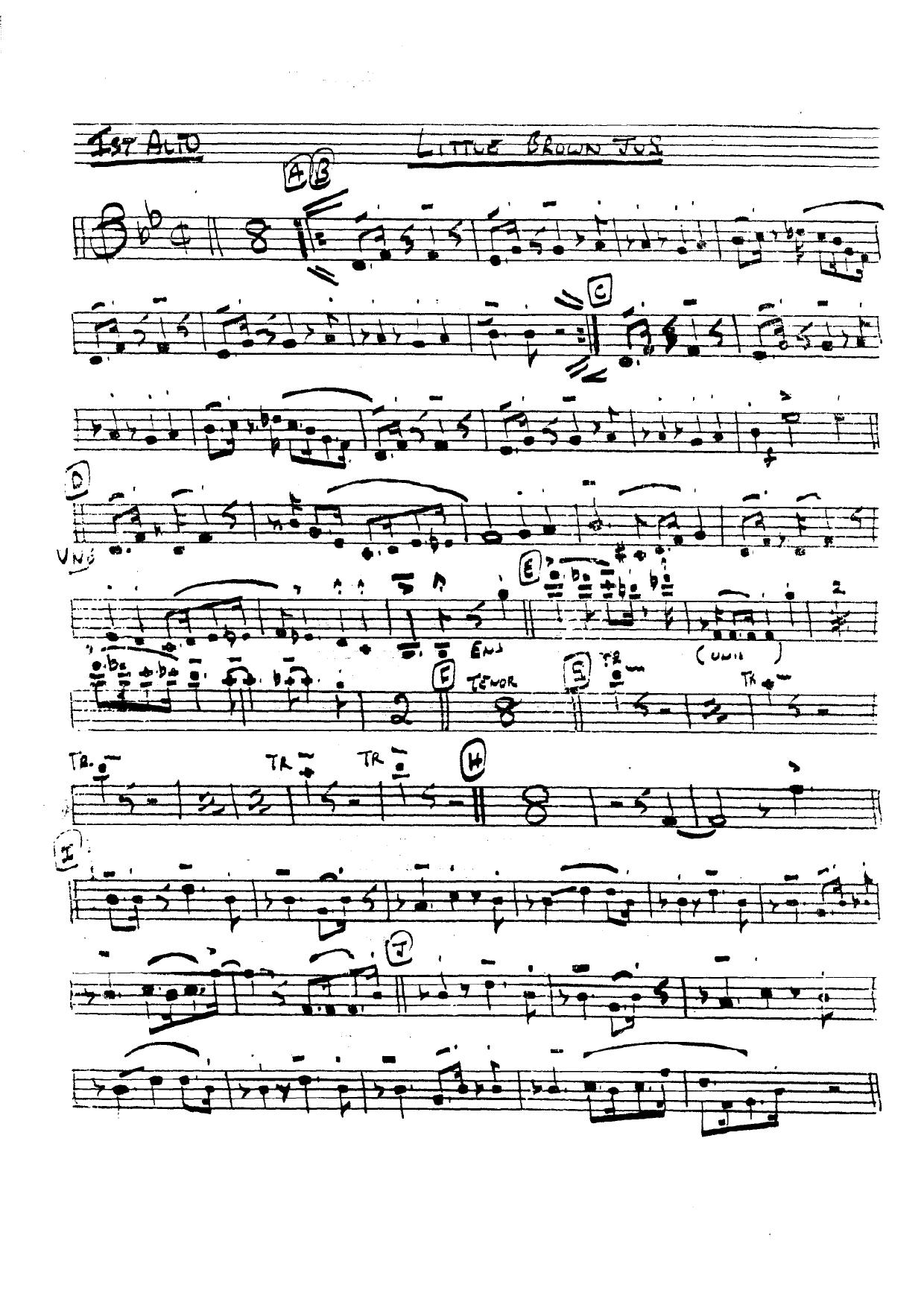
Little Brown Jug (J.Farley)
Composed by Joseph Winner
Arranged by John Farley
- Ensemble: Big Band
- Pages: 24
- Instruments (17): 1st Alto Saxophone, 2nd Alto Saxophone, 1st Tenor Saxophone, 2nd Tenor Saxophone, Baritone Saxophone, 1st Trumpet, 2nd Trumpet, 3rd Trumpet, 4th Trumpet, 1st Trombone, 2nd Trombone, 3rd Trombone, 4th Trombone, Guitar, Piano, Bass, Drums
- Difficulty: medium
- Content: Individual Parts
- Format: PDF Download (Instant)
- Price: $24.99
Joseph Winner’s 1869 American folk classic "Little Brown Jug" undergoes a brilliant stylistic metamorphosis in this dynamic big band jazz arrangement by John Farley. Originally popularized as a mid-19th-century drinking song and later immortalized in the swing era by Glenn Miller and his Orchestra in 1939, the tune transitioned seamlessly into the jazz lexicon through its infectious, bouncy melody and instantly recognizable hook. Farley’s adaptation taps directly into the vibrant energy of the late-1930s and early-1940s swing tradition, reimagining the traditional melody through the lens of sophisticated big band counterpoint, crisp sectional interplay, and driving rhythm-section momentum. Propelled by a bright, driving medium-swing groove in 4/4 time, the arrangement radiates an ebullient, foot-tapping mood that captures both the playful irreverence of the original folk tune and the polished sophistication of classic swing architecture. The chart opens with a catchy, rhythmically displaced intro in the piano and horns before establishing a robust groove in the core ensemble. Farley utilizes clever harmonic substitutions and secondary dominants to freshen the diatonic melody, injecting unexpected blues colorations into the bridge. Brass and woodwind voicings balance tight, block-chord shout sections with cascading counter-melodies, ensuring a rich, room-filling acoustic profile despite the streamlined 7-instrument instrumentation. The melodic narrative is shared dynamically across the frontline, with the Alto Saxophone and Trumpet frequently trading lead duties or weaving tight, interdependent counter-lines reminiscent of classic small-group swing arrangements scaled up for a punchy ensemble. A designated solo section over accessible blues-infused changes invites open improvisation from the Tenor Saxophone or Piano, backed by crisp, comping rhythms. Technical demands center primarily on clean articulation, accurate swing eighth-note subdivision, and dynamic contrast rather than extreme altissimo range or blinding velocity, making the charts deeply rewarding for players who relish stylistic authenticity and tight ensemble phrasing. Advanced high school, collegiate, and professional community jazz ensembles will find this arrangement an ideal centerpiece for standard concert programs, festival adjudication, or dance sets. Because it is expertly scored for a flexible 7-instrument lineup (including Alto Sax, Tenor Sax, Trumpet, Trombone, Piano, and rhythm section support), it provides the massive sound of a full traditional big band while remaining remarkably manageable for groups balancing instrumentation shortages. Farley’s meticulous attention to dynamic markings and articulation cues guarantees that conductors can easily shape an authentic, swinging performance straight from the 24-page score and parts. Achieving an authentic retro swing feel is paramount for the success of this arrangement; conductors should insist on a crisp, lifted articulation of all eighth-note pairs, avoiding heavy downbeats or overly legato phrasing. The recommended tempo is a lively medium swing around 144 BPM, allowing the groove to breathe without rushing. The primary technical challenge lies in the tight rhythmic unison passages between the saxophone and brass sections during the head and transitional interludes. Clean execution requires careful attention to short, clipped accents and controlled dynamic swells. Performers should utilize natural tongue-dampened staccatos rather than harsh stops. Trumpet and trombone players should incorporate subtle, stylistic falls and ghost notes where indicated to evoke the authentic big band atmosphere of the 1940s, though mutes are optional depending on the desired acoustic blend. Rehearsal should begin with the rhythm section establishing a locked, unyielding pulse before layering in the horn sections, ensuring the syncopated figures lock tightly with the bassline and ride cymbal. Q: What specific instruments and parts are included in this publication? A: The 24-page packet includes fully realized sheet music and individual parts scored for a 7-instrument configuration featuring Alto Saxophone, Tenor Saxophone, Trumpet, Trombone, Piano, and rhythm section support. Q: What is the overall difficulty level of this arrangement? A: This chart is graded at an intermediate-to-advanced level, making it well-suited for advanced high school, collegiate, and professional community jazz ensembles looking for rewarding stylistic challenges without extreme technical extremes. Q: What is the historical style and background of this piece? A: Based on Joseph Winner’s 1869 folk tune and filtered through the iconic 1930s big band swing style popularized by Glenn Miller, this arrangement bridges classic Americana with traditional mid-century jazz idiom. Q: What makes John Farley’s arrangement of "Little Brown Jug" unique? A: Farley cleverly adapts a standard 19-instrument big band aesthetic into an efficient 7-instrument scoring without sacrificing harmonic richness, utilizing smart voicings, blues-infused substitutions, and driving counterpoint. Q: What is the recommended performance tempo and duration? A: The arrangement is designed to be performed at a bright medium swing tempo around 144 BPM, resulting in a performance duration of approximately 3 to 4 minutes depending on solo extensions.
Questions and answers
- What is included in the Little Brown Jug (J.Farley) PDF?
- The verified current file contains individual parts across 24 pages.
- How many instruments or parts are listed for Little Brown Jug (J.Farley)?
- The verified instrumentation list contains 17 entries for this Big Band arrangement.
- Who is credited for Little Brown Jug (J.Farley)?
- Composer: Joseph Winner. Arranger: John Farley.
- What difficulty is listed for Little Brown Jug (J.Farley)?
- The verified difficulty level is medium.
- Can I preview Little Brown Jug (J.Farley) before buying?
- Yes. The product page provides a preview generated from the current PDF file.
- How is Little Brown Jug (J.Farley) delivered?
- After successful payment, the digital PDF is made available for download. The displayed price is $24.99.
Musicians Also Search For
Little Brown Jug John Farley PDF • Little Brown Jug John Farley sheet music • Little Brown Jug arranged by John Farley • John Farley big band charts • John Farley jazz arrangements PDF • Little Brown Jug Joseph Winner sheet music • Little Brown Jug Joseph Winner big band arrangements • Joseph Winner big band charts • Little Brown Jug big band arrangements • Little Brown Jug big band PDF download • Little Brown Jug jazz sheet music • big band sheet music download • Little Brown Jug individual parts download • Little Brown Jug sheet music PDF • buy Little Brown Jug sheet music • download Little Brown Jug PDF • Little Brown Jug jazz charts • best John Farley big band arrangements • Joseph Winner arranged by John Farley • Little Brown Jug printable sheet music • big band repertoire PDF