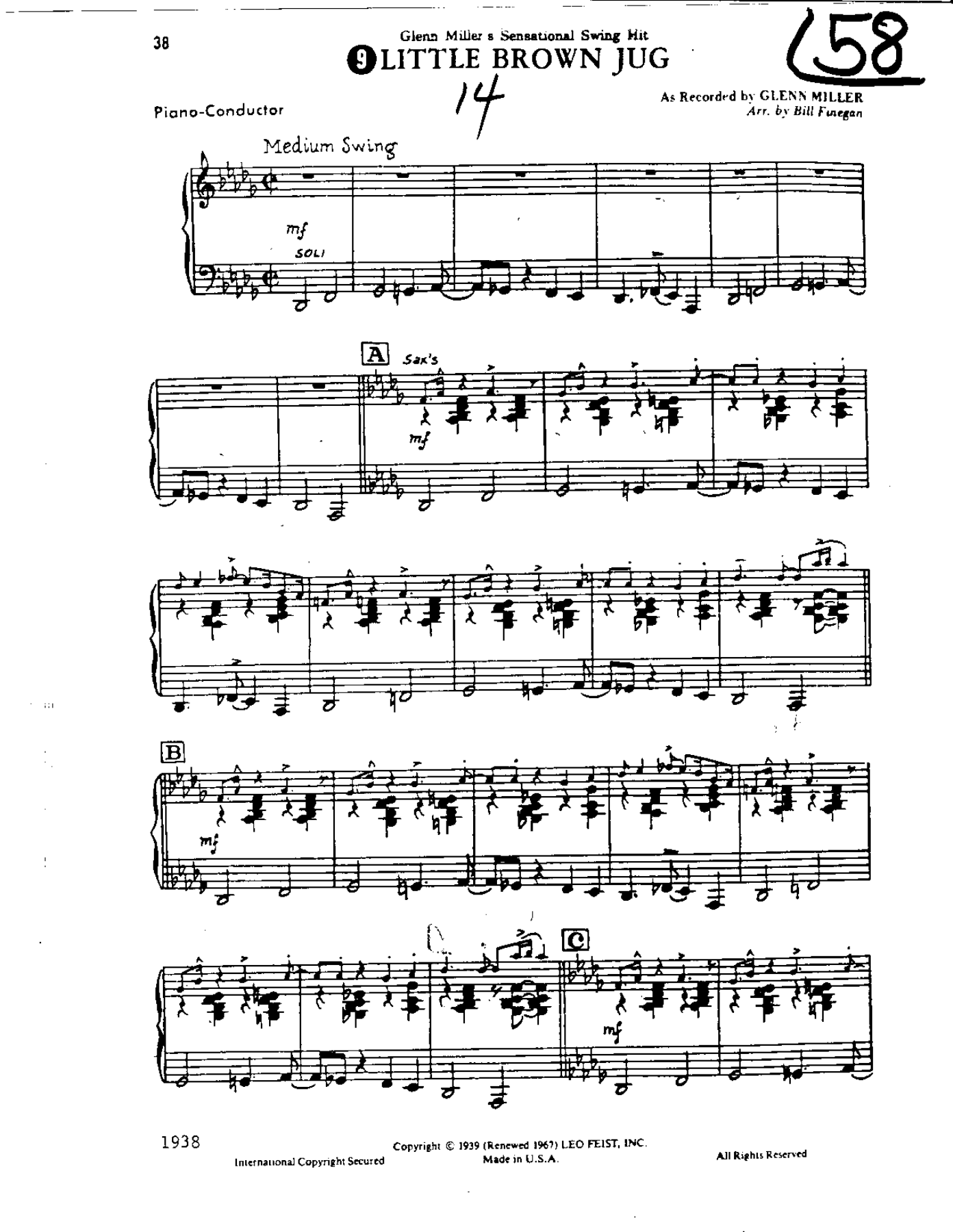
Little Brown Jug (B.Finegan)
Composed by Joseph Winner
Arranged by Bill Finegan
- Ensemble: Small Ensemble
- Style: Jazz Standard
- Pages: 13
- Instruments (8): Clarinet, Tenor Saxophone, Trumpet, Trombone, Piano, Bass, Banjo, Drums
- Difficulty: easy
- Content: Individual Parts
- Format: PDF Download (Instant)
- Price: $12.99
Joseph Winner's "Little Brown Jug," originally a popular 19th-century folk song, found new life and enduring fame within the jazz idiom, becoming a quintessential jazz standard. While its initial popularity stemmed from minstrel shows and vaudeville, it was Glenn Miller's iconic 1939 recording that cemented its place in the jazz canon, transforming the simple melody into a swing era staple. This arrangement, penned by the legendary Bill Finegan, who was a key architect of the Miller sound, offers a vibrant and sophisticated interpretation that honors its swing roots while infusing it with Finegan's distinctive harmonic and orchestrational genius. It represents the pinnacle of big band arranging from the late swing and early post-swing era, showcasing how a familiar tune can be elevated through inventive scoring. Finegan's treatment of "Little Brown Jug" is characterized by a medium swing tempo, typically around 120-140 BPM, maintaining a bright and buoyant energy throughout. The arrangement is primarily in a major key, evoking a cheerful and optimistic mood, yet Finegan masterfully employs chromaticism and extended harmonies to add depth and sophistication beyond the original folk tune's simplicity. Expect lush, close-voiced saxophone soli sections that glide effortlessly, contrasting with punchy brass figures. The overall sound is one of polished exuberance, designed to get feet tapping and spirits soaring, a hallmark of the era's most beloved dance music. What truly distinguishes Bill Finegan's approach in this small ensemble setting is his unparalleled command of voicings and counterpoint, even within a reduced instrumentation. He doesn't merely transpose his big band ideas; he re-imagines them for a more intimate group, ensuring each voice contributes meaningfully. Expect intricate melodic lines passed between instruments, surprising harmonic substitutions that add a modern edge, and dynamic contrasts that build excitement. Finegan's signature can be heard in the clever use of call-and-response figures, often between the brass and reeds, and in the way he builds tension and release through carefully constructed melodic and rhythmic motifs. This arrangement is a masterclass in how to create a full, rich sound with fewer players, demonstrating Finegan's ingenuity in maximizing the sonic potential of each instrument. The melody of "Little Brown Jug" is shared effectively across the ensemble, often featuring the trumpet or alto saxophone on the initial statements, followed by intricate soli passages. While specific solo sections are typically notated, Finegan's arrangements often provide ample space for improvisation, allowing featured soloists to shine over his rich harmonic backdrop. Technical challenges include precise articulation in the fast-moving soli sections, maintaining a consistent swing feel, and navigating Finegan's often dense harmonic language. The reward lies in performing a piece that is both historically significant and musically engaging, offering a satisfying blend of ensemble precision and individual expression. This arrangement is ideally suited for college-level jazz ensembles, advanced community bands, or professional small groups seeking a challenging yet highly rewarding piece that showcases both historical context and sophisticated arranging. Conductors should emphasize a consistent, relaxed medium swing feel, avoiding any rushed or stiff interpretations. Aim for a tempo between 120-140 BPM to allow Finegan's intricate voicings to breathe while maintaining the danceable energy. Key technical challenges include the precise articulation required in the saxophone and brass soli sections; encourage musicians to listen across sections for unified phrasing and attack. The brass players, particularly trumpets, will need strong breath support and clear tone for the sustained melodic lines and punchy accents. While specific mute indications might be sparse, encourage brass players to experiment with cup or harmon mutes for textural variety in certain passages, especially during background figures. Rehearsal time should be dedicated to balancing the inner voices within the soli sections to ensure harmonic clarity and to perfecting the dynamic contrasts that are crucial to Finegan's sophisticated sound. Q: What instruments are included in this "Little Brown Jug (B.Finegan)" arrangement? A: This arrangement is for a small jazz ensemble, typically including a standard rhythm section (piano, bass, drums) and a flexible horn section, often consisting of two or three saxophones (e.g., alto, tenor, baritone) and two or three brass instruments (e.g., trumpet, trombone). Q: What is the difficulty level of this arrangement? A: This arrangement is considered advanced intermediate to advanced, suitable for college-level jazz ensembles, accomplished community bands, or professional small groups due to its intricate voicings, harmonic complexity, and demands for precise articulation and ensemble blend. Q: What is the musical style and historical context of this arrangement? A: This is a classic jazz standard arranged in the swing style, specifically reflecting the sophisticated big band arranging techniques of the late 1930s and 1940s, as popularized by Bill Finegan's work with the Glenn Miller Orchestra. Q: What makes Bill Finegan's arrangement of "Little Brown Jug" unique? A: Finegan's arrangement is unique for its sophisticated harmonic language, intricate counterpoint, and masterful voicings that create a rich, full sound with a smaller ensemble, showcasing his signature approach to transforming a simple folk tune into a jazz masterpiece. Q: What is the typical performance duration or tempo for this piece? A: This arrangement is typically performed at a medium swing tempo, usually between 120-140 beats per minute, resulting in a performance duration of approximately 3 to 4 minutes depending on solo lengths and chosen repeats.
Questions and answers
- What is included in the Little Brown Jug (B.Finegan) PDF?
- The verified current file contains individual parts across 13 pages.
- How many instruments or parts are listed for Little Brown Jug (B.Finegan)?
- The verified instrumentation list contains 8 entries for this Small Ensemble arrangement.
- Who is credited for Little Brown Jug (B.Finegan)?
- Composer: Joseph Winner. Arranger: Bill Finegan.
- What difficulty is listed for Little Brown Jug (B.Finegan)?
- The verified difficulty level is easy.
- What style is listed for Little Brown Jug (B.Finegan)?
- The catalog lists the style as Jazz Standard.
- Can I preview Little Brown Jug (B.Finegan) before buying?
- Yes. The product page provides a preview generated from the current PDF file.
- How is Little Brown Jug (B.Finegan) delivered?
- After successful payment, the digital PDF is made available for download. The displayed price is $12.99.
Musicians Also Search For
Little Brown Jug Bill Finegan PDF • Little Brown Jug Bill Finegan sheet music • Little Brown Jug arranged by Bill Finegan • Bill Finegan small ensemble charts • Bill Finegan jazz arrangements PDF • Little Brown Jug Joseph Winner sheet music • Little Brown Jug Joseph Winner small ensemble arrangements • Joseph Winner small ensemble charts • Little Brown Jug small ensemble arrangements • Little Brown Jug small ensemble PDF download • Little Brown Jug jazz sheet music • small ensemble sheet music download • Little Brown Jug individual parts download • Little Brown Jug sheet music PDF • Little Brown Jug Jazz Standard charts • Jazz Standard small ensemble arrangements • buy Little Brown Jug sheet music • download Little Brown Jug PDF • Little Brown Jug jazz charts • best Bill Finegan small ensemble arrangements • Joseph Winner arranged by Bill Finegan • Little Brown Jug printable sheet music • small ensemble repertoire PDF