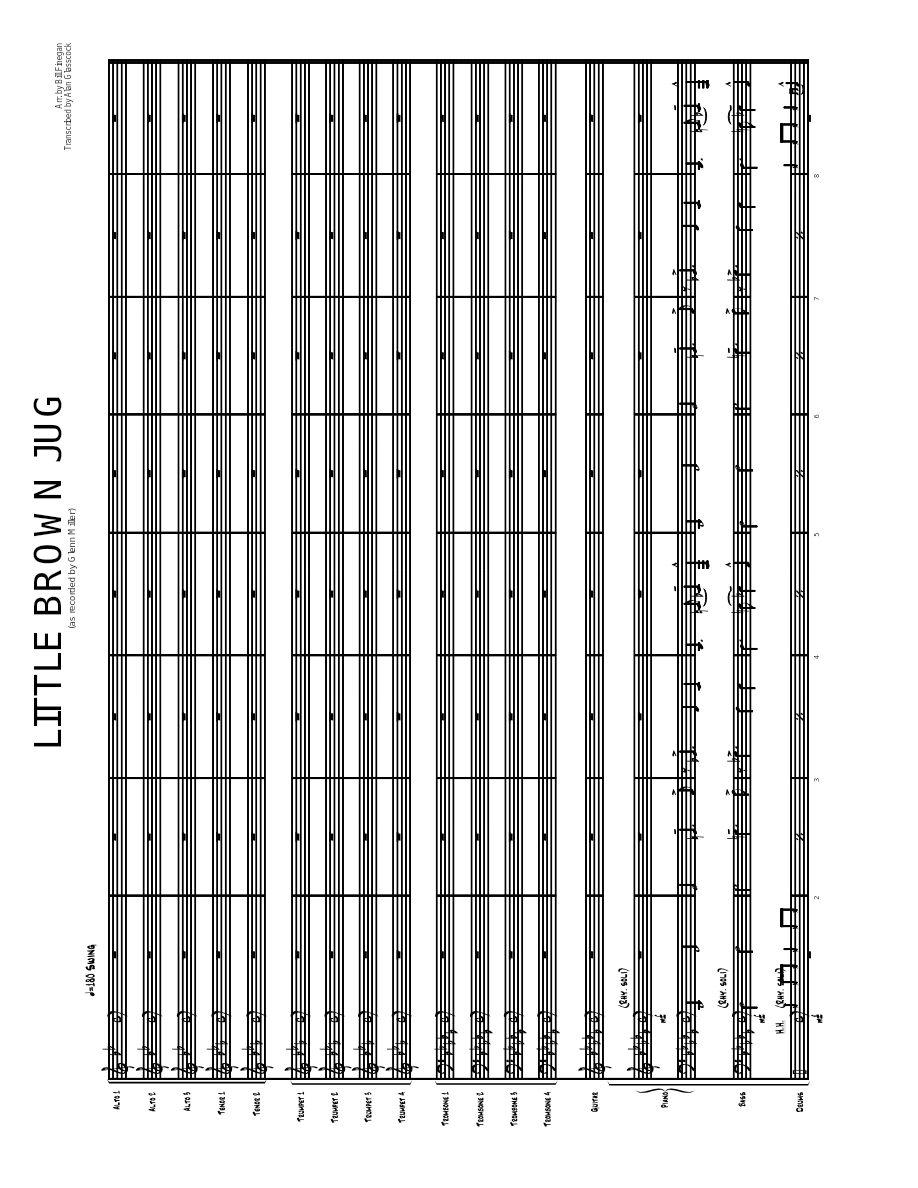
Little Brown Jug (A.Glasscock)
Composed by Joseph Winner
Arranged by Alan Glasscock
- Ensemble: Big Band
- Style: Jazz Standard
- Pages: 73
- Instruments (18): Alto Saxophone 1, Alto Saxophone 2, Alto Saxophone 3, Tenor Saxophone 1, Tenor Saxophone 2, Baritone Saxophone, Trumpet 1, Trumpet 2, Trumpet 3, Trumpet 4, Trombone 1, Trombone 2, Trombone 3, Trombone 4, Guitar, Piano, Bass, Drum Set
- Difficulty: easy
- Content: Individual Parts
- Format: PDF Download (Instant)
- Price: $24.99
Joseph Winner's "Little Brown Jug," originally a popular American folk song from 1869, gained immense popularity in the early 20th century, becoming a staple of dance halls and eventually a beloved jazz standard. Its simple, memorable melody and inherent swing feel made it a natural fit for the big band era. Glenn Miller's iconic 1939 recording with his Orchestra cemented its status, transforming it into a quintessential swing anthem characterized by its driving rhythm and infectious energy. The piece embodies the joyful, danceable spirit of the swing era, often evoking a sense of nostalgic exuberance and lighthearted fun, making it a perennial favorite for audiences and musicians alike. Alan Glasscock's arrangement of "Little Brown Jug" reimagines this classic with a sophisticated yet accessible medium swing feel, setting it in the bright key of B-flat major. Glasscock, known for his ability to infuse traditional material with fresh, contemporary big band voicings, maintains the tune's inherent charm while elevating its musical complexity. The arrangement opens with a playful, unison melody statement in the trombones, quickly joined by the saxophones, establishing a full, rich ensemble sound. Glasscock masterfully employs tight, harmonically interesting soli sections for the saxophones and brass, showcasing the ensemble's precision and blend. His signature technique of layering textures and building dynamic intensity is evident throughout, particularly in the lead-up to the powerful shout chorus, which features robust brass figures punctuated by driving saxophone lines, culminating in an exhilarating climax. This arrangement is designed to be both rewarding and challenging, offering ample opportunities for soloists and the full ensemble to shine. The primary melody is initially carried by the trombones, then shared and developed across the saxophone and brass sections. There are featured solo opportunities for Tenor Saxophone 1 and Trumpet 2, with clearly marked chord changes provided for improvisation. Technical challenges include precise articulation in the fast soli passages, maintaining a consistent medium swing groove, and executing dynamic contrasts effectively. The piece demands excellent ensemble cohesion and a strong sense of rhythmic integrity, particularly in the intricate call-and-response sections between the brass and reeds. Performing this arrangement is a truly rewarding experience, allowing musicians to engage with a historical jazz standard while exploring modern big band arranging techniques. Glasscock's "Little Brown Jug" is ideally suited for advanced high school, college, community, and professional big bands. Its thoughtful blend of traditional swing elements with contemporary arranging makes it an excellent teaching tool for developing ensemble precision, improvisation skills, and stylistic authenticity. The arrangement's clear structure and engaging musical content ensure it will be a crowd-pleaser, providing a vibrant and energetic addition to any concert program or dance event. This arrangement of "Little Brown Jug" thrives on a consistent, buoyant medium swing feel at a tempo around quarter note = 160-176 BPM. Emphasize a light, articulated swing eighth-note feel, avoiding a heavy or plodding rhythm. Key technical challenges include the precise execution of saxophone and brass soli sections, which require clean articulation and tight ensemble blend. Conductors should focus on rhythmic accuracy and dynamic shaping, particularly in the build-up to the shout chorus, ensuring a powerful yet controlled climax. Pay close attention to the marked dynamics and articulations; subtle nuances in phrasing will greatly enhance the performance. There are no special techniques like plunger mutes or extended techniques required, allowing musicians to focus on core big band performance practices. Rehearsal tips include isolating soli passages at a slower tempo, practicing the call-and-response sections between brass and reeds for rhythmic precision, and encouraging soloists to engage with the harmonic structure provided. Q: What instruments and parts are included in this arrangement? A: This arrangement is scored for a standard 17-piece big band: Alto Saxophone 1, Alto Saxophone 2, Tenor Saxophone 1, Tenor Saxophone 2, Baritone Saxophone, Trumpet 1, Trumpet 2, Trumpet 3, Trumpet 4, Trombone 1, Trombone 2, Trombone 3, Trombone 4, Piano, Bass, Drums, and Guitar. Q: What is the difficulty level of this arrangement? A: This arrangement is rated as Medium-Advanced. It requires solid instrumental technique, strong ensemble playing, and improvisational skills from the featured soloists, making it suitable for advanced high school, college, community, and professional jazz ensembles. Q: What is the musical style and historical context of "Little Brown Jug (A.Glasscock)"? A: This is a medium swing big band arrangement of the classic American folk tune "Little Brown Jug," which gained widespread popularity as a jazz standard during the Swing Era, notably through Glenn Miller's iconic recording. Alan Glasscock's treatment honors this tradition while adding contemporary big band voicings. Q: What makes Alan Glasscock's arrangement of "Little Brown Jug" unique? A: Glasscock's arrangement stands out for its sophisticated yet accessible medium swing feel, tight ensemble soli sections, engaging melodic development across instruments, and a powerful shout chorus, all while maintaining the infectious energy of the original standard. It showcases his signature blend of traditional big band sounds with modern harmonic sensibility. Q: What is the typical performance duration and tempo for this piece? A: The typical performance duration for this arrangement is approximately 3-4 minutes, depending on the length of the improvised solos. It is designed to be performed at a medium swing tempo, ideally around quarter note = 160-176 BPM.
Musicians Also Search For
Little Brown Jug Alan Glasscock PDF • Little Brown Jug Alan Glasscock sheet music • Little Brown Jug arranged by Alan Glasscock • Alan Glasscock big band charts • Alan Glasscock jazz arrangements PDF • Little Brown Jug Joseph Winner sheet music • Little Brown Jug Joseph Winner big band arrangement • Joseph Winner big band charts • Little Brown Jug big band arrangement • Little Brown Jug big band PDF download • Little Brown Jug jazz ensemble sheet music • big band sheet music instant download • Little Brown Jug conductor score PDF • Little Brown Jug individual parts download • Little Brown Jug sheet music with parts • Little Brown Jug Jazz Standard chart • Jazz Standard big band arrangements • buy Little Brown Jug sheet music online • download Little Brown Jug PDF • Little Brown Jug jazz chart • best Alan Glasscock big band arrangements • Joseph Winner songs arranged by Alan Glasscock • Little Brown Jug printable sheet music • big band repertoire PDF