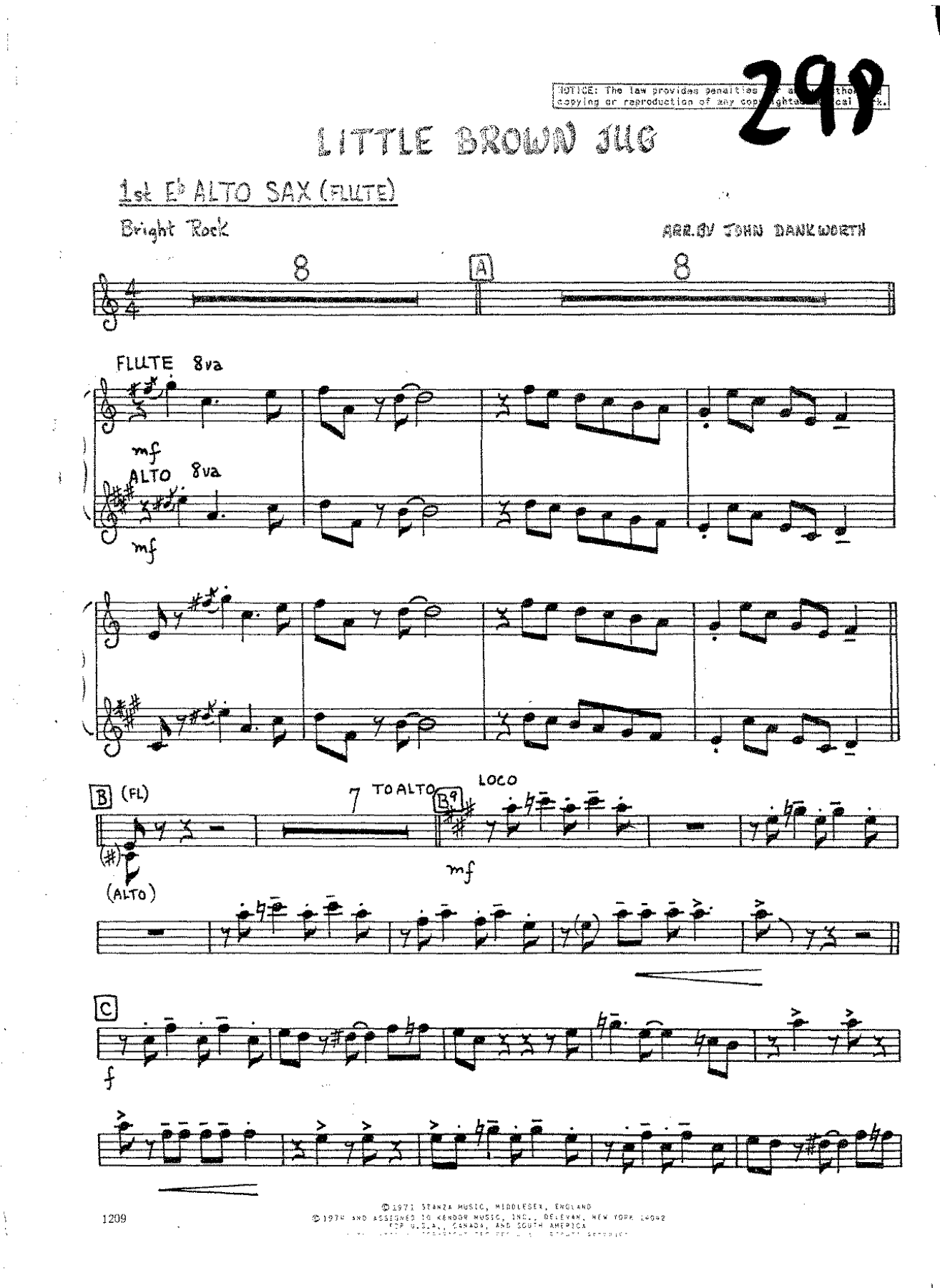
Little Brown Jug (J.Dankworth) sheet music preview

Little Brown Jug (J.Dankworth)

Composed by Joseph Winner

Arranged by J.Dankworth

  • Ensemble: Big Band
  • Style: Jazz Standard
  • Pages: 8
  • Instruments (17): Alto Saxophone 1, Alto Saxophone 2, Tenor Saxophone 1, Tenor Saxophone 2, Baritone Saxophone, Trumpet 1, Trumpet 2, Trumpet 3, Trumpet 4, Trombone 1, Trombone 2, Trombone 3, Bass Trombone, Guitar, Piano, Bass, Drums
  • Difficulty: easy
  • Content: Individual Parts
  • Format: PDF Download (Instant)
  • Price: $24.99

Joseph Winner's "Little Brown Jug," a timeless American folk tune composed in 1869, transcends its humble origins to become a beloved jazz standard, often associated with the swing era's dance halls and big band exuberance. While its initial popularity stemmed from minstrel shows and vaudeville, the tune's simple, memorable melody and robust harmonic structure made it ripe for jazz interpretation. Glenn Miller's iconic 1939 recording with his Orchestra cemented its place in the jazz lexicon, transforming it into a quintessential medium-swing staple. This arrangement, penned by the legendary British bandleader and composer J. Dankworth, pays homage to this rich history while infusing it with his characteristic wit and sophisticated harmonic palette. Dankworth's treatment elevates the familiar melody, presenting it with fresh voicings and dynamic contrasts that speak to both its traditional roots and its enduring jazz appeal. Dankworth's arrangement of "Little Brown Jug" is a vibrant, medium-swing chart, typically performed in the key of F major, radiating an infectious, celebratory mood. It maintains a consistent 4/4 time signature, encouraging a relaxed yet propulsive groove. The energy is bright and engaging, evoking the classic big band sound of the late 1930s and early 1940s, but with Dankworth's signature modern touches. The piece opens with a classic big band fanfare, immediately setting a lively tone before the melody is introduced. Dankworth masterfully uses dynamic layering and call-and-response figures between sections to build excitement, ensuring the arrangement never feels static. The overall character is one of joyful swing, designed to get feet tapping and spirits soaring. What distinguishes J. Dankworth's approach here is his ingenious blend of traditional big band voicings with unexpected harmonic twists. While the melody is primarily carried by the trumpet section in unison or octaves, often supported by the saxophones, Dankworth introduces intricate soli sections for the saxophones that showcase his advanced harmonic thinking, moving beyond simple block chords into more nuanced, often chromatic, progressions. The arrangement features several exciting shout choruses, where the full ensemble comes together in powerful, tightly voiced figures, punctuated by brass punches and saxophone swells. A notable feature is the inclusion of a written-out trombone soli, offering a fantastic opportunity for the section to shine with a harmonically rich and rhythmically engaging passage. There are ample opportunities for improvisation, typically featuring a tenor saxophone and/or trumpet solo over the standard chord changes, allowing soloists to stretch out within the familiar harmonic framework. Performing this arrangement is a truly rewarding experience for a big band. The primary technical challenges lie in maintaining clean articulation and precise rhythmic unity, particularly in the fast-moving soli sections and the powerful shout choruses. The brass sections will need strong endurance and accurate intonation for the sustained, high-energy passages, while the saxophones must navigate Dankworth's often complex inner voicings with clarity. This chart is ideally suited for college-level jazz ensembles, advanced high school bands, or community big bands with strong lead players and a solid rhythm section. Its blend of historical reverence, accessible swing feel, and sophisticated arranging makes it an excellent choice for concert programs, offering both familiar appeal and musical depth. This arrangement of "Little Brown Jug" thrives on a buoyant, medium-swing feel, typically around 130-140 BPM. Emphasize a light, driving rhythm section with a walking bass line and a crisp ride cymbal pattern. Articulation is key: brass should play short, detached notes with precision, while saxophones should aim for a smooth, connected legato in soli sections, contrasting with punchy accents elsewhere. Pay close attention to Dankworth's dynamic markings, which are crucial for shaping the piece's energy arc, particularly in the build-up to shout choruses. Rehearsal focus should be on the intricate saxophone soli passages to ensure harmonic clarity and rhythmic accuracy, and on balancing the brass sections during the powerful ensemble hits. Lead trumpet players should be comfortable in the upper register, as Dankworth often writes for a bright, commanding lead. Q: What instruments are included in this arrangement? A: This arrangement is scored for a standard 17-piece big band: Alto Saxophone 1, Alto Saxophone 2, Tenor Saxophone 1, Tenor Saxophone 2, Baritone Saxophone, Trumpet 1, Trumpet 2, Trumpet 3, Trumpet 4, Trombone 1, Trombone 2, Trombone 3, Trombone 4, Piano, Bass, Drums, and Guitar. It also includes a conductor score. Q: What is the difficulty level of J. Dankworth's "Little Brown Jug" arrangement? A: This arrangement is considered advanced intermediate to advanced. It requires strong section playing, precise articulation, and comfortable upper-register brass playing, making it suitable for college, advanced high school, or experienced community big bands. Q: What is the musical style and historical context of this arrangement? A: This is a medium-swing big band arrangement of "Little Brown Jug," a traditional American folk song popularized as a jazz standard by Glenn Miller. Dankworth's treatment blends classic swing era aesthetics with his signature sophisticated harmonies. Q: What makes J. Dankworth's arrangement of "Little Brown Jug" unique? A: Dankworth's arrangement stands out for its sophisticated harmonic voicings, particularly in the saxophone soli sections, and its dynamic use of shout choruses and a dedicated trombone soli, offering a fresh take on a familiar tune. Q: What is the typical performance tempo and duration for this piece? A: The typical performance tempo for this medium-swing chart is around 130-140 BPM. While exact duration can vary with solo lengths, it generally plays for approximately 3-4 minutes.

Musicians Also Search For

Little Brown Jug J.Dankworth PDFLittle Brown Jug J.Dankworth sheet musicLittle Brown Jug arranged by J.DankworthJ.Dankworth big band chartsJ.Dankworth jazz arrangements PDFLittle Brown Jug Joseph Winner sheet musicLittle Brown Jug Joseph Winner big band arrangementJoseph Winner big band chartsLittle Brown Jug big band arrangementLittle Brown Jug big band PDF downloadLittle Brown Jug jazz ensemble sheet musicbig band sheet music instant downloadLittle Brown Jug conductor score PDFLittle Brown Jug individual parts downloadLittle Brown Jug sheet music with partsLittle Brown Jug Jazz Standard chartJazz Standard big band arrangementsbuy Little Brown Jug sheet music onlinedownload Little Brown Jug PDFLittle Brown Jug jazz chartbest J.Dankworth big band arrangementsJoseph Winner songs arranged by J.DankworthLittle Brown Jug printable sheet musicbig band repertoire PDF

All arrangements by J.Dankworth All Joseph Winner sheet music