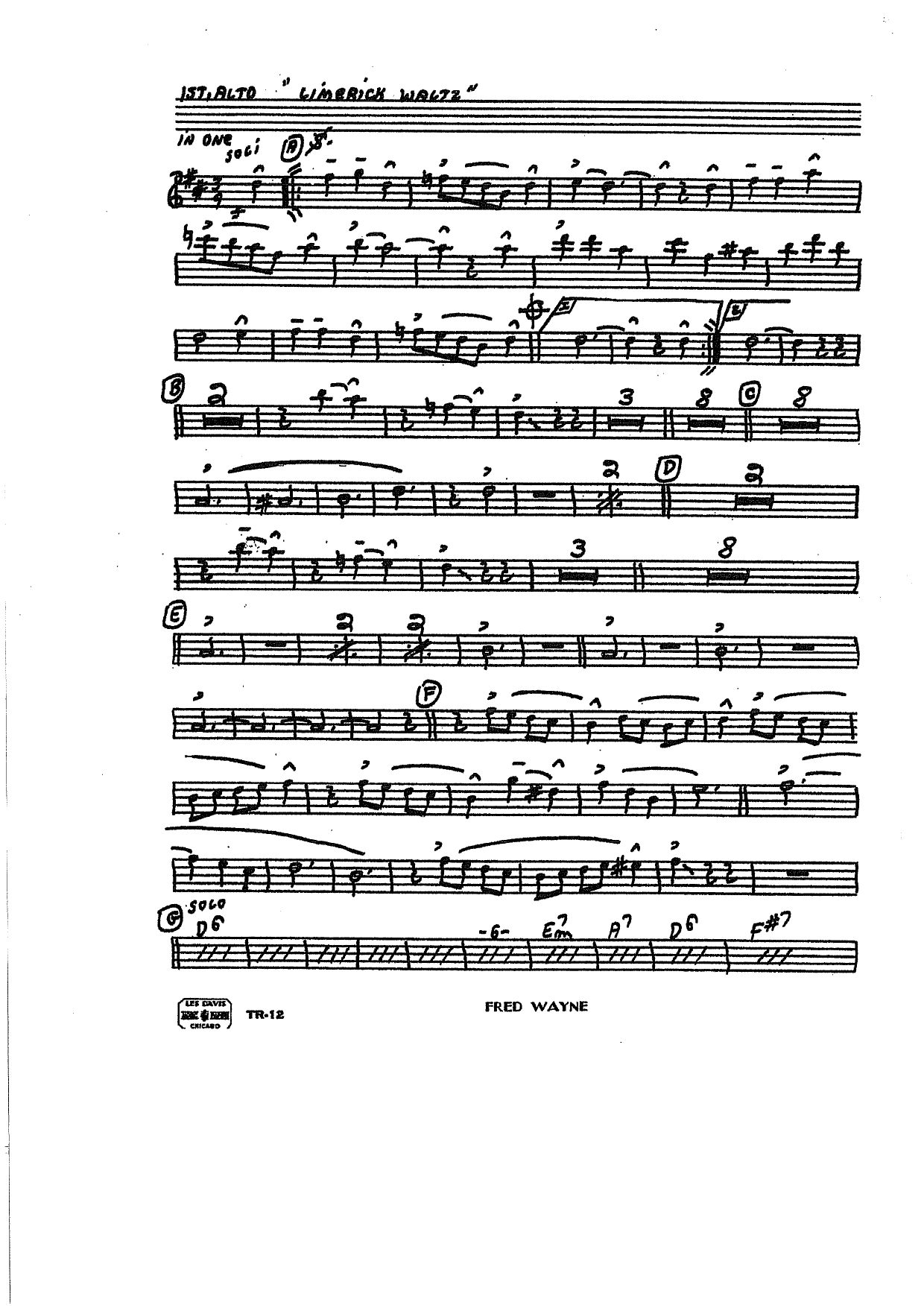
Limerick Waltz (B.Holman) sheet music preview

Limerick Waltz (B.Holman)

Composed by Terry Gibbs

Arranged by Terry Gibbs

  • Ensemble: Big Band
  • Pages: 37
  • Instruments (19): 1st Alto Saxophone, 2nd Alto Saxophone, 1st Tenor Saxophone, 2nd Tenor Saxophone, Baritone Saxophone, 1st Trumpet, 2nd Trumpet, 3rd Trumpet, 4th Trumpet, 5th Trumpet, 1st Trombone, 2nd Trombone, 3rd Trombone, 4th Trombone, Bass, Drums, Piano, Guitar, Vibes
  • Difficulty: medium
  • Content: Individual Parts
  • Format: PDF Download (Instant)
  • Price: $24.99

Vibraphone legend Terry Gibbs introduced "Limerick Waltz" as a charming, distinctive contribution to the mid-century modern big band repertoire, showcasing his knack for blending infectious swing energy with sophisticated harmonic palettes. Emerging from Gibbs’s celebrated work with his Dream Band and various recording projects in the late 1950s and 1960s, this composition captures the effervescent spirit of West Coast jazz while retaining the hard-driving punch of East Coast bop. Though often associated with Gibbs's high-octane mallet mastery, the work transcends standard instrumental showcase tunes by offering a robust compositional framework that treats the entire ensemble as a dynamic, cohesive unit. It represents a fascinating intersection of jazz composition and European waltz time, breathing fresh life into triple-meter swing. Operating at a lithe, bouncing medium-waltz tempo, "Limerick Waltz" establishes an immediate sense of playful sophistication from its opening downbeat. The harmonic landscape shifts gracefully between rich major-minor colorations and buoyant modal excursions, evoking a mood that is simultaneously nostalgic and sharply contemporary. Rather than relying on heavy, brooding voicings, Gibbs utilizes crisp, transparent orchestration that allows the inner voices to chatter playfully beneath the primary thematic statements. The emotional trajectory moves from a lighthearted, conversational exposition to an exhilarating, full-ensemble release of tension, proving that a 3/4 jazz chart can swing with just as much authority as traditional 4/4 literature. Terry Gibbs’s arranging philosophy on this chart centers on textural variety and conversational interplay between the brass and reed sections. The arrangement cleverly disguises the potential monotony of the waltz feel by utilizing syncopated counter-rhythms, shifting metric accents across the bar line, and lush, West Coast-style chordal extensions. The saxophones—featuring a tight frontline of alto, tenor, and baritone—often handle intricate, linear soli passages that demand precise articulation and unified phrasing. Meanwhile, the brass section functions both as a rhythmic punctuator and a warm, billowing cushion of sound, avoiding the overly aggressive clichés of standard shout choruses in favor of a jubilant, harmonically rich climax. Advanced high school, collegiate, and professional jazz ensembles will find this chart to be an exceptionally rewarding addition to their libraries. The primary technical demands lie not in blinding speed, but in rhythmic precision, intonation within tight chordal clusters, and maintaining an authentic, unhurried swing feel in three. Featured solo opportunities allow standout improvisers to stretch out over accessible yet stimulating changes, making it a guaranteed crowd-pleaser for festival performances, formal concerts, or recorded projects. Conductors approaching "Limerick Waltz" must prioritize the elusive triplet feel inherent in jazz waltz performance; avoid a stiff, classical 3/4 stiffness by instructing the rhythm section to lean into the downbeat while keeping the back-beats crisp and buoyant. The primary technical hurdle for the ensemble is navigating the syncopated figures that cross over the bar lines without rushing the tempo. Rehearsal should begin with the rhythm section establishing a locked-in groove, focusing particularly on the bass player's quarter-note pulse which anchors the triple-meter feel. Horn players must give careful attention to dynamic balance during the intricate sax soli sections, ensuring that the inner voices of the tenor and baritone parts project clearly beneath the alto lead. Articulations should generally be short and pointed on the unaccented notes, with smooth, vocal slurs applied to longer scalar runs. No special mutes are required for the brass, allowing for a pure, open-horn acoustic profile that enhances the bright, optimistic character of the arrangement. Q: What instrumentation and parts are included in this arrangement? A: This chart is scored for an 8-instrument ensemble comprising Alto Saxophone, Tenor Saxophone, Baritone Saxophone, Trumpet, Trombone, and a complete rhythm section framework. Q: What is the difficulty level of this Terry Gibbs arrangement? A: It is graded as advanced-intermediate to advanced, making it best suited for college ensembles, advanced high school bands, and professional groups with strong section reading skills. Q: What is the historical style and background of "Limerick Waltz"? A: Composed and arranged by vibraphone icon Terry Gibbs, the piece reflects the sophisticated, swinging West Coast jazz aesthetic of the late 1950s and 1960s, uniquely adapting the 3/4 waltz form to modern jazz idioms. Q: What makes this particular arrangement unique? A: Its distinctive blend of triple-meter time with driving swing articulation, combined with Gibbs's trademark transparent voicings and linear sax solis, sets it apart from standard 4/4 big band literature. Q: What is the recommended performance duration and tempo feel? A: The arrangement typically clocks in at around 3 to 4 minutes and is performed at a bright, bouncing medium-waltz tempo that prioritizes rhythmic grace and forward momentum.

Questions and answers

What is included in the Limerick Waltz (B.Holman) PDF?
The verified current file contains individual parts across 37 pages.
How many instruments or parts are listed for Limerick Waltz (B.Holman)?
The verified instrumentation list contains 19 entries for this Big Band arrangement.
Who is credited for Limerick Waltz (B.Holman)?
Composer: Terry Gibbs. Arranger: Terry Gibbs.
What difficulty is listed for Limerick Waltz (B.Holman)?
The verified difficulty level is medium.
Can I preview Limerick Waltz (B.Holman) before buying?
Yes. The product page provides a preview generated from the current PDF file.
How is Limerick Waltz (B.Holman) delivered?
After successful payment, the digital PDF is made available for download. The displayed price is $24.99.

Musicians Also Search For

Limerick Waltz Terry Gibbs PDFLimerick Waltz Terry Gibbs sheet musicLimerick Waltz arranged by Terry GibbsTerry Gibbs big band chartsTerry Gibbs jazz arrangements PDFLimerick Waltz Terry Gibbs big band arrangementsLimerick Waltz big band arrangementsLimerick Waltz big band PDF downloadLimerick Waltz jazz sheet musicbig band sheet music downloadLimerick Waltz individual parts downloadLimerick Waltz sheet music PDFbuy Limerick Waltz sheet musicdownload Limerick Waltz PDFLimerick Waltz jazz chartsbest Terry Gibbs big band arrangementsLimerick Waltz printable sheet musicbig band repertoire PDF

All arrangements by Terry Gibbs All Terry Gibbs sheet music