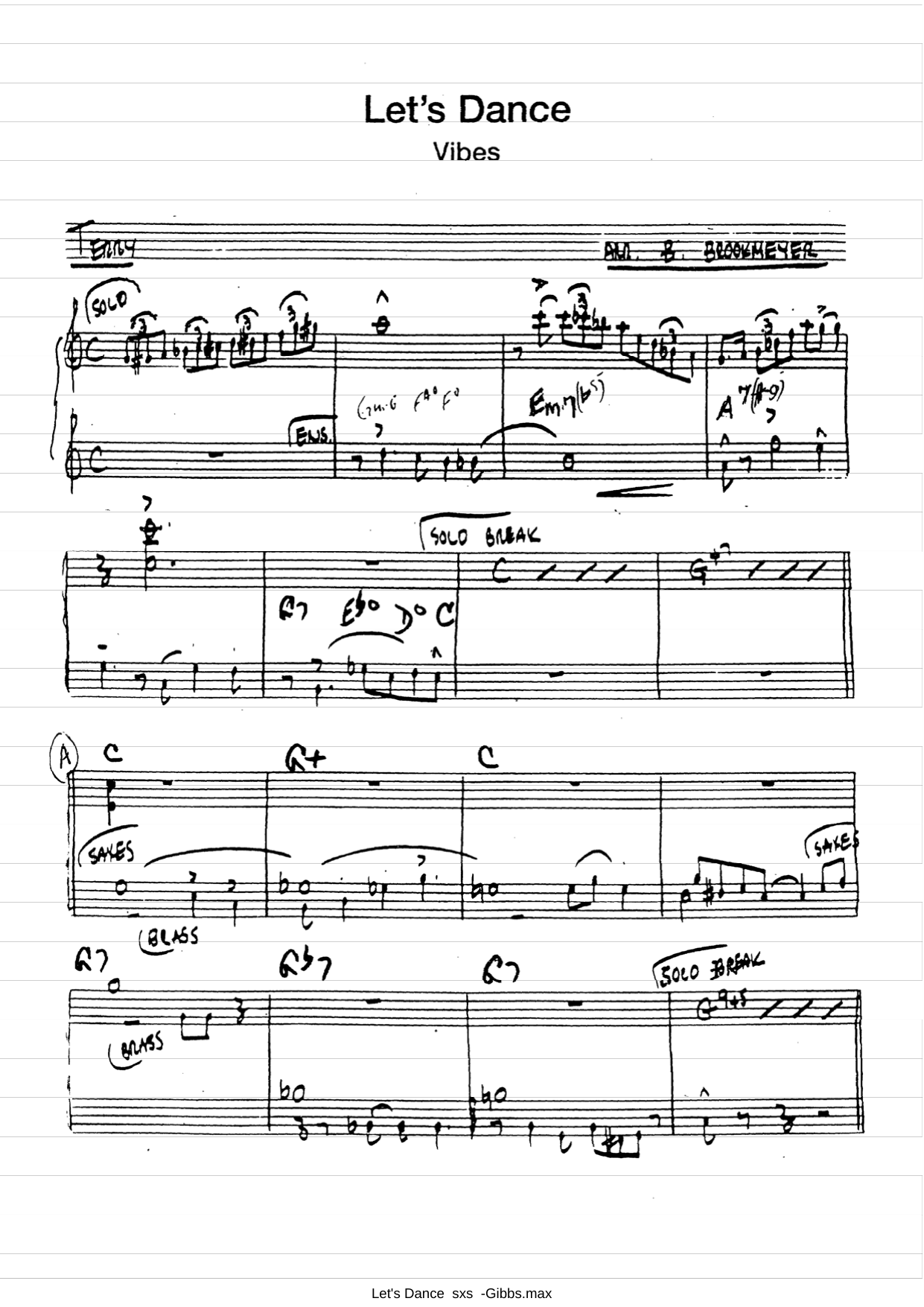
Let's Dance (B.Brookmeyer) sheet music preview

Let's Dance (B.Brookmeyer)

Composed by Terry Gibbs

Arranged by Terry Gibbs

  • Ensemble: Big Band
  • Pages: 73
  • Instruments (18): Vibes, 1st Alto Saxophone, 2nd Alto Saxophone, 1st Tenor Saxophone, 2nd Tenor Saxophone, Baritone Saxophone, 1st Trumpet, 2nd Trumpet, 3rd Trumpet, 4th Trumpet, 5th Trumpet, 1st Trombone, 2nd Trombone, 3rd Trombone, 4th Trombone, Piano, Bass, Drums
  • Difficulty: advanced
  • Content: Individual Parts
  • Format: PDF Download (Instant)
  • Price: $24.99

Vibraphonist and bandleader Terry Gibbs carved an indelible niche in mid-century modern jazz with his high-octane big bands, which brilliantly bridged the gap between infectious swing-era exuberance and the sophisticated harmonic language of bebop. "Let's Dance" captures this signature synthesis, showcasing Gibbs’s lifelong dedication to relentless energy, precision horn writing, and infectious groove. Emerging from an era when big bands were forced to adapt to the post-swing landscape, Gibbs’s writing channels the kinetic drive of Woody Herman’s Second Herd while retaining a distinct West Coast clarity and harmonic sophistication. The composition serves as a masterclass in driving momentum, celebrating the sheer physical joy of big band jazz at its most uninhibited. Driven by an explosive, high-velocity swing feel in 4/4 time, the arrangement explodes out of the gate with an urgent, bright tempo that demands immaculate time-keeping from the rhythm section. The mood is celebratory, breathless, and fiercely driving, evoking the electric atmosphere of a packed 1960s jazz club. Gibbs constructs the harmonic landscape using crisp, extended bebop voicings that push the brass into brilliant upper registers while maintaining a nimble, interwoven counterpoint across the saxophone section. The dynamic contour shifts dynamically from tightly coiled, rhythmic intensity during the head arrangements to wide-open, thunderous release valves during the ensemble climaxes. Gibbs’s arranging approach on this chart relies heavily on interlocking horn solis and razor-sharp ensemble punches that echo his virtuosic mallet phrasing. Rather than treating the wind sections as static harmonic blocks, the writing treats them as a unified, polyphonic organism where melodic fragments are tossed dynamically between the reeds and brass. The arrangement features prominent, high-energy solo spaces designed to test a soloist's ability to navigate rapid-fire changes without losing the blues-infused swing foundation. A blistering shout chorus serves as the structural apex of the chart, meticulously building tension through syncopated cross-rhythms before resolving into a roaring, full-ensemble unison finish that leaves both the audience and performers breathless. Tailored specifically for advanced collegiate, community, and professional big bands, this 73-page manuscript requires elite technical proficiency, particularly within the trumpet and saxophone sections. High endurance is mandatory, as the brass frequently operate in the upper clarion register, and the woodwinds must execute lightning-fast bebop line unisons with pristine articulation. Conceived for a 9-instrument configuration (featuring Alto Sax, Tenor Sax, Baritone Sax, Trumpet, Trombone, and a dynamic rhythm section framework), this chart provides an exhilarating vehicle for groups seeking to master the virtuosic intersection of swing-era vitality and modern jazz complexity. Unlocking the kinetic brilliance of this arrangement requires absolute rhythmic precision and exceptional physical endurance, particularly from the brass section. The tempo must remain relentlessly steady; avoid any tendency to drag during complex ensemble passages or rush during high-register shout choruses. Conductors should emphasize a bright, forward-moving swing eighth-note feel where the upbeats are articulated with crisp, biting accents rather than heavy downbeats. The saxophone section must practice their unisons separately at slower tempos to ensure flawless intonation and unified articulation before integrating with the brass. Pay close attention to dynamic contrast—the quiet, coiled-spring moments must crackle with tension to make the explosive ensemble tuttis fully impactful. Players should utilize clean, modern articulations with minimal excessive vibrato to preserve the bright, West Coast bebop aesthetic characteristic of Terry Gibbs’s writing style. Q: What specific instruments and parts are included in this 73-page arrangement? A: This arrangement is scored for a 9-instrument ensemble comprising Alto Saxophone, Tenor Saxophone, Baritone Saxophone, Trumpet, Trombone, and a fully integrated rhythm section including piano, bass, drums, and auxiliary percussion/vibraphone parts. Q: What is the difficulty level of this Terry Gibbs chart? A: This piece is graded as advanced, making it best suited for college ensembles, professional big bands, and high-level community jazz orchestras with strong sight-readers and high-endurance players. Q: What is the musical style and historical background of "Let's Dance"? A: The piece is an up-tempo modern jazz/bebop arrangement that reflects Terry Gibbs's signature approach of combining the high-energy drive of the late-swing era with advanced post-war harmonic sophistication. Q: What makes this specific arrangement unique compared to standard big band charts? A: It features Gibbs’s trademark interlocking horn solis, rapid-fire unison lines that mimic vibraphone mallet phrasing, and a meticulously structured shout chorus that builds intense syncopated cross-rhythms. Q: What is the recommended performance duration and tempo feel for this arrangement? A: The piece is performed at a fast, driving swing tempo (approximately quarter note = 220-240 BPM) with a total duration of roughly 3.5 to 4.5 minutes depending on the length of the open improvised solos.

Questions and answers

What is included in the Let's Dance (B.Brookmeyer) PDF?
The verified current file contains individual parts across 73 pages.
How many instruments or parts are listed for Let's Dance (B.Brookmeyer)?
The verified instrumentation list contains 18 entries for this Big Band arrangement.
Who is credited for Let's Dance (B.Brookmeyer)?
Composer: Terry Gibbs. Arranger: Terry Gibbs.
What difficulty is listed for Let's Dance (B.Brookmeyer)?
The verified difficulty level is advanced.
Can I preview Let's Dance (B.Brookmeyer) before buying?
Yes. The product page provides a preview generated from the current PDF file.
How is Let's Dance (B.Brookmeyer) delivered?
After successful payment, the digital PDF is made available for download. The displayed price is $24.99.

Musicians Also Search For

Let's Dance Terry Gibbs PDFLet's Dance Terry Gibbs sheet musicLet's Dance arranged by Terry GibbsTerry Gibbs big band chartsTerry Gibbs jazz arrangements PDFLet's Dance Terry Gibbs big band arrangementsLet's Dance big band arrangementsLet's Dance big band PDF downloadLet's Dance jazz sheet musicbig band sheet music downloadLet's Dance individual parts downloadLet's Dance sheet music PDFbuy Let's Dance sheet musicdownload Let's Dance PDFLet's Dance jazz chartsbest Terry Gibbs big band arrangementsLet's Dance printable sheet musicbig band repertoire PDF

All arrangements by Terry Gibbs All Terry Gibbs sheet music