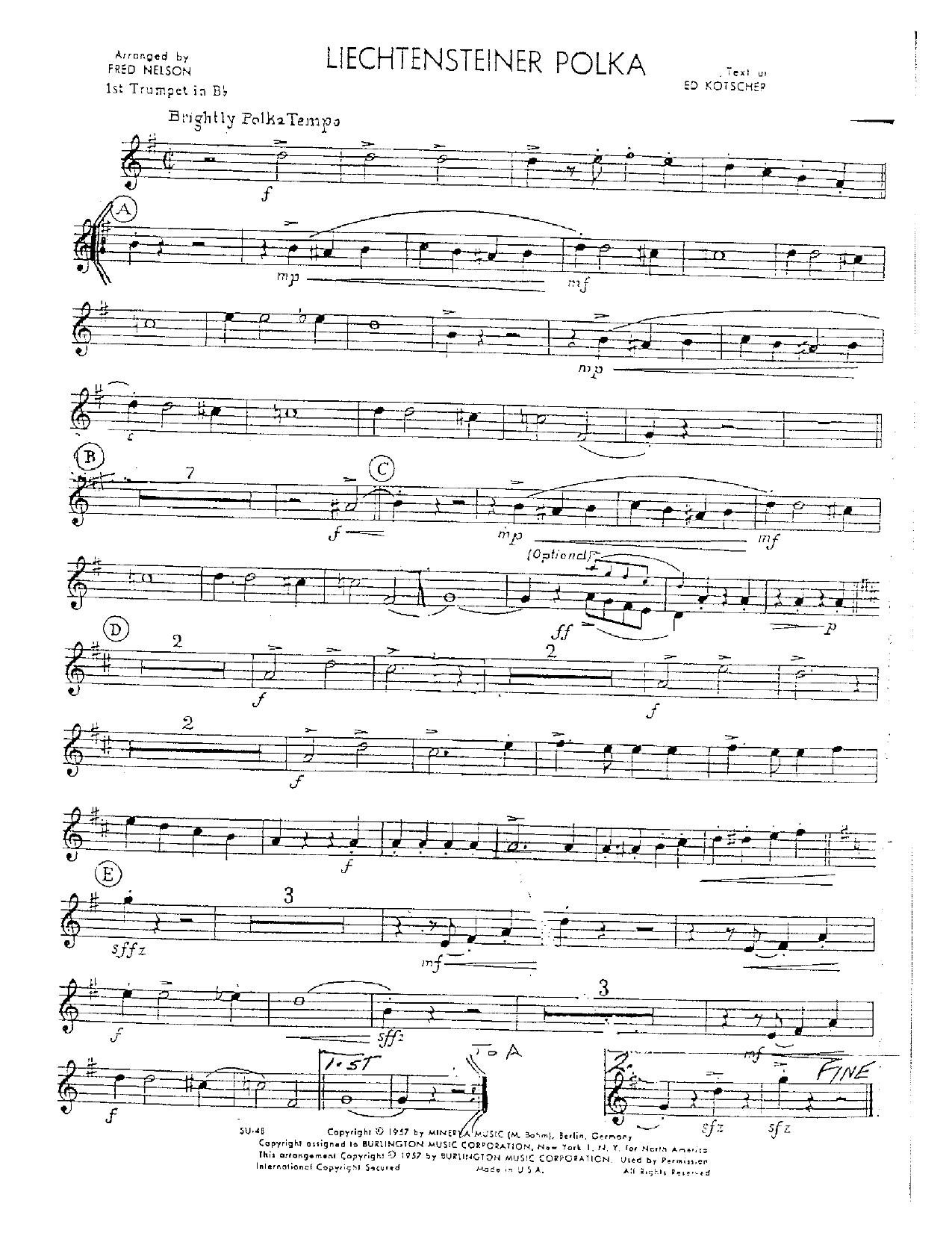
Liechtensteiner Polka (F.Nelson) sheet music preview

Liechtensteiner Polka (F.Nelson)

Composed by Ed Kotscher

Arranged by F.Nelson

  • Ensemble: Big Band
  • Style: Jazz Standard
  • Pages: 23
  • Instruments (17): 1st Trumpet in Bb, 2nd Trumpet in Bb, 3rd Trumpet in Bb, 4th Trumpet in Bb, 1st Trombone, 2nd Trombone, 3rd Trombone, 4th Trombone, Drums, Guitar, String Bass, Piano, 1st Sax. Eb Alto, 2nd Sax. Bb Tenor, 3rd Sax. Eb Alto, 4th Sax. Bb Tenor, 5th Sax. Eb Baritone
  • Difficulty: medium
  • Content: Individual Parts
  • Format: PDF Download (Instant)
  • Price: $24.99

Originally composed by Ed Kotscher with lyrics by Karl Lindra in 1957, the "Liechtensteiner Polka" quickly transcended its traditional European folk roots to become an international sensation, most notably popularized by Will Glahé and his orchestra. While rooted in the upbeat, celebratory tradition of Alpine folk music, this enduring melody has long captured the imagination of jazz and swing arrangers looking to bridge the gap between traditional European dance forms and American big band syncopation. The tune represents a fascinating mid-century crossover era where novelty continental tunes were frequently re-imagined through the lens of big band orchestration, utilizing crisp swing rhythms and infectious horn interplay to elevate a simple folk melody into a high-energy crowd-pleaser. Transforming the quintessential oompah-style polka into a swinging big band masterpiece, F.Nelson’s arrangement infuses the chart with a vibrant medium-up swing groove while retaining the joyous, bouncy character of the original composition. The harmonic language is expanded beyond simple triads into rich, extended major and dominant seventh voicings that give the brass section a lush, sophisticated edge. Bright trumpet fanfares and playful trombone countermelodies drive the primary theme, contrasting sharply with tightly-knit saxophone solis that swing effortlessly over a walking bassline foundation. The overall mood is buoyant, infectious, and relentlessly optimistic, designed to elicit immediate audience engagement through its sheer rhythmic vitality and sparkling ensemble textures. Throughout the chart, the melody is passed dynamically between the sections, giving every player a chance to shine while demanding precise articulation and tight ensemble phrasing. F.Nelson incorporates classic big band devices, including crisp stop-time figures that highlight the rhythm section's agility and a soaring shout chorus that builds steadily in both volume and harmonic tension before a triumphant final resolution. Solos are open for flexible features, allowing directors to showcase their strongest improvisers over accessible, swinging chord changes. The primary technical demands lie in maintaining a light, buoyant articulation at a brisk tempo; the passages require clean tongue-work and immaculate breath support, particularly in the upper register for the trumpet section. Advanced high school ensembles with strong section leaders, as well as collegiate and professional community big bands, will find this arrangement an ideal addition to their repertoire. It provides a masterclass in style contrast, forcing players to balance the staccato precision of traditional polka articulation with the relaxed, behind-the-beat feel essential to mainstream jazz interpretation. Whether used as a high-impact concert opener, a memorable encore, or a stylistic curveball in a festival set, this chart offers a refreshing blend of nostalgic charm and sophisticated big band writing that rewards careful rehearsal and exuberant performance. The key to unlocking F.Nelson’s arrangement of the "Liechtensteiner Polka" lies in balancing the infectious, bouncy energy of the original folk tune with an authentic jazz swing feel. Conductors should establish a brisk, steady medium-up tempo, ensuring the rhythm section maintains a driving, unhurried pulse that anchors the syncopated horn figures. The primary technical challenge rests in the articulation: the eighth notes must not be played overly legato, nor should they sound stiffly classical. Aim for a crisp, buoyant style where the upbeat is slightly accented to generate forward momentum. Saxophones should focus on seamless blend during the tightly voiced soli sections, while the brass must execute dynamic crescendos without forcing their tone quality, particularly during the climactic shout chorus. Players should utilize subtle falls and doits where indicated to accentuate the playful, jazz-inflected nature of the arrangement, keeping the overall texture bright and transparent. Rehearsals should initially focus on isolated section work to lock in the articulation before integrating the rhythm section's counterlines. Q: What specific instrumentation and parts are included in this big band arrangement? A: This 23-page arrangement is scored for a standard 17-instrument big band, comprising four trumpets (Trumpet 1 through 4), trombones (starting with Trombone 1), and a full complement of saxophones and rhythm section parts. Q: What is the designated difficulty level for this arrangement? A: This chart is graded as medium-advanced, making it exceptionally well-suited for proficient high school ensembles, college jazz bands, and advanced community big bands looking for strong stylistic contrast. Q: What is the historical and musical style of this piece? A: Based on Ed Kotscher’s 1957 international hit, this arrangement reimagines a traditional European polka through the vibrant, swinging aesthetic of mid-century American big band jazz. Q: What makes F.Nelson’s arrangement unique compared to other versions? A: F.Nelson expertly bridges folk tradition with modern jazz harmony by introducing extended chord voicings, clever stop-time figures, a swinging saxophone soli, and a powerful, high-energy shout chorus. Q: What is the recommended performance duration and tempo feel? A: The arrangement is designed to be performed at a brisk, celebratory medium-up swing tempo, typically resulting in a performance duration of approximately three to four minutes depending on solo sections.

Questions and answers

What is included in the Liechtensteiner Polka (F.Nelson) PDF?
The verified current file contains individual parts across 23 pages.
How many instruments or parts are listed for Liechtensteiner Polka (F.Nelson)?
The verified instrumentation list contains 17 entries for this Big Band arrangement.
Who is credited for Liechtensteiner Polka (F.Nelson)?
Composer: Ed Kotscher. Arranger: F.Nelson.
What difficulty is listed for Liechtensteiner Polka (F.Nelson)?
The verified difficulty level is medium.
What style is listed for Liechtensteiner Polka (F.Nelson)?
The catalog lists the style as Jazz Standard.
Can I preview Liechtensteiner Polka (F.Nelson) before buying?
Yes. The product page provides a preview generated from the current PDF file.
How is Liechtensteiner Polka (F.Nelson) delivered?
After successful payment, the digital PDF is made available for download. The displayed price is $24.99.

Musicians Also Search For

Liechtensteiner Polka F.Nelson PDFLiechtensteiner Polka F.Nelson sheet musicLiechtensteiner Polka arranged by F.NelsonF.Nelson big band chartsF.Nelson jazz arrangements PDFLiechtensteiner Polka Ed Kotscher sheet musicLiechtensteiner Polka Ed Kotscher big band arrangementsEd Kotscher big band chartsLiechtensteiner Polka big band arrangementsLiechtensteiner Polka big band PDF downloadLiechtensteiner Polka jazz sheet musicbig band sheet music downloadLiechtensteiner Polka individual parts downloadLiechtensteiner Polka sheet music PDFLiechtensteiner Polka Jazz Standard chartsJazz Standard big band arrangementsbuy Liechtensteiner Polka sheet musicdownload Liechtensteiner Polka PDFLiechtensteiner Polka jazz chartsbest F.Nelson big band arrangementsEd Kotscher arranged by F.NelsonLiechtensteiner Polka printable sheet musicbig band repertoire PDF

All arrangements by F.Nelson All Ed Kotscher sheet music