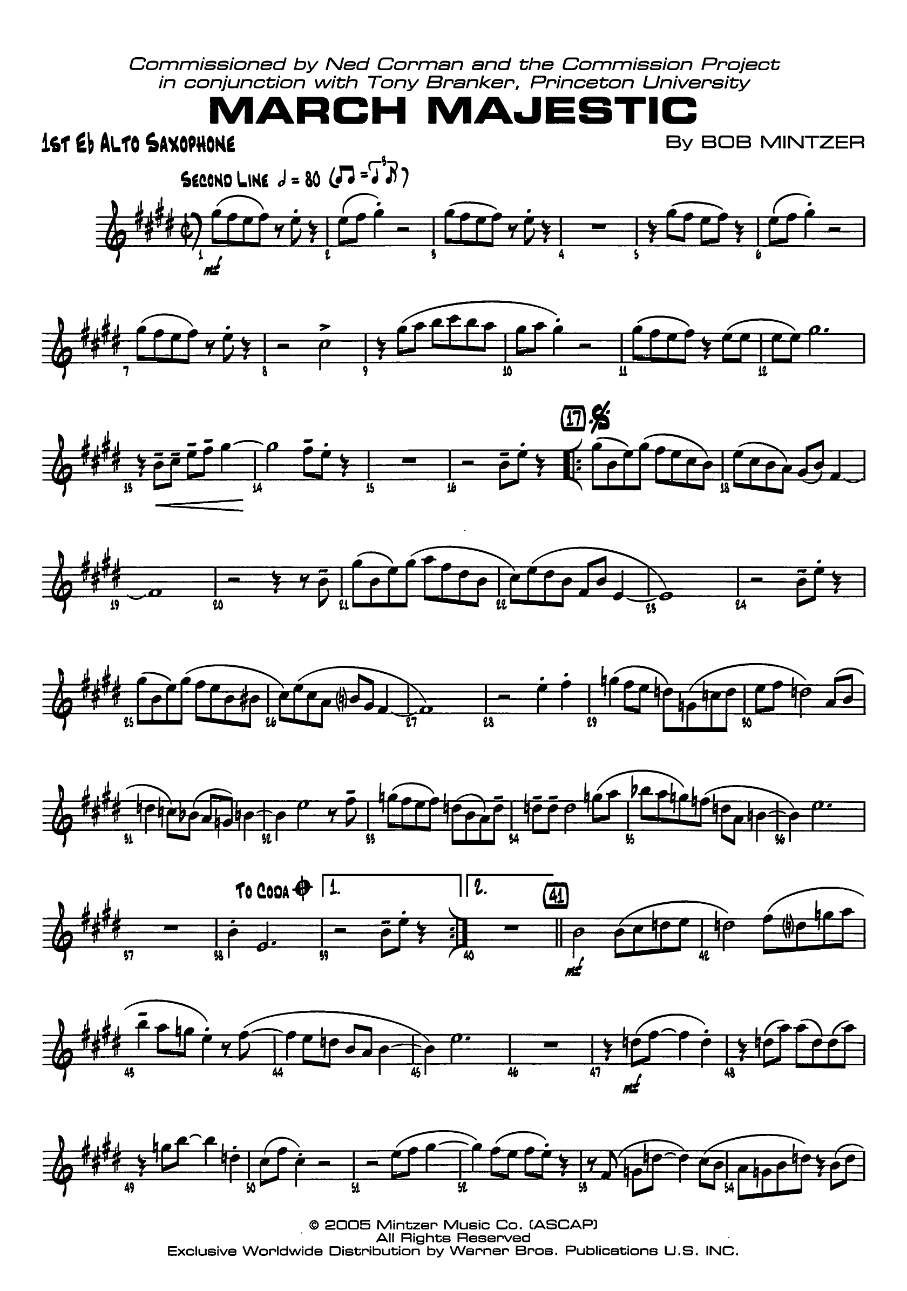
March Majestic (B.Mintzer)
Composed by Bob Mintzer
Arranged by B.Mintzer
- Ensemble: Big Band
- Style: Jazz Standard
- Pages: 34
- Instruments (16): 1st Eb Alto Saxophone, 2nd Eb Alto Saxophone, 1st Bb Tenor Saxophone, 2nd Bb Tenor Saxophone, Eb Baritone Saxophone, 1st Bb Trumpet, 2nd Bb Trumpet, 3rd Bb Trumpet, 1st Trombone, 2nd Trombone, 3rd Trombone, 4th Trombone, Guitar, Piano, Bass, Drums
- Difficulty: medium
- Content: Individual Parts
- Format: PDF Download (Instant)
- Price: $24.99
"March Majestic" is an original composition by the renowned saxophonist, composer, and arranger Bob Mintzer, first released on the Yellowjackets' 2003 album *Altered State*. It was subsequently featured on the Bob Mintzer Big Band's 2006 album *Old School: New Lessons*, solidifying its place in the contemporary big band repertoire. The piece is a quintessential example of modern jazz big band writing, showcasing Mintzer's distinctive blend of sophisticated harmony, rhythmic vitality, and accessible melodicism. While not a traditional "jazz standard" in the historical sense, its widespread performance by collegiate and professional ensembles, coupled with Mintzer's stature as a leading voice in jazz education and composition, has elevated it to a de facto standard within the contemporary big band idiom. This arrangement captures a vibrant, New Orleans-flavored swing feel, drawing influences from both traditional jazz and the orchestral textures of composers like Aaron Copland. The musical character is energetic and celebratory, driven by a "second-line" groove that provides a buoyant foundation. The piece is primarily in a major key, evoking a bright and optimistic mood, though Mintzer's harmonic language incorporates rich extended chords and subtle chromaticism, adding depth without sacrificing clarity. The overall energy is consistently high, punctuated by dynamic contrasts and intricate ensemble passages that demand precision and stylistic authenticity. Bob Mintzer's arranging approach in "March Majestic" is characterized by his masterful orchestration and rhythmic ingenuity. He expertly balances powerful brass fanfares with agile saxophone soli sections, often employing his signature dense voicings that create a full, resonant sound. The arrangement features prominent melodic statements shared between sections, creating a dynamic interplay. There are designated solo sections, with chord changes provided for Tenor Saxophone 1 and Trombone 1, offering improvisational opportunities over the driving rhythmic backdrop. Mintzer's arrangements are known for their meticulous attention to detail in articulation and dynamics, ensuring that the intended rhythmic feel and emotional impact are conveyed. The technical challenges include maintaining the precise second-line rhythmic integrity, executing rapid ensemble figures cleanly, and achieving blend and balance in the complex voicings. A particular moment that stands out is the contrasting section at measure 83, which calls for a lighter, more sustained character before returning to the main groove. This arrangement is ideally suited for college, university, and advanced community big bands, as well as professional ensembles. Its technical demands and sophisticated musicality require musicians with solid instrumental technique, strong sight-reading skills, and a firm grasp of contemporary jazz big band style. High school bands with exceptionally strong sections and an experienced director may also find it a rewarding challenge. The piece offers significant educational value in exploring modern big band orchestration, advanced rhythmic concepts, and the integration of traditional jazz influences into a contemporary setting. To effectively perform "March Majestic," the rhythm section must internalize the New Orleans "second-line" groove, which is foundational to the piece's character. This requires a nuanced understanding of rhythmic displacement and a strong, yet flexible, swing feel. Drummers should listen to authentic second-line examples to grasp the snare drum and bass drum patterns. All eighth-note lines in the wind sections should be played with a consistent swing feel. Key technical challenges include maintaining precise articulation and dynamics throughout the ensemble, particularly in the fast-moving soli sections and brass figures. Lead trumpet reaches a written E-flat above the staff, requiring a strong upper register player. Measure 83 presents a distinct shift in character, demanding a lighter, softer tone and a more sustained approach, creating a crucial dynamic and textural contrast before the return to the main groove. Rehearsal time should focus on rhythmic accuracy in the ensemble passages, balance within and between sections, and ensuring the soloists are comfortable improvising over the specific harmonic and rhythmic framework. Q: What instruments are included in this arrangement? A: This arrangement is scored for a standard 17-piece big band: Alto Saxophone 1 & 2, Tenor Saxophone 1 & 2, Baritone Saxophone, Trumpet 1-4, Trombone 1-4, Guitar, Piano, Bass, and Drums. Q: What is the difficulty level of "March Majestic (B.Mintzer)"? A: This arrangement is considered advanced, suitable for college, university, advanced community, and professional big bands due to its technical demands, complex voicings, and sophisticated rhythmic concepts. Q: What is the musical style and historical context of this piece? A: "March Majestic" is an original contemporary jazz big band composition by Bob Mintzer, featuring a New Orleans-flavored swing feel with "second-line" rhythmic influences. It was first recorded by the Yellowjackets in 2003 and later by the Bob Mintzer Big Band in 2006. Q: What makes this arrangement unique compared to other big band charts? A: This arrangement stands out for its fusion of traditional New Orleans second-line grooves with modern big band harmony and orchestration, Mintzer's signature dense voicings, and dynamic interplay between sections, providing a fresh take on the big band idiom. Q: What is the typical performance tempo and duration for "March Majestic"? A: While a precise tempo marking is not provided, the piece is described as having a vibrant, energetic swing feel with a "second-line" groove, suggesting a medium-up tempo. Live performances typically range from approximately 6 to 8 minutes.
Questions and answers
- What is included in the March Majestic (B.Mintzer) PDF?
- The verified current file contains individual parts across 34 pages.
- How many instruments or parts are listed for March Majestic (B.Mintzer)?
- The verified instrumentation list contains 16 entries for this Big Band arrangement.
- Who is credited for March Majestic (B.Mintzer)?
- Composer: Bob Mintzer. Arranger: B.Mintzer.
- What difficulty is listed for March Majestic (B.Mintzer)?
- The verified difficulty level is medium.
- What style is listed for March Majestic (B.Mintzer)?
- The catalog lists the style as Jazz Standard.
- Can I preview March Majestic (B.Mintzer) before buying?
- Yes. The product page provides a preview generated from the current PDF file.
- How is March Majestic (B.Mintzer) delivered?
- After successful payment, the digital PDF is made available for download. The displayed price is $24.99.
Musicians Also Search For
March Majestic B.Mintzer PDF • March Majestic B.Mintzer sheet music • March Majestic arranged by B.Mintzer • B.Mintzer big band charts • B.Mintzer jazz arrangements PDF • March Majestic Bob Mintzer sheet music • March Majestic Bob Mintzer big band arrangements • Bob Mintzer big band charts • March Majestic big band arrangements • March Majestic big band PDF download • March Majestic jazz sheet music • big band sheet music download • March Majestic individual parts download • March Majestic sheet music PDF • March Majestic Jazz Standard charts • Jazz Standard big band arrangements • buy March Majestic sheet music • download March Majestic PDF • March Majestic jazz charts • best B.Mintzer big band arrangements • Bob Mintzer arranged by B.Mintzer • March Majestic printable sheet music • big band repertoire PDF