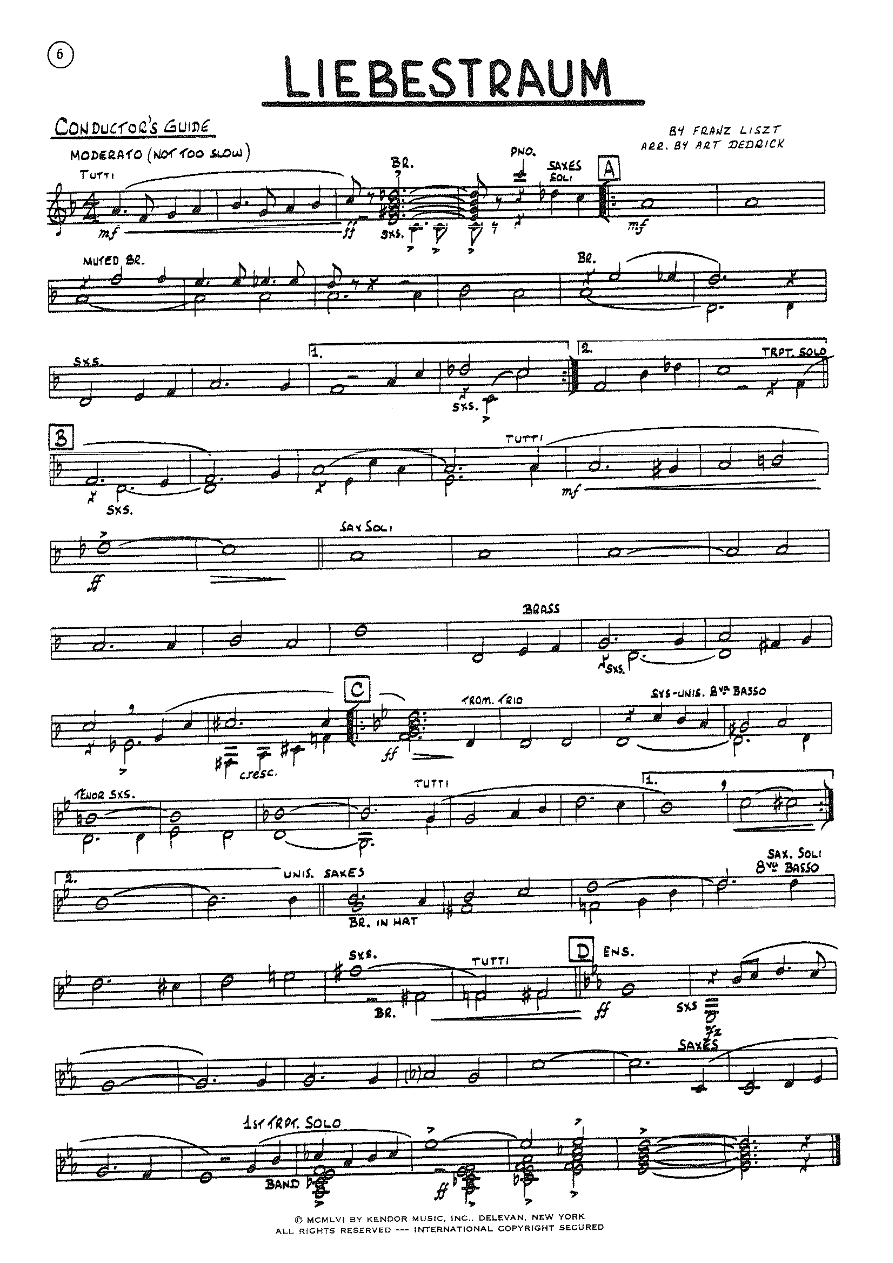
Liebestraum (A.Dedrick) sheet music preview

Liebestraum (A.Dedrick)

Composed by Franz Liszt

Arranged by Art Dedrick

  • Ensemble: Big Band
  • Style: Jazz Standard
  • Pages: 21
  • Instruments (20): Conductor's Guide, 1st Eb Alto Saxophone, 2nd Eb Alto Saxophone, 1st Bb Tenor Saxophone, 2nd Bb Tenor Saxophone, Eb Baritone Saxophone, 1st Bb Trumpet, 2nd Bb Trumpet, 3rd Bb Trumpet, 4th Bb Trumpet, 1st Trombone, 2nd Trombone, 3rd Trombone, 4th Trombone, Piano, Guitar, String Bass, Drums, Tuba, Bb Bass (Bes-Bas)
  • Difficulty: medium
  • Content: Individual Parts
  • Format: PDF Download (Instant)
  • Price: $24.99

Franz Liszt's "Liebesträume No. 3 in A-flat major," originally composed as a Romantic piano nocturne in the mid-19th century, stands as one of the most iconic and beloved classical melodies. Its lush harmonies, soaring melodic lines, and expressive emotional depth have captivated audiences for generations. While not originally a jazz standard, the inherent beauty and memorable nature of Liszt's theme have made it a fertile ground for interpretation across various genres, including jazz. Its enduring popularity stems from its universal appeal, evoking feelings of tender love and profound introspection, making it a powerful foundation for a big band treatment that bridges the classical and jazz worlds. Art Dedrick's masterful arrangement of "Liebestraum" reimagines this classical gem as a sophisticated, medium-tempo swing chart for the modern big band. Dedrick, known for his accessible yet musically rich arrangements, approaches this piece with a keen understanding of both the original's romantic essence and the rhythmic drive of a jazz ensemble. The arrangement maintains the original's key of A-flat major, preserving its inherent warmth, while infusing it with a relaxed, grooving 4/4 swing feel. The mood is one of elegant romance and understated energy, gradually building in intensity. Dedrick's signature lies in his ability to craft voicings that are full and resonant, giving the ensemble a rich, polished sound without excessive technical demands. The arrangement opens with a beautifully voiced saxophone section carrying the iconic melody, establishing the romantic atmosphere before the full band enters with a gently swinging accompaniment. Throughout the piece, Dedrick strategically employs soli sections, particularly for the brass, providing contrasting textures and showcasing the ensemble's blend. There are no extended improvised solos in this particular arrangement, keeping the focus on the ensemble's interpretation of the melody and Dedrick's harmonic re-imagining. The technical challenges are primarily centered around achieving a unified ensemble sound, precise articulation in the swing style, and navigating Dedrick's rich, often chromatic, harmonic progressions. The rewarding aspect lies in performing a familiar, beautiful melody with a fresh, swinging perspective, allowing the band to explore expressive phrasing within a jazz context. This arrangement is ideally suited for high school, college, and community jazz ensembles looking to expand their repertoire beyond traditional jazz standards. Its blend of classical melody and jazz swing provides an excellent educational opportunity for developing musicians to work on blend, balance, and expressive phrasing while maintaining a consistent swing feel. The absence of demanding improvised solos makes it particularly accessible for bands where soloists may still be developing, allowing the entire ensemble to shine in a cohesive, polished performance. "Liebestraum (A.Dedrick)" should be approached with a relaxed, medium swing feel, around 108-120 BPM. The primary technical challenge lies in achieving a unified, expressive ensemble sound, particularly in the saxophone melody sections. Encourage players to listen across sections for intonation and blend, especially in the sustained, harmonized passages. Articulation should be light and legato, characteristic of a smooth swing style, avoiding overly aggressive attacks. Pay close attention to dynamics; Dedrick utilizes a wide range to build and release tension, crucial for conveying the romantic mood. The brass soli sections require crisp, unified articulation and precise rhythmic placement. No special techniques like plunger mutes or falls are explicitly notated, allowing the focus to remain on clean execution and musical phrasing. Rehearse the harmonic shifts carefully, ensuring all voices contribute to the rich chordal textures without one section overpowering another. Q: What instruments are included in this arrangement? A: This big band arrangement is scored for 17 instruments: Alto Saxophone 1, Alto Saxophone 2, Tenor Saxophone 1, Tenor Saxophone 2, Baritone Saxophone, Trumpet 1, Trumpet 2, Trumpet 3, Trumpet 4, Trombone 1, Trombone 2, Trombone 3, Trombone 4, Piano, Bass, Drums, and Guitar. Q: What is the difficulty level of "Liebestraum (A.Dedrick)"? A: This arrangement is rated as a Medium-Easy to Medium difficulty, making it suitable for high school, college, and community jazz ensembles. It focuses on ensemble blend, phrasing, and swing feel rather than demanding technical solos. Q: What is the musical style and historical context of this arrangement? A: This is a jazz big band arrangement of Franz Liszt's classical piano nocturne "Liebesträume No. 3." Art Dedrick reinterprets the romantic 19th-century melody with a sophisticated, medium-tempo 4/4 swing feel, bridging classical elegance with jazz sensibility. Q: What makes Art Dedrick's arrangement of "Liebestraum" unique? A: Dedrick's arrangement is unique for its ability to transform a classical piano piece into a swinging big band chart while preserving the original's romantic essence. It features lush, accessible voicings, well-crafted soli sections, and a focus on ensemble performance rather than improvised solos. Q: What is the typical performance duration and tempo for this piece? A: The typical performance duration for "Liebestraum (A.Dedrick)" is approximately 3-4 minutes. It is designed to be played at a medium swing tempo, ideally between 108-120 beats per minute.

Questions and answers

What is included in the Liebestraum (A.Dedrick) PDF?
The verified current file contains a conductor score and individual parts across 21 pages.
How many instruments or parts are listed for Liebestraum (A.Dedrick)?
The verified instrumentation list contains 20 entries for this Big Band arrangement.
Who is credited for Liebestraum (A.Dedrick)?
Composer: Franz Liszt. Arranger: Art Dedrick.
What difficulty is listed for Liebestraum (A.Dedrick)?
The verified difficulty level is medium.
What style is listed for Liebestraum (A.Dedrick)?
The catalog lists the style as Jazz Standard.
Can I preview Liebestraum (A.Dedrick) before buying?
Yes. The product page provides a preview generated from the current PDF file.
How is Liebestraum (A.Dedrick) delivered?
After successful payment, the digital PDF is made available for download. The displayed price is $24.99.

Musicians Also Search For

Liebestraum Art Dedrick PDFLiebestraum Art Dedrick sheet musicLiebestraum arranged by Art DedrickArt Dedrick big band chartsArt Dedrick jazz arrangements PDFLiebestraum Franz Liszt sheet musicLiebestraum Franz Liszt big band arrangementsFranz Liszt big band chartsLiebestraum big band arrangementsLiebestraum big band PDF downloadLiebestraum jazz sheet musicbig band sheet music downloadLiebestraum conductor score PDFLiebestraum individual parts downloadLiebestraum sheet music PDFLiebestraum Jazz Standard chartsJazz Standard big band arrangementsbuy Liebestraum sheet musicdownload Liebestraum PDFLiebestraum jazz chartsbest Art Dedrick big band arrangementsFranz Liszt arranged by Art DedrickLiebestraum printable sheet musicbig band repertoire PDF

All arrangements by Art Dedrick All Franz Liszt sheet music