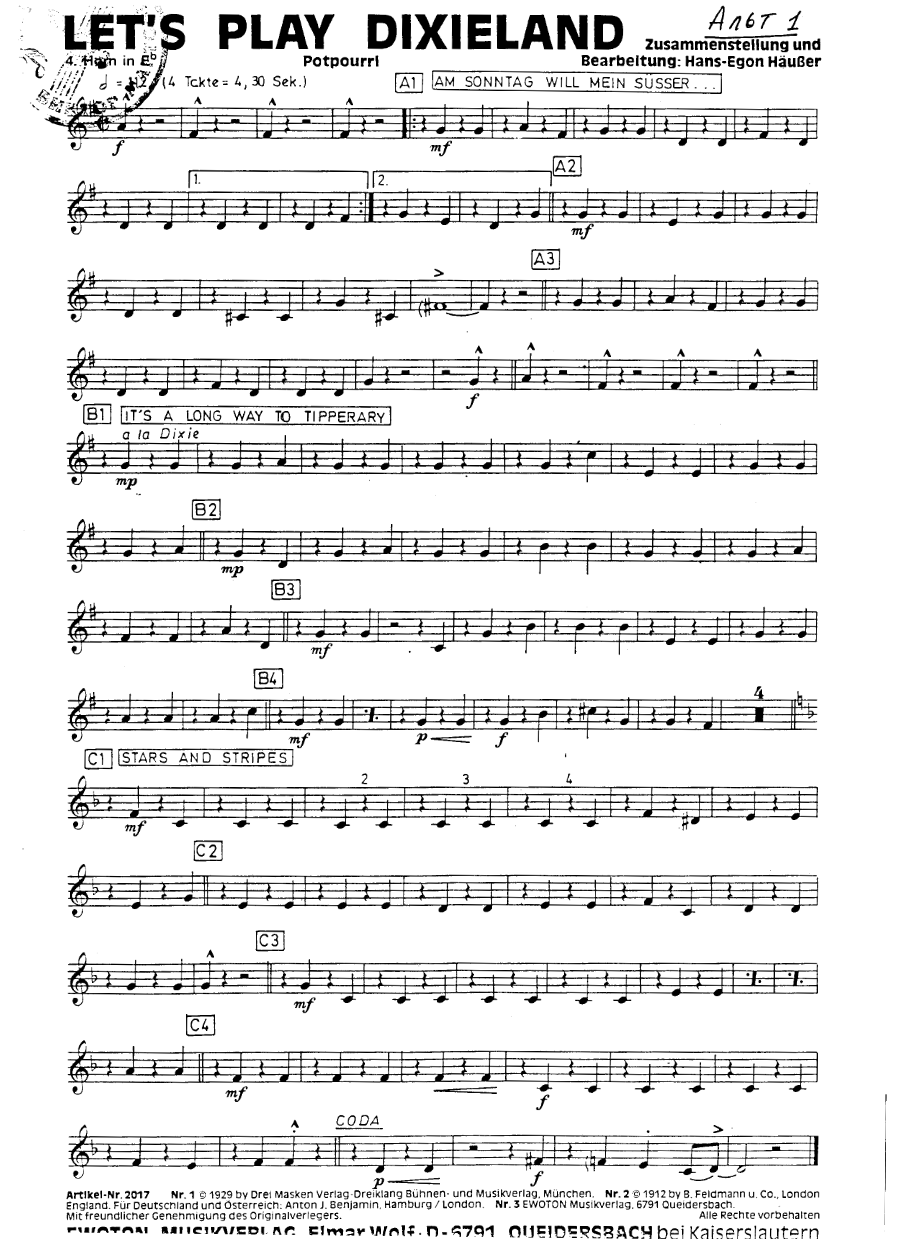
Let's Play Dixieland (H.Häußer) sheet music preview

Let's Play Dixieland (H.Häußer)

Composed by Hans-Egon Häußer

Arranged by Hans-Egon Häußer

  • Ensemble: Big Band
  • Style: Dixieland
  • Pages: 26
  • Instruments (25): 4. Horn in Eb, 3. Horn in Eb, Bariton in Bb, E-Baß, 2. Baß in C, Direktion/Orgel/Klavier, 1. Klarinette in Bb, 2. Klarinette in Bb, 3. Klarinette in Bb, 1. Trompete in Bb, 2. Trompete, 3. Trompete in Bb, 4. Trompete in Bb, 1. Alt-Saxophon in Eb, 2. Alt-Saxophon in Eb, Bariton-Saxophon in Eb, 1. Tenor-Saxophon in Bb, 2. Tenor-Saxophon in Bb, Tenorhorn in Bb, 2. Tenorhorn in Bb, 1. Posaune in C, 2. Posaune in C, 3. Posaune in C, Schlagzeug, Flöte in C
  • Difficulty: medium
  • Content: Individual Parts
  • Format: PDF Download (Instant)
  • Price: $24.99

Brimming with the infectious, high-octane spirit of early 20th-century New Orleans revivalism, "Let's Play Dixieland" captures the collective polyphonic brilliance that defined the birth of jazz. Composed and arranged by German multi-instrumentalist and bandleader Hans-Egon Häußer, this composition pays homage to the classic Chicago and traditional Dixieland eras popularized by legends like Louis Armstrong’s Hot Five and King Oliver. Rather than a mere historical pastiche, the work revitalizes the genre through a European brass-band lens, merging traditional collective improvisation with the structured discipline of a modern big band framework. Driven by an energetic, bounding two-four and four-four traditional jazz feel, the chart bursts out of the gate with an ebullient tempo and a bright, buoyant key center. The emotional landscape is unapologetically joyful, evoking smoky 1920s speakeasies, bustling parade routes, and unbridled celebratory fervor. Häußer constructs the arrangement with a brilliant interplay of textures, alternating between thunderous, full-ensemble polyphony where the trumpet, clarinet, and trombone lines weave independent yet harmonically locked countermelodies, and sparse, driving rhythm sections that keep the momentum relentlessly pushing forward. Häußer’s distinct arranging methodology shines through the clever integration of traditional European brass instrumentation—notably featuring Eb Alto Horns and Bb Baritones alongside standard big band configurations—which thickens the middle voices and creates a robust, choir-like harmonic cushion. The arrangement avoids stagnant background writing; instead, every section is given active, counter-melodic movement. Traditional collective front-line polyphony takes center stage, requiring the trumpet, trombone, and reed sections to master the art of simultaneous melodic improvisation and tight ensemble phrasing. Solos are strategically placed over swinging, transparent rhythm changes, allowing featured instrumentalists to stretch out in an authentic traditional style before the ensemble surges back together for a roaring, freight-train shout chorus. Executing this chart successfully requires a mature grasp of traditional jazz articulation, including crisp front-end accents, precise tailgate trombone slides, and a buoyant, unhurried eighth-note feel that avoids modern swing stiffness. Because the score utilizes a 25-instrument expanded lineup—incorporating specialized horn parts like Alto Horn 1 and 2 in Eb, Baritone in Bb, dual bass options including E-Bass and Bass 2 in C, and a comprehensive conductor score—it presents a rewarding challenge for advanced community big bands, university traditional jazz ensembles, and specialized brass orchestras looking to authentically recreate the roots of jazz with rich, contemporary depth. Achieving an authentic Dixieland sound with this expanded 25-piece instrumentation requires meticulous attention to articulation and balance. The rhythm section must anchor the performance with a crisp, driving two-beat feel, avoiding a heavy modern heavy-ride cymbal wash in favor of a crisp acoustic hi-hat or block click on beats two and four. Brass players should utilize traditional stylistic devices sparingly but effectively, incorporating gentle scoops, smears, and plunger effects where appropriate to emulate the vocalized phrasing of early New Orleans pioneers. Conductors must carefully manage the dynamic balance during the polyphonic sections; because the trumpet, clarinet, and trombone parts feature simultaneous independent melodies, no single voice should inadvertently overpower the texture. Rehearsal should begin slowly, isolating the front-line counterpoint at a reduced tempo to ensure intonation and rhythmic alignment are airtight before pushing up to Häußer's brisk performance tempo. Pay close attention to the unique inner-voice interplay carried by the Eb Alto Horns and Bb Baritones, as blending these traditional brass-band voices smoothly into the standard big band saxophone and trombone sections forms the unique sonic signature of this arrangement. Q: What instruments and parts are included in this publication? A: This comprehensive 26-page publication includes a full conductor score and individual parts for 25 instruments, featuring standard big band instrumentation alongside specialized European brass voices including Alto Horn 1 in Eb, Alto Horn 2 in Eb, Baritone in Bb, E-Bass, and Bass 2 in C. Q: What is the difficulty level of this arrangement? A: This piece is best suited for advanced high school, collegiate, and proficient community big bands or traditional jazz orchestras that possess strong ensemble intonation and comfort with polyphonic ensemble playing. Q: What musical style and historical context does this arrangement represent? A: It is written in the authentic Dixieland style, capturing the spirited, collective improvisation and polyphonic texture of 1920s traditional jazz and the New Orleans revival era. Q: What makes Hans-Egon Häußer’s arrangement unique? A: Häußer uniquely bridges traditional American Dixieland counterpoint with European brass band orchestration, utilizing expanded inner voices like Eb alto horns and Bb baritones to create an unusually rich, textured harmonic foundation. Q: What is the recommended tempo and performance duration for this piece? A: The arrangement is designed to be played at a brisk, energetic two-beat and four-four tempo typical of traditional Dixieland standards, resulting in a performance duration of approximately 3 to 4 minutes depending on solo extensions.

Questions and answers

What is included in the Let's Play Dixieland (H.Häußer) PDF?
The verified current file contains a conductor score and individual parts across 26 pages.
How many instruments or parts are listed for Let's Play Dixieland (H.Häußer)?
The verified instrumentation list contains 25 entries for this Big Band arrangement.
Who is credited for Let's Play Dixieland (H.Häußer)?
Composer: Hans-Egon Häußer. Arranger: Hans-Egon Häußer.
What difficulty is listed for Let's Play Dixieland (H.Häußer)?
The verified difficulty level is medium.
What style is listed for Let's Play Dixieland (H.Häußer)?
The catalog lists the style as Dixieland.
Can I preview Let's Play Dixieland (H.Häußer) before buying?
Yes. The product page provides a preview generated from the current PDF file.
How is Let's Play Dixieland (H.Häußer) delivered?
After successful payment, the digital PDF is made available for download. The displayed price is $24.99.

Musicians Also Search For

Let's Play Dixieland Hans-Egon Häußer PDFLet's Play Dixieland Hans-Egon Häußer sheet musicLet's Play Dixieland arranged by Hans-Egon HäußerHans-Egon Häußer big band chartsHans-Egon Häußer jazz arrangements PDFLet's Play Dixieland Hans-Egon Häußer big band arrangementsLet's Play Dixieland big band arrangementsLet's Play Dixieland big band PDF downloadLet's Play Dixieland jazz sheet musicbig band sheet music downloadLet's Play Dixieland conductor score PDFLet's Play Dixieland individual parts downloadLet's Play Dixieland sheet music PDFLet's Play Dixieland Dixieland chartsDixieland big band arrangementsbuy Let's Play Dixieland sheet musicdownload Let's Play Dixieland PDFLet's Play Dixieland jazz chartsbest Hans-Egon Häußer big band arrangementsLet's Play Dixieland printable sheet musicbig band repertoire PDF

All arrangements by Hans-Egon Häußer