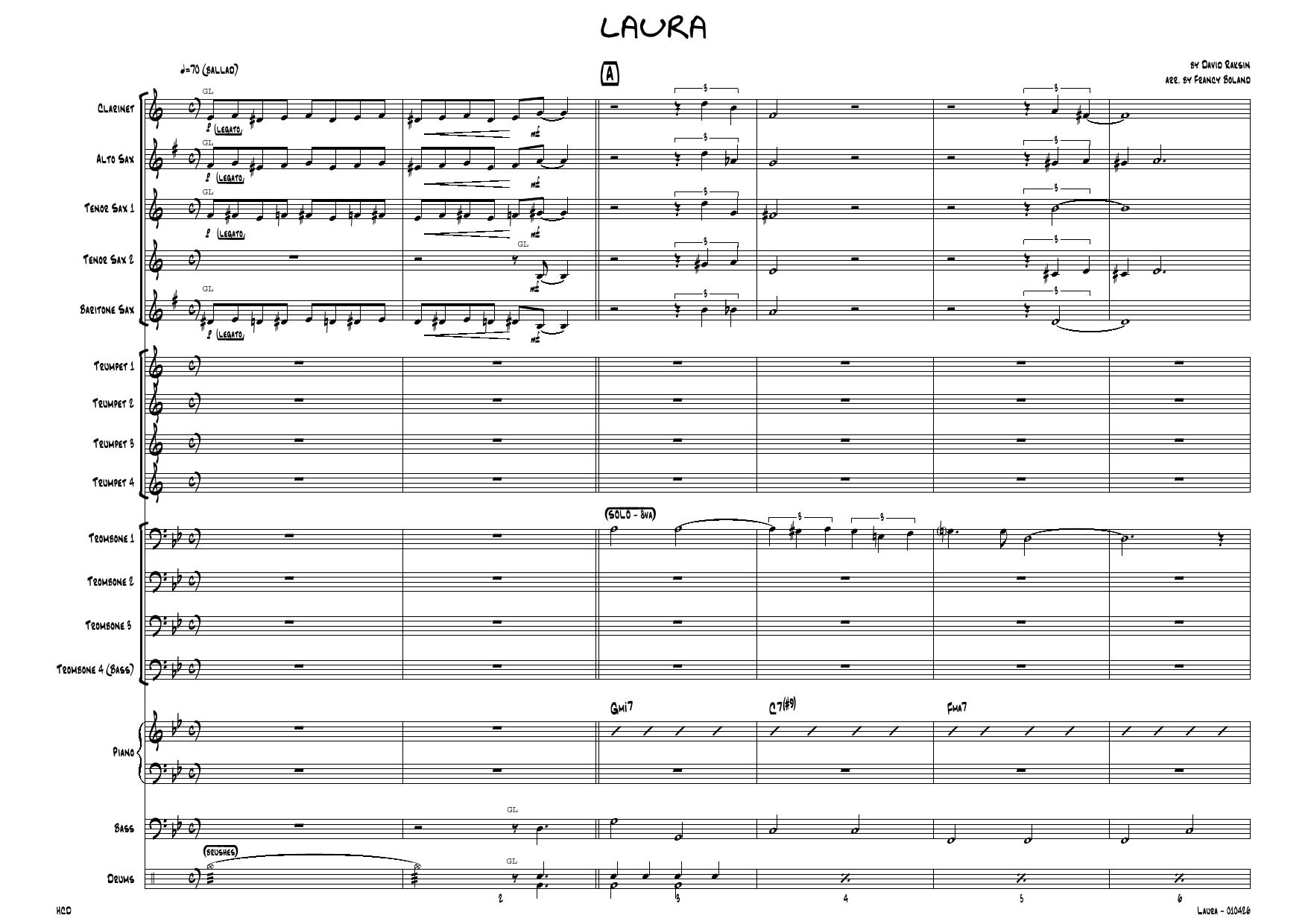
Laura (F.Boland)
Composed by David Raksin
Arranged by Francy Boland
- Ensemble: Big Band
- Pages: 29
- Instruments (17): Clarinet, Alto Sax (Sub for Clarinet), Alto Sax, Tenor Sax 1, Tenor Sax 2, Baritone Sax, Trumpet 1, Trumpet 2, Trumpet 3, Trumpet 4, Trombone 1 (Solo), Trombone 2, Trombone 3, Trombone 4 (Bass), Piano, Bass, Drums
- Difficulty: medium
- Content: Individual Parts
- Format: PDF Download (Instant)
- Price: $24.99
David Raksin’s haunting cinematic masterpiece "Laura," originally penned for Otto Preminger’s 1944 film noir of the same name, stands as one of the most enduring and frequently interpreted contributions to the Great American Songbook. Over the decades, the ethereal melody has transitioned from silver-screen theme to quintessential jazz standard, recorded by luminaries ranging from Charlie Parker and Stan Getz to Frank Sinatra. Within this rich lineage, the treatment by Belgian-born pianist, composer, and arranger Francy Boland—renowned the world over for his legendary collaboration with drummer Kenny Clarke in the Clarke-Boland Big Band—elevates the tune into a sophisticated post-bop masterclass. Boland’s writing captures the smoky, nocturnal atmosphere of the original film noir while injecting it with the blistering harmonic sophistication and rhythmic vitality of European modern jazz from the 1960s and ’70s. Built around a smoldering, sophisticated medium-slow swing feel, this arrangement trades traditional, predictable ballad pacing for an underlying rhythmic tension that gives the chart a perpetual forward momentum. The key center shifts through lush, unexpected modal colorations, utilizing extended and altered harmonies that evoke a sense of urbane melancholy and sophisticated longing. Boland avoids standard, formulaic head-arrangements; instead, the melody is introduced through shimmering woodwind textures and rich brass voicings that emphasize dissonance resolving into luxurious, open-position chords. The emotional trajectory moves from cool, mysterious introspection to sweeping, cinematic intensity, ultimately resolving back into the quiet, haunting shadows from which it emerged. Francy Boland’s signature arranging style is defined by his meticulous, dense voicing of the saxophone section—utilizing doubling on clarinet and flute to create orchestral woodwind colors—coupled with punchy, brass-heavy counterlines that demand absolute precision. In this chart, the reed section acts as a cohesive, highly mobile unit, weaving intricate counterpoint behind featured soloists while the rhythm section lays down a supple, driving swing groove. Boland’s mastery of dynamic contrast is on full display here; quiet, breath-control-intensive ensemble passages give way without warning to soaring, brass-driven climaxes that test the upper registers of both trumpets and trombones. The arrangement features designated solo space for tenor saxophone, allowing a featured improviser to stretch out over sophisticated chord changes that reward a lyrical, blues-infused yet harmonically aware approach. Advanced collegiate ensembles, professional big bands, and elite community jazz orchestras will find this 16-instrument, 29-page manuscript an exceptional vehicle for developing deep sectional blend, intonation, and stylistic maturity. Because Boland’s writing relies heavily on subtle dynamic shading, precise articulation, and complex internal voice-leading, it requires a mature lead player and an ensemble capable of playing with unified phrasing. Performing this arrangement offers audiences a rare glimpse into the sophisticated European big band tradition, presenting a masterclass in how to reimagine a familiar standard through a lens of uncompromising modernism and cinematic grandeur. Conductors approaching Francy Boland’s chart of "Laura" must prioritize extreme dynamic control and balance, particularly during the muted brass and dense woodwind passages. The tempo should settle comfortably into a relaxed, forward-moving medium swing; avoid dragging, as the rhythmic vitality depends on the rhythm section's light, buoyant ride cymbal pulse and crisp hi-hat placement on beats two and four. The saxophone section, featuring robust double parts including clarinet, must blend organically to achieve Boland’s signature orchestral palette—ensure that internal chord tones within the reeds are tuned meticulously before adding brass. Trumpets and trombones should utilize harmon or cup mutes where indicated, maintaining a warm, dark core to their sound rather than an aggressive edge. In solo sections, the rhythm section should react dynamically to the soloist, avoiding static comping in favor of conversational, comping voicings that mirror Boland’s advanced harmonic language. Rehearsals should isolate the intricate counterlines between the lower reeds and upper brass to ensure every inner voice speaks clearly through the ensemble texture. Q: What instruments and parts are included in this arrangement? A: The chart is scored for a 16-instrument big band lineup featuring clarinet, alto saxophone, tenor saxophone 1, tenor saxophone 2, baritone saxophone, a full brass section, and a rhythm section across a 29-page manuscript. Q: What is the difficulty level of this Francy Boland arrangement? A: This arrangement is best suited for advanced collegiate, professional, and elite community big bands due to its sophisticated harmonic language, dense woodwind doublings, and demanding dynamic control. Q: What musical style and historical context does this chart represent? A: It represents post-bop European big band jazz from the mid-to-late 20th century, transforming David Raksin’s 1944 film noir theme into a harmonically rich, modern jazz masterclass. Q: What makes this specific arrangement unique compared to other big band versions of "Laura"? A: Boland avoids standard ballad treatments by utilizing a driving medium-slow swing feel, complex modal colorations, lush woodwind textures, and intricate internal voice-leading that evoke a cinematic atmosphere. Q: What is the performance tempo and duration of the piece? A: The arrangement is performed at a relaxed, driving medium swing tempo, allowing for a performance duration of approximately 4 to 5 minutes depending on the length of the featured improvisation.
Questions and answers
- What is included in the Laura (F.Boland) PDF?
- The verified current file contains a conductor score and individual parts across 29 pages.
- How many instruments or parts are listed for Laura (F.Boland)?
- The verified instrumentation list contains 17 entries for this Big Band arrangement.
- Who is credited for Laura (F.Boland)?
- Composer: David Raksin. Arranger: Francy Boland.
- What difficulty is listed for Laura (F.Boland)?
- The verified difficulty level is medium.
- Can I preview Laura (F.Boland) before buying?
- Yes. The product page provides a preview generated from the current PDF file.
- How is Laura (F.Boland) delivered?
- After successful payment, the digital PDF is made available for download. The displayed price is $24.99.
Musicians Also Search For
Laura Francy Boland PDF • Laura Francy Boland sheet music • Laura arranged by Francy Boland • Francy Boland big band charts • Francy Boland jazz arrangements PDF • Laura David Raksin sheet music • Laura David Raksin big band arrangements • David Raksin big band charts • Laura big band arrangements • Laura big band PDF download • Laura jazz sheet music • big band sheet music download • Laura conductor score PDF • Laura individual parts download • Laura sheet music PDF • buy Laura sheet music • download Laura PDF • Laura jazz charts • best Francy Boland big band arrangements • David Raksin arranged by Francy Boland • Laura printable sheet music • big band repertoire PDF