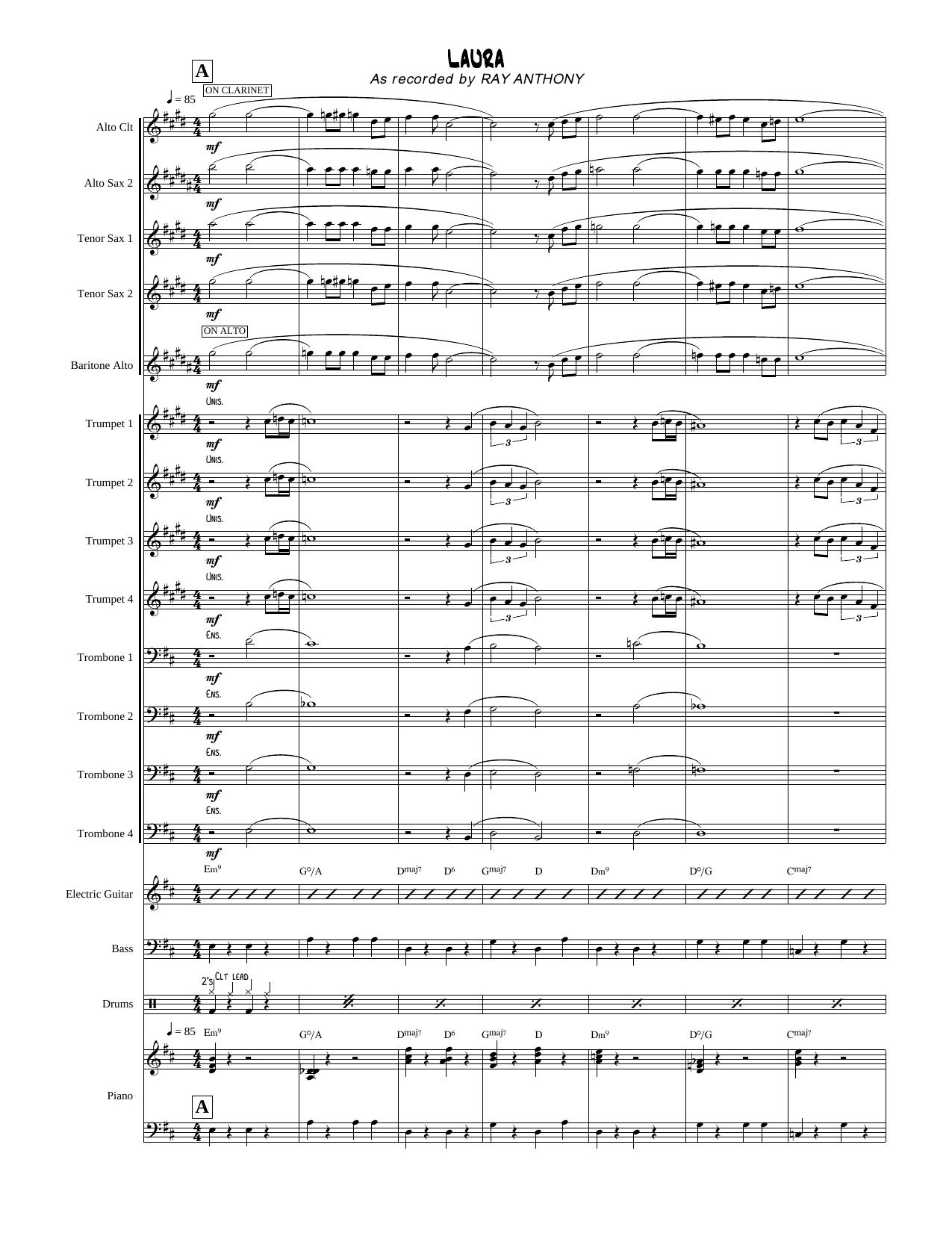
Laura (J.Farley)
Composed by David Raksin
Arranged by John Farley
- Ensemble: Big Band
- Pages: 41
- Instruments (17): Alto Saxophone 1 (doubling Clarinet), Alto Saxophone 2, Tenor Saxophone 1, Tenor Saxophone 2, Baritone Saxophone (labeled Baritone Alto), Trumpet 1, Trumpet 2, Trumpet 3, Trumpet 4, Trombone 1, Trombone 2, Trombone 3, Trombone 4, Electric Guitar, Piano, Bass, Drums
- Difficulty: medium
- Content: Individual Parts
- Format: PDF Download (Instant)
- Price: $24.99
David Raksin’s haunting cinematic masterpiece "Laura," originally penned as the theme for Otto Preminger’s 1944 film noir of the same name, stands as one of the most enduring and sophisticated contributions to the American Songbook. Before Johnny Mercer added his evocative lyrics, the melody had already captured the imagination of jazz musicians through its lush, chromatic harmonic movement and melancholic, yearning contour. It swiftly transitioned from the silver screen into an essential bebop and cool jazz vehicle, famously interpreted by giants like Charlie Parker, Stan Getz, and Woody Herman. The song represents the bridge between classic Hollywood orchestration and sophisticated mid-century jazz harmony, relying on suspended chords and unexpected resolution points that create a deep, nocturnal atmosphere. John Farley’s sophisticated big band interpretation frames this timeless standard as a smoldering, late-night ballad with an underlying rhythmic tension. Operating at a relaxed, sultry tempo with a subtle, flowing 12/8 or slow-swing subdivision, the arrangement explores a rich palette of dark, extended chord voicings. The overall mood is evocative, cinematic, and deeply introspective, unfolding with a smoky elegance that builds from whispered intimacy into soaring, harmonically dense climaxes. Farley utilizes the full color spectrum of the ensemble, contrasting sparse, crystalline horn textures against thick, impressionistic brass pads that evoke the rain-slicked streets of 1940s film noir. The structural blueprint of the chart showcases brilliant sectional writing, with the baritone saxophone and low trombone anchoring a warm, resonant foundation. The lead alto saxophone carries the primary thematic weight through the opening statements, wrapped in shimmering muted trumpet counter-melodies. A standout feature of Farley’s treatment is a lush sax soli that reharmonizes the secondary bridge with breathtaking chromatic slide voicings, demanding absolute intonation control and stylistic unity. Following an expressive, open-ended improvised solo section—tailor-made for a featured tenor saxophone or fluegelhorn—the arrangement builds organically into a restrained, emotionally charged shout chorus. Rather than relying on sheer volume, this peak achieves its power through massive chordal density and controlled dynamic swells before dissolving back into the quiet melancholy of the head. Advanced high school ensembles with strong section leaders, as well as collegiate and professional community big bands, will find this chart an ideal vehicle for developing ensemble maturity. While the technical demands regarding extreme ranges are moderate, the true challenge lies in the realm of musicality: maintaining consistent breath support during long, sustained phrases, balancing subtle dynamic shifts, and nailing the nuanced rubato-in-tempo feel. It provides a masterclass in ensemble blend, phrasing, and emotional communication, making it a standout centerpiece for any serious jazz concert program. Conductors should approach John Farley’s arrangement of "Laura" with an emphasis on horizontal linear momentum rather than rigid vertical timekeeping. The tempo must feel relaxed yet purposeful, avoiding any tendency to drag during the sparse, exposed introductory measures. Key technical challenges center around intonation within the extended brass and reed voicings; players must lock in their balance on the altered dominants and major-seventh suspensions that populate Farley’s harmonic landscape. Saxophones should practice their soli section with a metronome at half-tempo, ensuring that rapid chromatic shifts maintain an even, legato articulation without sacrificing stylistic warmth. The brass section should utilize cup mutes or harmon mutes (stem out where indicated) to achieve the authentic noir timbre during the first chorus, transitioning to open, dark tones by the time the ensemble reaches the climax. Ensure that the rhythm section treats the swing eighth notes with a relaxed, behind-the-beat placement, maintaining a heartbeat-like pulse on the bass while the piano avoids over-voicing, leaving ample space for the horn textures to breathe and resonate. Q: What instruments and parts are included in this arrangement? A: This chart is scored for a standard 9-instrument big band instrumentation, featuring Alto Saxophone, Tenor Saxophone, Baritone Saxophone, Trumpet, Trombone, and a complete rhythm section, spanning a total of 41 pages of professionally engraved music. Q: What is the difficulty level of this chart? A: It is graded as advanced-intermediate to advanced, making it best suited for college, advanced high school, or professional community big bands that possess strong sectional blend and intonation skills. Q: What is the historical style and background of this piece? A: Based on David Raksin’s iconic 1944 film noir theme, this arrangement reimagines the classic standard in a sultry, late-night jazz ballad style steeped in the tradition of cool jazz and sophisticated Hollywood-influenced harmony. Q: What makes John Farley’s arrangement unique? A: Farley’s treatment stands out through its lush, impressionistic reharmonizations, a striking chromatic saxophone soli, and a uniquely restrained shout chorus that builds emotional intensity through chordal density rather than sheer volume. Q: What is the performance duration and recommended tempo feel? A: The arrangement runs approximately 4 to 5 minutes in duration and is designed around a slow, smoldering ballad tempo with a relaxed, flowing swing feel that prioritizes linear phrasing and expressive rubato elements.
Questions and answers
- What is included in the Laura (J.Farley) PDF?
- The verified current file contains a conductor score and individual parts across 41 pages.
- How many instruments or parts are listed for Laura (J.Farley)?
- The verified instrumentation list contains 17 entries for this Big Band arrangement.
- Who is credited for Laura (J.Farley)?
- Composer: David Raksin. Arranger: John Farley.
- What difficulty is listed for Laura (J.Farley)?
- The verified difficulty level is medium.
- Can I preview Laura (J.Farley) before buying?
- Yes. The product page provides a preview generated from the current PDF file.
- How is Laura (J.Farley) delivered?
- After successful payment, the digital PDF is made available for download. The displayed price is $24.99.
Musicians Also Search For
Laura John Farley PDF • Laura John Farley sheet music • Laura arranged by John Farley • John Farley big band charts • John Farley jazz arrangements PDF • Laura David Raksin sheet music • Laura David Raksin big band arrangements • David Raksin big band charts • Laura big band arrangements • Laura big band PDF download • Laura jazz sheet music • big band sheet music download • Laura conductor score PDF • Laura individual parts download • Laura sheet music PDF • buy Laura sheet music • download Laura PDF • Laura jazz charts • best John Farley big band arrangements • David Raksin arranged by John Farley • Laura printable sheet music • big band repertoire PDF