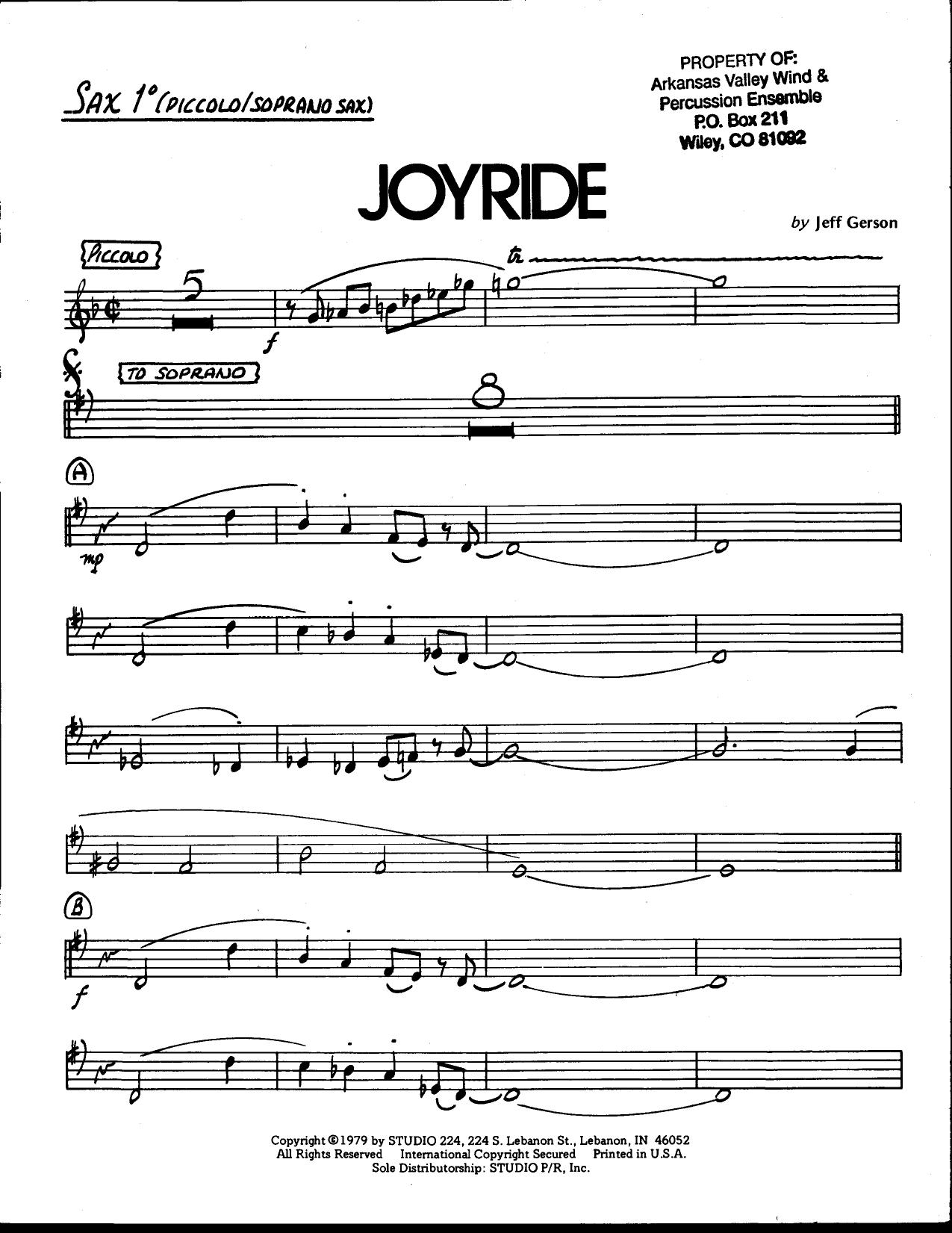
Joyride (J.Gerson)
Composed by J. Gerson
Arranged by J.Gerson
- Ensemble: Big Band
- Style: Jazz Standard
- Pages: 44
- Instruments (17): Sax 1 (Piccolo/Soprano Sax), Sax 2 (Flute), Sax 3 (Flute/Tenor Sax), Sax 4 (Flute/Tenor Sax), Sax 5 (Baritone Sax), Trumpet 1, Trumpet 2, Trumpet 3 (Flugelhorn), Trumpet 4 (Flugelhorn), Trombone 1, Trombone 2, Trombone 3, Trombone 4, Bass, Drums, Piano, Guitar
- Difficulty: medium
- Content: Individual Parts
- Format: PDF Download (Instant)
- Price: $24.99
"Joyride" captures the kinetic, high-octane spirit of modern post-bop and contemporary big band writing, serving up an exhilarating showcase for advanced ensembles. Rooted in the rich tradition of high-velocity modal jazz and driving swing, the composition bridges the harmonic sophistication of the 1960s Blue Note era with the muscular, dynamic punch of contemporary large-ensemble writing. It evokes the neon-lit rush of urban transit and late-night highway cruising, driven by an unyielding momentum that keeps both performers and audiences on the edge of their seats from the initial downbeat to the final explosive chord. The chart opens with a blistering up-tempo swing feel in 4/4, anchored by a relentless walking bassline and crisp ride cymbal patterns that establish an infectious, forward-leaning groove. The harmonic landscape is rich with extended alterations, sharp chromatic passing tones, and soaring modal vamps that demand absolute precision from the entire brass and reed sections. J.Gerson’s arrangement treats the standard big band architecture with inventive structural twists, avoiding predictable formulas by weaving intricate counterpoint between the upper and lower voices. A standout feature is the tightly interlocked sax soli, which unfurls like a cascading ribbon over subtle, punchy background figures from the trombones. The subsequent shout chorus builds through a masterclass in tension and release, layering cross-rhythms and soaring trumpet lines before dropping dynamically into a breathtaking, full-ensemble unison passage. Melodic duties are shared dynamically across sections, preventing the texture from becoming monolithic. The primary heads are introduced by the alto saxophone and lead trumpet, later passed fluidly to the tenor section with crisp baritone anchor points. Ample space is carved out for extended open solo sections—ideally suited for piano and tenor saxophone—backed by rhythmic comping figures that shift seamlessly between suspended chordal clusters and driving block-voicing. Technically, the chart demands fluid fingerwork in fast registers, agile double-tonguing in the trumpet section, and a mature command of balance during dense harmonic climaxes. Rhythm section players will find the chart deeply rewarding, as the drum and bass parts provide a sophisticated canvas for interactive, supportive accompaniment rather than rigid metronomic timekeeping. Advanced collegiate, top-tier high school, and professional community big bands will find "Joyerson: Joyride" an ideal centerpiece for festival performances and formal concert programs. The level of interplay required between sections makes it an exceptional vehicle for testing ensemble listening skills, dynamic control, and endurance. Directors seeking a modern chart that respects traditional swing roots while injecting fresh, adrenaline-fueled compositional energy will discover an indispensable addition to their library. Navigating "Joyride" successfully requires meticulous attention to articulation and tempo discipline. The recommended tempo is a brisk quarter note = 220–224 BPM, where the swing eighth notes must remain light, buoyant, and strictly on the palate rather than heavy or squared off. Rhythm section players should treat the time with a driving, linear approach, avoiding over-syncopation that might drag the momentum. Horn players must execute all written accented notes with crisp, non-forced tonguing, utilizing natural drop-offs and short doits rather than exaggerated theatrical effects. Rehearsal should begin by isolating the complex saxophone soli at a reduced tempo, ensuring absolute rhythmic unity before integrating the rhythm section. Pay close attention to dynamic markings during the shout chorus; the ensemble must balance the upper brass to prevent the lead trumpet from straining, allowing the underlying harmonic textures to cut through cleanly. Q: What instruments and parts are included in this arrangement? A: The 17-instrument big band instrumentation includes standard scoring for 5 saxophones (Alto 1-2, Tenor 1-2, Baritone), 4 trumpets, 4 trombones, and a 4-piece rhythm section consisting of piano, guitar, bass, and drums, spanning a comprehensive 44-page score and parts set. Q: What is the difficulty level of this arrangement? A: This piece is graded as advanced (Level 5), best suited for collegiate ensembles, advanced high school jazz bands, and professional community big bands capable of handling fast tempos and complex harmonies. Q: What musical style and historical context does the piece represent? A: "Joyride" is rooted in the high-energy post-bop and modern jazz standard tradition, drawing stylistic inspiration from the sophisticated modal and hard-bop eras of the 1960s while incorporating contemporary big band arranging techniques. Q: What makes J.Gerson's arrangement unique? A: The chart stands out for its intricate cross-sectional counterpoint, a cascading and harmonically rich saxophone soli, and a dynamic shout chorus that cleverly alternates between dense block-voicing and explosive unison passages. Q: What is the performance duration and tempo of the arrangement? A: The piece runs approximately 5 to 6 minutes in performance and is anchored by a fast, driving up-tempo swing feel set around quarter note = 220–224 BPM.
Questions and answers
- What is included in the Joyride (J.Gerson) PDF?
- The verified current file contains individual parts across 44 pages.
- How many instruments or parts are listed for Joyride (J.Gerson)?
- The verified instrumentation list contains 17 entries for this Big Band arrangement.
- Who is credited for Joyride (J.Gerson)?
- Composer: J. Gerson. Arranger: J.Gerson.
- What difficulty is listed for Joyride (J.Gerson)?
- The verified difficulty level is medium.
- What style is listed for Joyride (J.Gerson)?
- The catalog lists the style as Jazz Standard.
- Can I preview Joyride (J.Gerson) before buying?
- Yes. The product page provides a preview generated from the current PDF file.
- How is Joyride (J.Gerson) delivered?
- After successful payment, the digital PDF is made available for download. The displayed price is $24.99.
Musicians Also Search For
Joyride J.Gerson PDF • Joyride J.Gerson sheet music • Joyride arranged by J.Gerson • J.Gerson big band charts • J.Gerson jazz arrangements PDF • Joyride J. Gerson sheet music • Joyride J. Gerson big band arrangements • J. Gerson big band charts • Joyride big band arrangements • Joyride big band PDF download • Joyride jazz sheet music • big band sheet music download • Joyride individual parts download • Joyride sheet music PDF • Joyride Jazz Standard charts • Jazz Standard big band arrangements • buy Joyride sheet music • download Joyride PDF • Joyride jazz charts • best J.Gerson big band arrangements • J. Gerson arranged by J.Gerson • Joyride printable sheet music • big band repertoire PDF