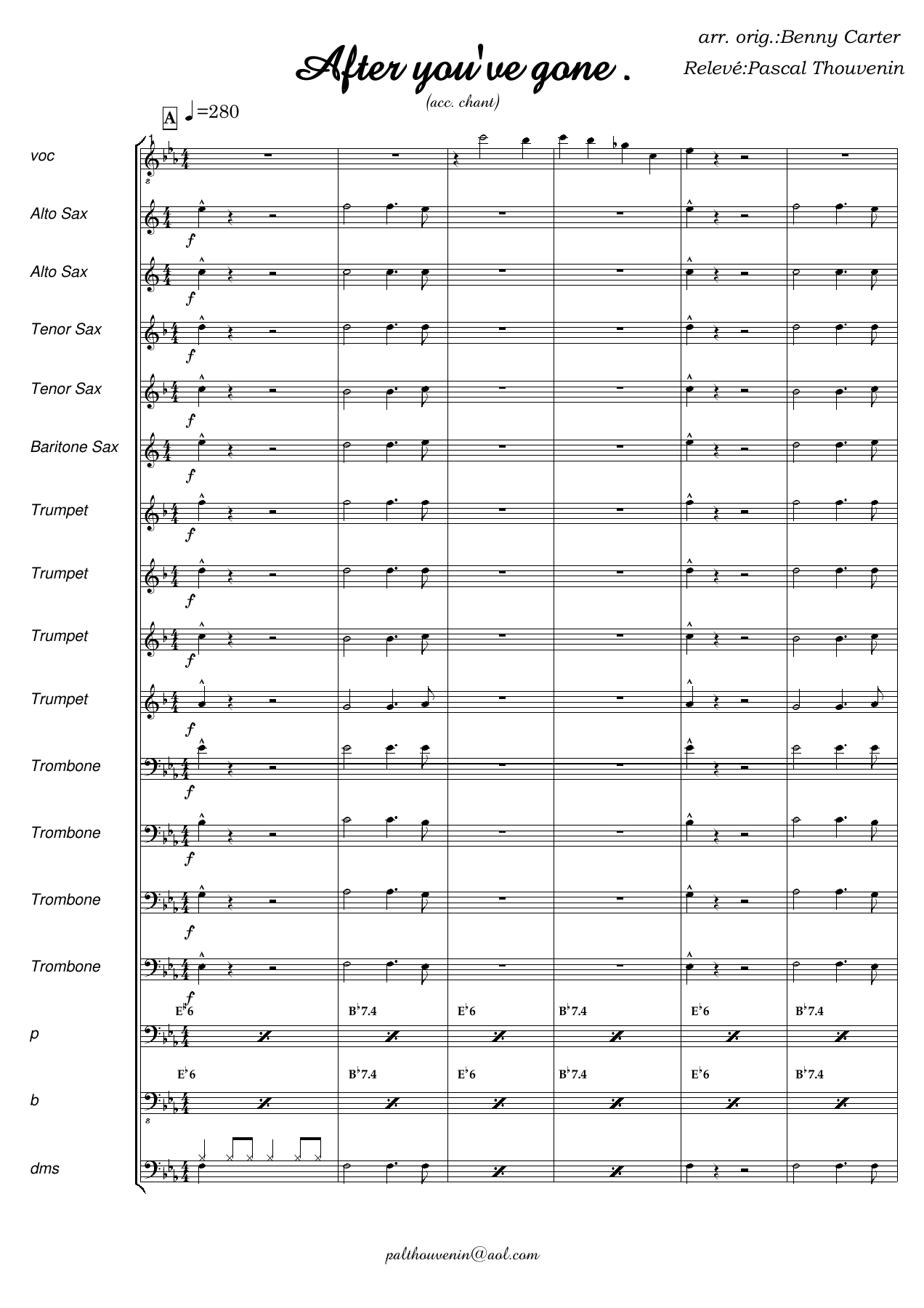
After You've Gone (B.Carter) sheet music preview

After You've Gone (B.Carter)

Composed by Turner Layton, Henry Creamer

Arranged by Benny Carter

  • Ensemble: Big Band
  • Style: Jazz Standard
  • Pages: 71
  • Instruments (18): Vocals, Alto Saxophone 1, Alto Saxophone 2, Tenor Saxophone 1, Tenor Saxophone 2, Baritone Saxophone, Trumpet 1, Trumpet 2, Trumpet 3, Trumpet 4, Trombone 1, Trombone 2, Trombone 3, Trombone 4, Guitar, Piano, Bass, Drums
  • Difficulty: advanced
  • Content: Individual Parts
  • Format: PDF Download (Instant)
  • Price: $24.99

"After You've Gone," penned by Turner Layton and Henry Creamer in 1918, stands as a cornerstone of the American Songbook, its enduring melody and poignant lyrics making it an immediate favorite during the Tin Pan Alley era. Quickly embraced by early jazz pioneers, it became a vehicle for improvisation and hot jazz expression, famously recorded by artists like Bessie Smith, Louis Armstrong, and Benny Goodman. Its harmonic structure and energetic potential have cemented its status as a perennial jazz standard, offering a rich canvas for countless interpretations across decades. This particular arrangement, crafted by the legendary Benny Carter, breathes new life into the classic, showcasing his unparalleled mastery of big band orchestration and his deep understanding of the tune's inherent swing. Benny Carter's treatment of "After You've Gone" is a masterclass in sophisticated swing. Set at a bright, driving medium-up tempo, the arrangement is firmly rooted in the classic swing era, yet infused with Carter's signature harmonic elegance and melodic inventiveness. The piece opens with a vibrant, full-ensemble statement, immediately establishing a joyful, energetic mood in the key of F major. Carter's voicings are characteristically smooth and rich, often featuring close-knit saxophone soli sections that glide effortlessly, showcasing his genius for weaving intricate lines. The arrangement maintains a consistently uplifting energy, punctuated by dynamic contrasts and strategically placed ensemble punches that propel the narrative forward. The arrangement features prominent solo opportunities, notably for the alto saxophone and trumpet, allowing skilled improvisers to shine over the driving rhythm section. Carter's genius is particularly evident in his development of the thematic material; he doesn't merely present the melody but elaborates on it through counter-melodies and call-and-response figures between sections. A highlight is the meticulously crafted shout chorus, where the full ensemble unleashes a powerful, harmonically dense statement that is both exhilarating and impeccably voiced. This section demands precision and strong ensemble blend, rewarding performers with a truly impactful musical moment. The arrangement concludes with a classic swing-era tag, leaving the audience with an undeniable sense of exhilaration. This Benny Carter arrangement is ideally suited for college, community, and professional jazz ensembles looking to perform an authentic and challenging piece from the swing repertoire. The technical demands are moderate to advanced, requiring strong section playing, precise articulation, and confident soloists. While the full 17-instrument instrumentation provides the richest sound, the thoughtful scoring ensures that the core musicality remains intact even with slightly reduced forces. Its blend of historical significance, melodic appeal, and brilliant orchestration makes it a highly rewarding piece for both musicians and audiences, offering a direct connection to the golden age of big band jazz through the lens of one of its greatest architects. Conductors should establish a clear, driving medium-up swing feel from the outset, emphasizing a light, buoyant rhythm section groove. Articulation is paramount; saxophones and brass must execute Carter's precise markings for crisp attacks and releases, particularly in the soli sections and ensemble punches. Pay close attention to dynamics, as Carter uses them effectively to build tension and release. The saxophone soli passages require careful balance and blend, ensuring each voice contributes to the seamless melodic lines. Soloists should be encouraged to embrace the swing idiom, focusing on melodic invention and rhythmic drive. Rehearsal time should be dedicated to perfecting the shout chorus, ensuring precise ensemble attacks, strong intonation, and a unified, powerful sound that drives to the final, exhilarating tag. Q: What instruments are included in this arrangement? A: This arrangement is scored for a standard 17-piece big band: Alto Saxophone 1, Alto Saxophone 2, Tenor Saxophone 1, Tenor Saxophone 2, Baritone Saxophone, Trumpet 1, Trumpet 2, Trumpet 3, Trumpet 4, Trombone 1, Trombone 2, Trombone 3, Trombone 4, Piano, Bass, Drums, and Guitar. Q: What is the difficulty level of Benny Carter's "After You've Gone"? A: This arrangement is considered advanced intermediate to advanced. It requires strong section playing, precise articulation, and capable improvisers for the featured alto saxophone and trumpet solos. Q: What musical style and historical period does this arrangement represent? A: This is a classic big band swing arrangement from the mid-20th century, showcasing Benny Carter's sophisticated approach to a Tin Pan Alley standard first composed in 1918. Q: What makes Benny Carter's arrangement of "After You've Gone" unique? A: Carter's arrangement is distinguished by his elegant harmonic voicings, intricate saxophone soli lines, and a brilliantly constructed shout chorus, all while maintaining an authentic, driving swing feel true to his signature style. Q: What is the typical performance duration and tempo for this piece? A: The performance duration is approximately 3-4 minutes, played at a bright, medium-up swing tempo (around 180-200 BPM) to capture the energetic character of the arrangement.

Questions and answers

What is included in the After You've Gone (B.Carter) PDF?
The verified current file contains a conductor score and individual parts across 71 pages.
How many instruments or parts are listed for After You've Gone (B.Carter)?
The verified instrumentation list contains 18 entries for this Big Band arrangement.
Who is credited for After You've Gone (B.Carter)?
Composer: Turner Layton, Henry Creamer. Arranger: Benny Carter.
What difficulty is listed for After You've Gone (B.Carter)?
The verified difficulty level is advanced.
What style is listed for After You've Gone (B.Carter)?
The catalog lists the style as Jazz Standard.
Can I preview After You've Gone (B.Carter) before buying?
Yes. The product page provides a preview generated from the current PDF file.
How is After You've Gone (B.Carter) delivered?
After successful payment, the digital PDF is made available for download. The displayed price is $24.99.

Musicians Also Search For

After You've Gone Benny Carter PDFAfter You've Gone Benny Carter sheet musicAfter You've Gone arranged by Benny CarterBenny Carter big band chartsBenny Carter jazz arrangements PDFAfter You've Gone Turner Layton, Henry Creamer sheet musicAfter You've Gone Turner Layton, Henry Creamer big band arrangementsTurner Layton, Henry Creamer big band chartsAfter You've Gone big band arrangementsAfter You've Gone big band PDF downloadAfter You've Gone jazz sheet musicbig band sheet music downloadAfter You've Gone conductor score PDFAfter You've Gone individual parts downloadAfter You've Gone sheet music PDFAfter You've Gone Jazz Standard chartsJazz Standard big band arrangementsbuy After You've Gone sheet musicdownload After You've Gone PDFAfter You've Gone jazz chartsbest Benny Carter big band arrangementsTurner Layton, Henry Creamer arranged by Benny CarterAfter You've Gone printable sheet musicbig band repertoire PDF

All arrangements by Benny Carter All Turner Layton, Henry Creamer sheet music