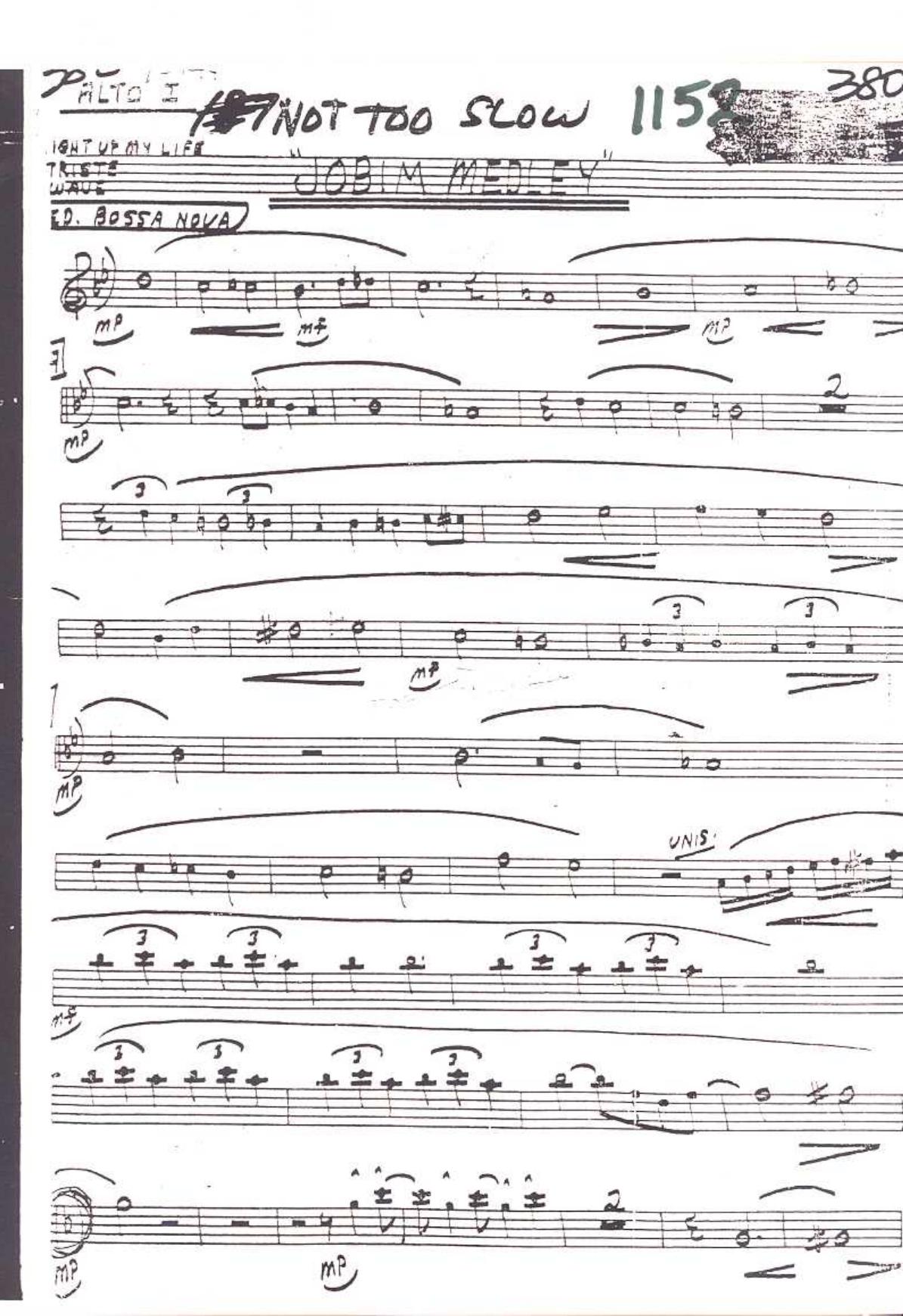
Jobim Medley
Composed by Antonio Carlos Jobim
Arranged by Unknown
- Ensemble: Big Band
- Style: Jazz Standard
- Pages: 49
- Instruments (17): Alto Saxophone 1, Alto Saxophone 2, Tenor Saxophone 1, Tenor Saxophone 2, Baritone Saxophone, Trumpet 1, Trumpet 2, Trumpet 3, Trumpet 4, Trombone 1, Trombone 2, Trombone 3, Trombone 4 (Bass Trombone), Piano, Bass, Drums, Guitar
- Difficulty: medium
- Content: Individual Parts
- Format: PDF Download (Instant)
- Price: $24.99
Bossa nova emerged from the lively neighborhoods of Rio de Janeiro in the late 1950s, forever marrying the cool, sophisticated harmonies of modern jazz with the sensuous, syncopated rhythms of Brazilian samba. At the heart of this global revolution stood Antônio Carlos Jobim, whose timeless compositions—such as "The Girl from Ipanema," "Desafinado," and "Wave"—transcended their South American roots to become permanent fixtures of the Great American Songbook. Recorded by jazz legends ranging from Stan Getz and Chet Baker to Ella Fitzgerald, Jobim’s writing is celebrated for its lush chord progressions, modal shifts, and an effortless lyrical melancholy that captures both the sun-drenched coast and the introspection of midnight jam sessions. Blending breezy bossa nova grooves with swinging 4/4 jazz interludes, this comprehensive big band setting captures the sophisticated essence of Jobim’s greatest contributions to the genre. The musical landscape shifts fluidly between gentle, undulating Latin feels driven by authentic percussion patterns and crisp, driving medium-swing sections that test the ensemble’s rhythmic precision. Harmonic colors are rich and expansive, utilizing maj7(#11) voicings, suspended chords, and chromatic subdominants to evoke a warm, coastal mood. The energy flows naturally from hushed, intimate woodwind textures to sunlit, high-spirited ensemble passages that evoke the vibrant spirit of Copacabana. The arrangement opens with an atmospheric introduction before handing the primary melodic statements to the saxophone section, which weaves delicate counter-lines beneath lush brass pads. Throughout the medley, individual voices are highlighted through sophisticated sax solis and concise, lyrical solo changes allotted to the alto saxophone and trumpet chairs. Technical demands center on rhythmic independence; the rhythm section must master the subtle interplay between straight-eighth bossa feels and traditional dotted-eighth/sixteenth swing articulation. Brass players will need a refined sense of blend and dynamic control to execute the velvety muted passages without sacrificing core tone. Advanced high school ensembles with strong section players, as well as collegiate and professional community jazz orchestras, will find this chart an exceptionally rewarding addition to their repertoire. The meticulous 49-page score and 17-instrument breakdown offer a masterclass in dynamic contrast and textural variation. Because it seamlessly bridges two distinct stylistic worlds—the relaxed sway of Brazilian jazz and the polished sheen of the traditional big band—it serves as an ideal centerpiece for festival performances, formal concerts, and sophisticated club dates. Navigating this medley requires a deep understanding of stylistic duality, shifting seamlessly between authentic Brazilian bossa nova feels and traditional swing. The primary challenge lies in the rhythm section: the drummer must establish a crisp, understated bossa groove on the ride cymbal and rim click before transitioning smoothly into a driving, buoyant swing feel. Conductors should ensure the bass player maintains a steady, hypnotic half-note or walking foundation that anchors the floating, unresolved harmonic structures of the upper horns. Ensemble articulation must be pristine; avoid heavy tonguing on the Latin sections, keeping eighth notes light and speech-like, while adopting a sharper, blues-inflected articulation during the swing interludes. Trumpets and trombones should utilize harmon or cup mutes where indicated to achieve that quintessential sultry, smoky timbre characteristic of mid-century bossa recordings. Rehearsals should isolate the tempo transitions first without the full score, ensuring the entire band internalizes the subtle accelerandos and ritardandos that bind the disparate Jobim themes into a cohesive, flowing narrative. Q: What instruments and parts are included in this big band arrangement? A: The 17-instrument configuration features a standard big band lineup consisting of Alto Saxophone 1, Alto Saxophone 2, Tenor Saxophone 1, Tenor Saxophone 2, Baritone Saxophone, four trumpets, four trombones, and a full four-piece rhythm section (piano, bass, drums, and guitar). Q: What is the difficulty level of this arrangement? A: This piece is graded as advanced intermediate to advanced, making it ideal for skilled high school, collegiate, and professional community big bands that possess strong rhythm section coordination and mature horn section blend. Q: What musical style and historical era does this medley represent? A: It represents the bossa nova and Latin-jazz movements pioneered by Antonio Carlos Jobim during the late 1950s and 1960s, blending traditional Brazilian rhythms with sophisticated post-bop harmonic voicings. Q: What makes this specific arrangement unique? A: Unlike single-tune charts, this 49-page master score weaves multiple iconic Jobim melodies into a unified symphonic-jazz narrative, offering seamless transitions between gentle bossa feels and swinging, high-energy counterpoint. Q: What is the performance duration and tempo framework of the medley? A: The medley runs approximately 6 to 7 minutes in length, anchored by a relaxed opening bossa tempo around 120 BPM that shifts dynamically into a brighter, medium-swing groove near 168 BPM for the up-tempo sections.
Questions and answers
- What is included in the Jobim Medley PDF?
- The verified current file contains individual parts across 49 pages.
- How many instruments or parts are listed for Jobim Medley?
- The verified instrumentation list contains 17 entries for this Big Band arrangement.
- Who is credited for Jobim Medley?
- Composer: Antonio Carlos Jobim. Arranger: Unknown.
- What difficulty is listed for Jobim Medley?
- The verified difficulty level is medium.
- What style is listed for Jobim Medley?
- The catalog lists the style as Jazz Standard.
- Can I preview Jobim Medley before buying?
- Yes. The product page provides a preview generated from the current PDF file.
- How is Jobim Medley delivered?
- After successful payment, the digital PDF is made available for download. The displayed price is $24.99.
Musicians Also Search For
Jobim Medley Unknown PDF • Jobim Medley Unknown sheet music • Jobim Medley arranged by Unknown • Unknown big band charts • Unknown jazz arrangements PDF • Jobim Medley Antonio Carlos Jobim sheet music • Jobim Medley Antonio Carlos Jobim big band arrangements • Antonio Carlos Jobim big band charts • Jobim Medley big band arrangements • Jobim Medley big band PDF download • Jobim Medley jazz sheet music • big band sheet music download • Jobim Medley individual parts download • Jobim Medley sheet music PDF • Jobim Medley Jazz Standard charts • Jazz Standard big band arrangements • buy Jobim Medley sheet music • download Jobim Medley PDF • Jobim Medley jazz charts • best Unknown big band arrangements • Antonio Carlos Jobim arranged by Unknown • Jobim Medley printable sheet music • big band repertoire PDF