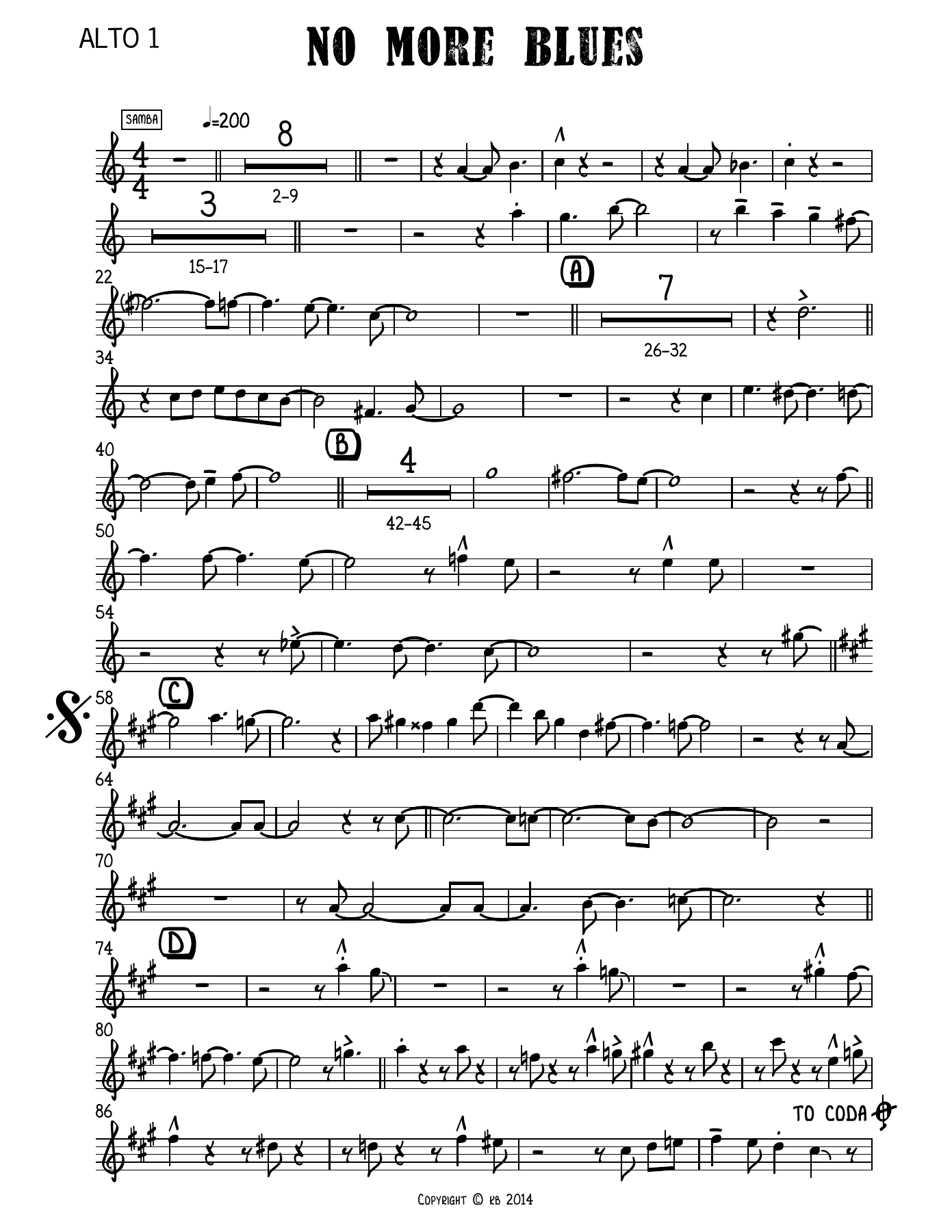
No More Blues — Complete Set (comp. Antonio Carlos Jobim)
Composed by Antonio Carlos Jobim
Arranged by KB
- Ensemble: Small Ensemble
- Style: Bossa Nova
- Pages: 30
- Instruments (8): Alto 1, Bass Guitar, Drums, Piano, Tenor 1, Trombone 1, Trumpet 1, Voice
- Difficulty: easy
- Content: Individual Parts
- Format: PDF Download (Instant)
- Price: $18.99
Composed by the legendary Antonio Carlos Jobim in 1958 with original Portuguese lyrics by Vinícius de Moraes (and later English lyrics by Jon Hendricks and Jessie Cavanaugh), "Chega de Saudade"—known globally as "No More Blues"—stands as the foundational masterpiece that launched the worldwide bossa nova phenomenon. Recorded definitively by João Gilberto and later embraced by jazz icons like Stan Getz, Dizzy Gillespie, and Oscar Peterson, this standard bridges the sophisticated harmonies of the American Songbook with the cool, syncopated rhythms of coastal Rio de Janeiro. It represents a pivotal cross-cultural moment in jazz history, transforming samba into an international chamber-jazz language defined by relaxed elegance, melancholic longing, and effortless rhythmic drive. KB’s sophisticated small-ensemble arrangement captures the authentic warmth and rhythmic nuance of mid-century Rio while infusing the chart with modern harmonic color. Driven by a buoyant, feather-light bossa nova groove in 4/4 time, the arrangement balances breezy melodic statements with rich, interlocking counter-lines. The underlying mood shifts seamlessly between introspection and sunlit optimism, evoking the cool ocean breezes and urban sophistication of 1950s Copacabana. KB utilizes lush, extended voicings—frequently leveraging major-seventh and suspended fourth sonorities—to give the compact ensemble a much larger, texturally dense footprint without ever losing the genre's characteristic rhythmic transparency. The melody is initially introduced with crisp articulation, shared or passed fluidly between the lead horns, establishing an intimate dialogue that invites the rhythm section to lay down an authentic, understated bossa foundation. Solos are thoughtfully integrated into the 30-page score, offering ample room for improvisers to explore the shifting tonal centers while backed by clever, harmonically rich background figures that reference Jobim's original orchestration style. Technical challenges center primarily on stylistic authenticity: performers must maintain a relaxed, non-rushed sixteenth-note subdivision over the syncopated bass line, avoiding the trap of playing too heavily or dragging the tempo. The rewards lie in the sheer elegance of the line-writing, where every counter-melody serves to propel the form forward. Tailored specifically for advanced high school, collegiate, and professional small jazz ensembles (such as a standard horn-plus-rhythm setup), this chart requires players with a strong grasp of Latin-jazz phrasing and independent rhythmic independence. College and professional groups will appreciate the subtle harmonic turnarounds and nuanced dynamic shadings written into the charts, making it an exceptional centerpiece for a concert program, festival set, or intimate club performance. Achieving an authentic bossa nova feel requires absolute rhythmic precision combined with a relaxed, unhurried physical approach. The tempo should sit at a steady, medium-up groove (around 132 to 140 BPM)—fast enough to maintain momentum, yet relaxed enough to let the eighth-note syncopations breathe. Horn players must avoid heavy accents on downbeats, instead leaning into the characteristic back-end anticipation of the bossa rhythm. Key technical challenges involve navigating the frequent key and modal shifts without letting the dynamic level creep up; the entire ensemble must maintain a transparent, chamber-like balance so that the intricate inner-voice movements remain audible. The rhythm section is the engine: the drummer should utilize a clean, acoustic bossa pattern on the ride cymbal and rim click, while the bass player anchors the form with a steady, unforced two-bar tumbao-derived pattern. Rehearsal should begin slowly with just the bass and drums, layering the horn harmonies gradually to ensure complete blend and intonation across the extended chord structures. Q: What specific instrumentation and parts are included in this 30-page set? A: The arrangement is scored for a flexible small jazz ensemble, typically accommodating a front line of two horns (such as alto sax and trumpet, or tenor sax and trombone) alongside a full rhythm section, complete with detailed piano, bass, drum, and optional guitar parts. Q: What is the designated difficulty level for this arrangement? A: This chart is pitched at an advanced high school to collegiate and professional level, primarily due to its demand for stylistic bossa nova phrasing, independent rhythmic syncopation, and navigation of extended jazz harmonies. Q: What is the historical and stylistic background of this piece? A: Originally composed by Antonio Carlos Jobim in 1958 as "Chega de Saudade," this piece is widely recognized as the genesis of the bossa nova movement, blending Brazilian samba rhythms with sophisticated jazz harmony. Q: What makes KB’s arrangement unique compared to standard fake-book versions? A: KB provides custom-tailored counter-melodies, sophisticated voice-leading, and meticulously crafted background figures behind the solo sections that elevate the tune beyond a standard head-solos-head chart into a fully realized concert arrangement. Q: What is the recommended performance duration and tempo for this piece? A: The arrangement performs ideally at around 3 to 4 minutes when taken at the recommended medium bossa tempo of approximately 136 BPM, allowing space for concise, expressive soloing within a tightly structured form.
Questions and answers
- What is included in the No More Blues — Complete Set (comp. Antonio Carlos Jobim) PDF?
- The verified current file contains individual parts across 30 pages.
- How many instruments or parts are listed for No More Blues — Complete Set (comp. Antonio Carlos Jobim)?
- The verified instrumentation list contains 8 entries for this Small Ensemble arrangement.
- Who is credited for No More Blues — Complete Set (comp. Antonio Carlos Jobim)?
- Composer: Antonio Carlos Jobim. Arranger: KB.
- What difficulty is listed for No More Blues — Complete Set (comp. Antonio Carlos Jobim)?
- The verified difficulty level is easy.
- What style is listed for No More Blues — Complete Set (comp. Antonio Carlos Jobim)?
- The catalog lists the style as Bossa Nova.
- Can I preview No More Blues — Complete Set (comp. Antonio Carlos Jobim) before buying?
- Yes. The product page provides a preview generated from the current PDF file.
- How is No More Blues — Complete Set (comp. Antonio Carlos Jobim) delivered?
- After successful payment, the digital PDF is made available for download. The displayed price is $18.99.
Musicians Also Search For
No More Blues — Complete Set KB PDF • No More Blues — Complete Set KB sheet music • No More Blues — Complete Set arranged by KB • KB small ensemble charts • KB jazz arrangements PDF • No More Blues — Complete Set Antonio Carlos Jobim sheet music • No More Blues — Complete Set Antonio Carlos Jobim small ensemble arrangements • Antonio Carlos Jobim small ensemble charts • No More Blues — Complete Set small ensemble arrangements • No More Blues — Complete Set small ensemble PDF download • No More Blues — Complete Set jazz sheet music • small ensemble sheet music download • No More Blues — Complete Set individual parts download • No More Blues — Complete Set sheet music PDF • No More Blues — Complete Set Bossa Nova charts • Bossa Nova small ensemble arrangements • buy No More Blues — Complete Set sheet music • download No More Blues — Complete Set PDF • No More Blues — Complete Set jazz charts • best KB small ensemble arrangements • Antonio Carlos Jobim arranged by KB • No More Blues — Complete Set printable sheet music • small ensemble repertoire PDF