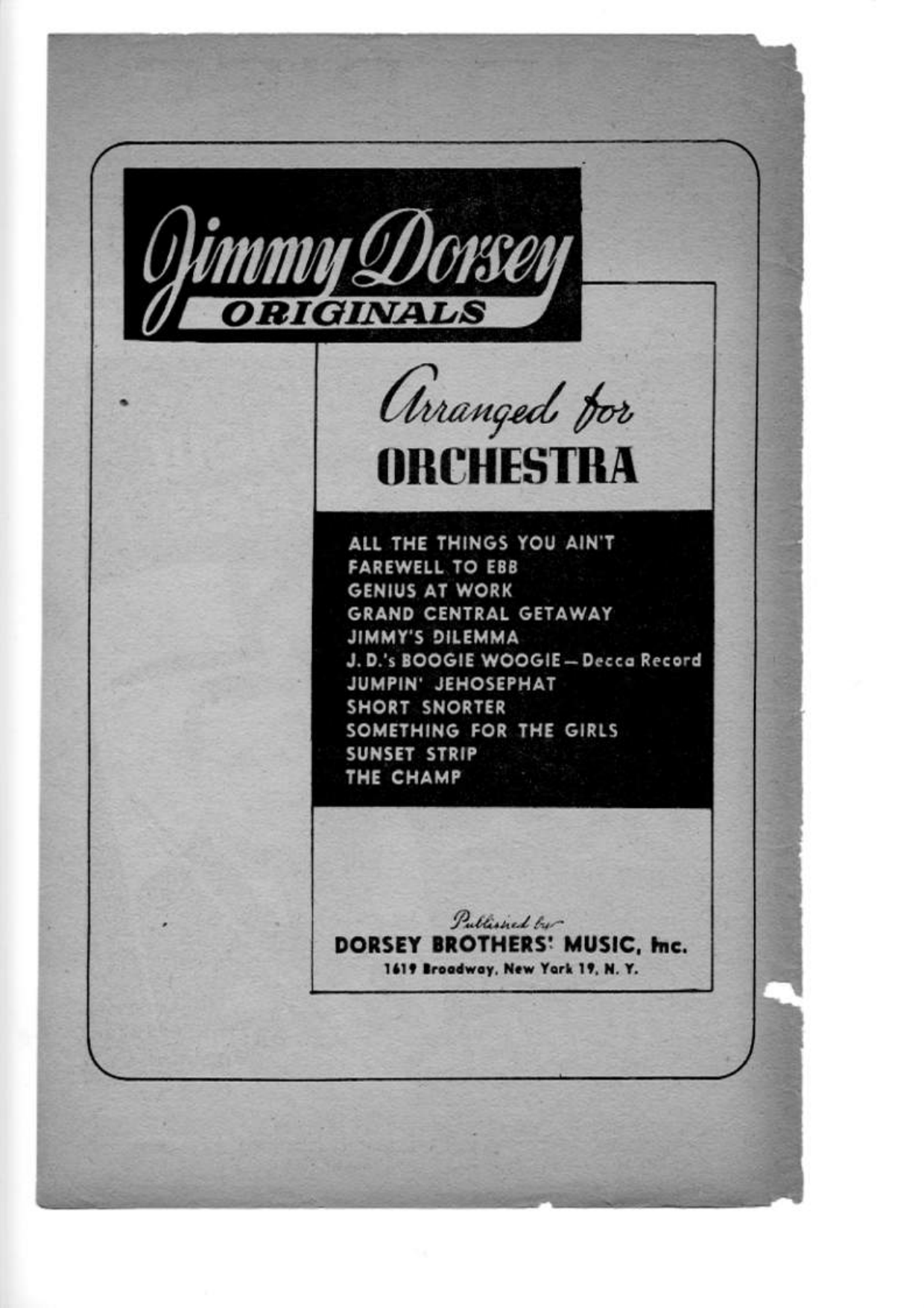
Jimmy's Dilemma (J.Dorsey)
Composed by Jimmy Dorsey
Arranged by Tommy Dorsey-Jimmy Dorsey
- Ensemble: Big Band
- Pages: 31
- Instruments (14): Piano, Violin Conductor, 1st Saxophone Eb Alto, 2nd Saxophone Bb Tenor, 3rd Saxophone Eb Alto, 4th Saxophone Bb Tenor, 1st Trumpet in Bb, 2nd Trumpet in Bb, 3rd Trumpet in Bb, 1st Trombone, 2nd Trombone, Guitar, Bass, Drums
- Difficulty: medium
- Content: Individual Parts
- Format: PDF Download (Instant)
- Price: $24.99
The swing era bore witness to a fierce yet deeply respectful sibling rivalry, perhaps best embodied by the contrasting yet complementary musical minds of Jimmy and Tommy Dorsey. "Jimmy's Dilemma," originally crafted and popularized by Jimmy Dorsey and his renowned orchestra during the peak of the 1930s and 1940s big band golden age, captures the sophisticated duality of the Dorsey sound. While Tommy was celebrated for his velvet-toned trombone and soaring emotional balladry, Jimmy was a master of fleet-fingered alto saxophone virtuosity, immaculate section precision, and a smooth, commercial yet deeply swinging approach to dance band jazz. This composition serves as an exemplary showcase of Jimmy Dorsey’s signature writing style, blending polished sweet-band aesthetics with swinging, intricate counterpoint that challenges both the mind and the fingers. Propelled by an infectious, driving medium-up swing groove in 4/4 time, the musical character of "Jimmy's Dilemma" oscillates between crystalline, harmonically rich ensemble passages and high-energy release. The arrangement opens with an inviting, buoyant rhythmic pulse that immediately evokes the glamorous atmosphere of mid-century ballroom stages like the Hotel Astor. The mood is both sophisticated and playful, building tension through clever chromatic voice-leading and snappy syncopation before erupting into exhilarating tutti bursts. Emotional peaks are achieved through dynamic contrast—shifting seamlessly from hushed, tightly-voiced saxophone interludes to roaring brass declarations that capture the quintessential exuberance of the swing era. In this masterful adaptation credited to the Dorsey brothers' collaborative legacy, the arranger utilizes classic 1930s big band scoring techniques adapted for an agile 8-instrument ensemble format. Rather than relying on a massive, standard 17-piece footprint, this chart distributes the harmonic and melodic weight across Alto Saxophone, Tenor Saxophone, Trumpet, Trombone, Piano, and rhythm section components, achieving a surprisingly full, transparent texture reminiscent of the Dorsey small-group and studio configurations. The alto and tenor saxophones frequently lock into tight, harmonized solis that demand absolute rhythmic unity and clean articulation, while the brass punctuates the arrangement with punchy, plunger-assisted or open-horn accents. The piano acts as both a rhythmic anchor and a harmonic bridge, featuring sophisticated stride-influenced or comping voicings that keep the forward momentum relentlessly engaged. Ideal for advanced high school, collegiate, and professional-level ensembles looking to capture an authentic vintage jazz vocabulary, this 31-page arrangement requires clean execution of swing eighth-notes, precise dynamic control, and a strong sense of internal time. Solo opportunities are integrated naturally into the form, allowing featured woodwind or brass players to stretch out over classic chord changes. Performers will find immense artistic satisfaction in navigating the clever interplay between the saxophone and brass sections, making "Jimmy's Dilemma" a brilliant historical centerpiece and a crowd-pleasing highlight for any serious jazz concert or dance program. Navigating "Jimmy's Dilemma" successfully requires a deep commitment to authentic swing-era phrasing, where eighth-notes must be heavily swung with a relaxed, back-beat-oriented pulse rather than treated strictly mathematically. The tempo should remain a steady, confident medium-up swing (around 160–172 BPM), ensuring that the intricate melodic lines never feel rushed. A primary technical challenge lies in the tight ensemble integration between the alto and tenor saxophones during fast, interlocking soli sections. Players must match vibrato widths, articulation lengths (balancing staccato punches with legato slurs), and pitch tendencies meticulously. Brass players should utilize a warm, open tone for standard passages, reserving any mutes or stylistic colorations (such as gentle falls or shakes) for designated climactic accents rather than overusing them. Rehearsal should begin section-by-section at a reduced tempo, focusing heavily on syncopated rhythms and off-beat entrances. Conductors must ensure the rhythm section locks in tightly to support the horn voicings, maintaining a light, driving ride cymbal pattern and articulate bass line that honors the historic Dorsey rhythm concept. Q: What instruments and parts are included in this arrangement of "Jimmy's Dilemma"? A: The arrangement is scored across 31 pages for an 8-instrument core ensemble, specifically featuring Alto Saxophone, Tenor Saxophone, Trumpet, Trombone, Piano, and accompanying rhythm section parts tailored for a compact big band format. Q: What is the difficulty level of this chart? A: This arrangement is best suited for advanced high school, collegiate, and professional ensembles due to its dense harmonic structures, rapid ensemble interplay, and the requirement for authentic swing-era articulation. Q: What is the historical style and background of this piece? A: Composed and popularized by Jimmy Dorsey during the golden age of 1930s and 1940s swing, the piece reflects the sophisticated dance-orchestra tradition blended with virtuosic jazz improvisation and tight section writing. Q: What makes this specific arrangement unique? A: It condenses the rich, multi-layered textures of a full 17-piece orchestra into an agile 8-instrument configuration without sacrificing harmonic depth, capturing the signature Dorsey blend of sweet elegance and hot swing. Q: What is the recommended performance tempo and duration? A: The piece is designed to be performed at a confident medium-up swing tempo (approximately 160 to 172 BPM), with a standard performance duration of roughly 3 to 4 minutes depending on solo extensions.
Questions and answers
- What is included in the Jimmy's Dilemma (J.Dorsey) PDF?
- The verified current file contains a conductor score and individual parts across 31 pages.
- How many instruments or parts are listed for Jimmy's Dilemma (J.Dorsey)?
- The verified instrumentation list contains 14 entries for this Big Band arrangement.
- Who is credited for Jimmy's Dilemma (J.Dorsey)?
- Composer: Jimmy Dorsey. Arranger: Tommy Dorsey-Jimmy Dorsey.
- What difficulty is listed for Jimmy's Dilemma (J.Dorsey)?
- The verified difficulty level is medium.
- Can I preview Jimmy's Dilemma (J.Dorsey) before buying?
- Yes. The product page provides a preview generated from the current PDF file.
- How is Jimmy's Dilemma (J.Dorsey) delivered?
- After successful payment, the digital PDF is made available for download. The displayed price is $24.99.
Musicians Also Search For
Jimmy's Dilemma Tommy Dorsey-Jimmy Dorsey PDF • Jimmy's Dilemma Tommy Dorsey-Jimmy Dorsey sheet music • Jimmy's Dilemma arranged by Tommy Dorsey-Jimmy Dorsey • Tommy Dorsey-Jimmy Dorsey big band charts • Tommy Dorsey-Jimmy Dorsey jazz arrangements PDF • Jimmy's Dilemma Jimmy Dorsey sheet music • Jimmy's Dilemma Jimmy Dorsey big band arrangements • Jimmy Dorsey big band charts • Jimmy's Dilemma big band arrangements • Jimmy's Dilemma big band PDF download • Jimmy's Dilemma jazz sheet music • big band sheet music download • Jimmy's Dilemma conductor score PDF • Jimmy's Dilemma individual parts download • Jimmy's Dilemma sheet music PDF • buy Jimmy's Dilemma sheet music • download Jimmy's Dilemma PDF • Jimmy's Dilemma jazz charts • best Tommy Dorsey-Jimmy Dorsey big band arrangements • Jimmy Dorsey arranged by Tommy Dorsey-Jimmy Dorsey • Jimmy's Dilemma printable sheet music • big band repertoire PDF