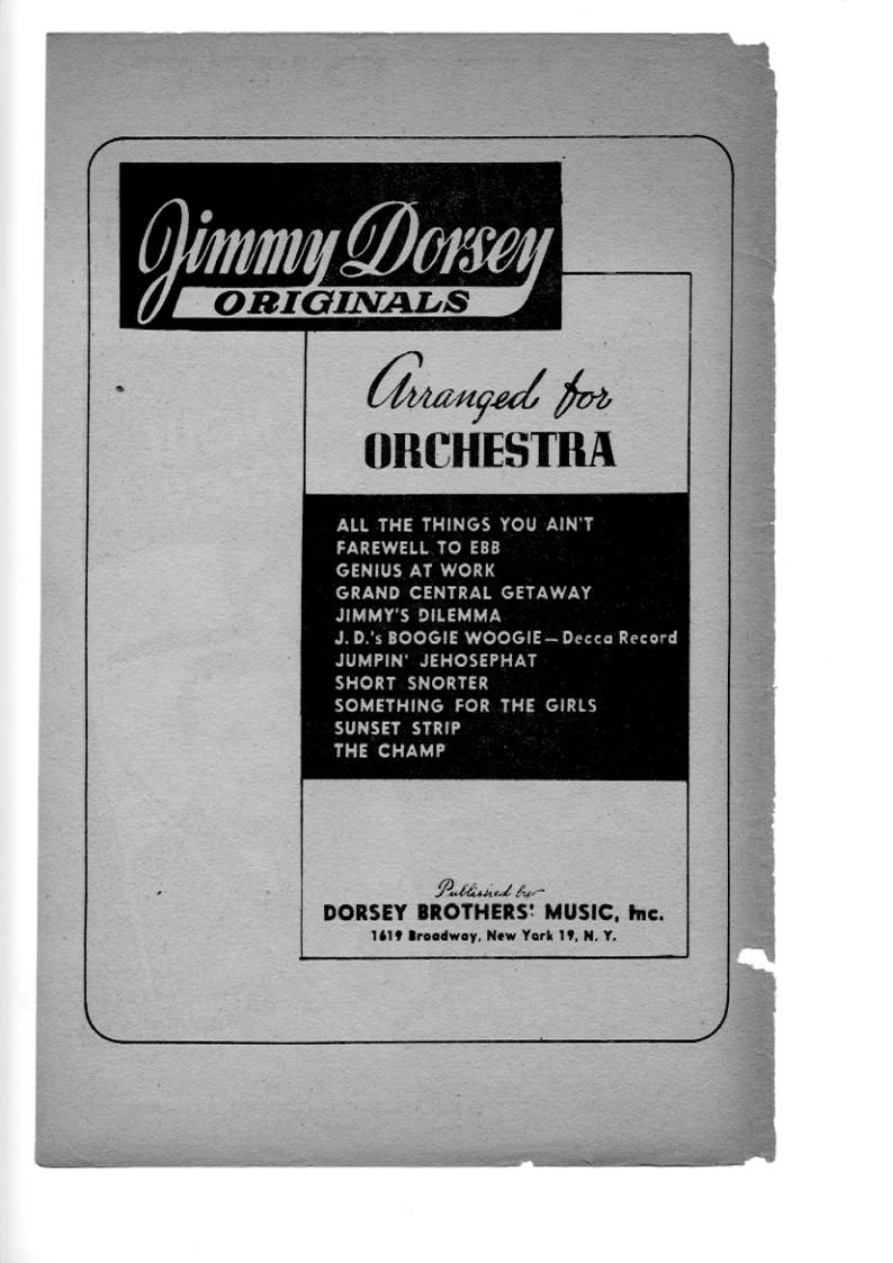
Jimmy's Dilemma (J.Dorsey)
Composed by Jimmy Dorsey
- Ensemble: Big Band Dance
- Style: Big Band Dance
- Pages: 31
- Instruments (14): Piano, Violin Conductor, 1st Saxophone Eb Alto, 2nd Saxophone Bb Tenor, 3rd Saxophone Eb Alto, 4th Saxophone Bb Tenor, 1st Trumpet in Bb, 2nd Trumpet in Bb, 3rd Trumpet in Bb, 1st Trombone, 2nd Trombone, Guitar, Bass, Drums
- Difficulty: medium
- Content: Individual Parts
- Format: PDF Download (Instant)
- Price: $24.99
"Jimmy's Dilemma," a quintessential big band dance chart, transports performers and audiences alike to the golden age of the Swing Era, specifically the late 1930s and early 1940s. Penned by the legendary Jimmy Dorsey, this piece embodies the sophisticated yet irresistibly danceable sound that defined his orchestra's immense popularity. Dorsey, a virtuoso clarinetist and alto saxophonist, was renowned for his smooth, melodic approach to jazz, blending intricate arrangements with a strong emphasis on melody and a driving, yet refined, swing feel. This particular composition, while not always cited as a "standard" in the improvisational sense, is a significant historical artifact, showcasing the compositional and arranging prowess prevalent in the era's top dance bands. It captures the spirit of an era when big bands were the primary popular music vehicle, filling ballrooms with vibrant energy and elegant musicality. This arrangement of "Jimmy's Dilemma" is a vibrant showcase of the big band dance style, characterized by a medium-up swing tempo in 4/4 time, typically hovering around 180-200 BPM. The key center, often in a bright, accessible major key, contributes to its uplifting and energetic mood. The arrangement is built upon a foundation of tight ensemble playing, featuring crisp articulation and precise rhythmic interplay. The overall sound is bright and full-bodied, evoking the classic big band sound with its rich brass fanfares, soaring saxophone soli, and a rhythm section that provides a relentless yet supple groove. While the original arranger is unknown, their approach clearly honors Dorsey's aesthetic, emphasizing clarity, melodicism, and a driving, dance-oriented pulse. Expect well-crafted sectional writing, with brass and saxophones engaging in call-and-response figures and tightly voiced harmonies that are characteristic of the period. The arrangement unfolds with a clear melodic presentation, often featuring the lead alto saxophone or trumpet carrying the initial melodic statements, supported by lush ensemble pads. Soli sections are prominent, particularly for the saxophone section, showcasing intricate lines that demand precision and blend. While extended improvised solos are not the primary focus of this dance chart, there may be brief, written-out solo breaks or short, accessible improvised sections for a lead instrumentalist, typically trumpet or tenor saxophone, designed to maintain the dance momentum rather than explore complex harmonic improvisation. The technical challenges lie primarily in ensemble precision, dynamic control, and maintaining a consistent, authentic swing feel throughout. Rewarding moments include the exhilarating shout choruses, where the full ensemble comes together in powerful, harmonically rich statements, and the satisfying interplay between sections. This arrangement is well-suited for college, community, and advanced high school jazz ensembles looking to authentically recreate the sound and feel of a classic Swing Era dance band. Its structured nature and clear musical directives make it an excellent teaching tool for historical big band performance practices. Approaching "Jimmy's Dilemma" requires a strong emphasis on rhythmic precision and stylistic authenticity. Maintain a consistent medium-up swing feel, ensuring the eighth notes are properly swung without becoming overly dotted or triplet-heavy. Articulation is paramount; brass should play with crisp, unified attacks, while saxophones should aim for a smooth, connected legato in soli passages, punctuated by precise staccato where marked. Dynamic contrasts are crucial for shaping the piece's energy; emphasize crescendos into shout choruses and sudden dynamic shifts for dramatic effect. The rhythm section must lay down a solid, unwavering foundation, with the bass providing a strong walking line and the drums driving the ensemble with a classic swing pattern, utilizing brushes or sticks appropriately. Pay close attention to blend and balance, especially in the saxophone soli sections and brass fanfares, ensuring no single voice dominates. Rehearse tricky ensemble figures slowly to achieve absolute tightness before bringing them up to tempo, focusing on unified cut-offs and releases. Q: What instruments and parts are included in this arrangement? A: This arrangement is scored for a full 17-piece big band, including Alto Saxophone 1, Alto Saxophone 2, Tenor Saxophone 1, Tenor Saxophone 2, Baritone Saxophone, Trumpet 1, Trumpet 2, Trumpet 3, Trumpet 4, Trombone 1, Trombone 2, Trombone 3, Trombone 4, Piano, Bass, Drums, and Guitar. Q: What is the difficulty level of "Jimmy's Dilemma"? A: This arrangement is rated as an intermediate to advanced level, appropriate for college, community, and proficient high school jazz ensembles. Its demands lie in rhythmic precision, ensemble blend, and stylistic authenticity rather than complex improvisation. Q: What musical style and historical context does this arrangement represent? A: "Jimmy's Dilemma" is a classic example of the Big Band Dance style from the late 1930s to early 1940s, embodying the sophisticated, danceable sound popularized by Jimmy Dorsey's orchestra during the Swing Era. Q: What makes this arrangement unique or particularly notable? A: This arrangement offers an authentic recreation of a Jimmy Dorsey big band chart, emphasizing tight ensemble writing, prominent saxophone soli, and a driving yet refined medium-up swing feel, making it an excellent vehicle for exploring historical big band performance practices. Q: What is the typical performance duration or tempo for this piece? A: "Jimmy's Dilemma" is typically performed at a medium-up swing tempo, generally ranging from 180-200 beats per minute, resulting in a performance duration of approximately 3 to 4 minutes, depending on any optional repeats.
Questions and answers
- What is included in the Jimmy's Dilemma (J.Dorsey) PDF?
- The verified current file contains a conductor score and individual parts across 31 pages.
- How many instruments or parts are listed for Jimmy's Dilemma (J.Dorsey)?
- The verified instrumentation list contains 14 entries for this Big Band Dance arrangement.
- Who is credited for Jimmy's Dilemma (J.Dorsey)?
- Composer: Jimmy Dorsey.
- What difficulty is listed for Jimmy's Dilemma (J.Dorsey)?
- The verified difficulty level is medium.
- What style is listed for Jimmy's Dilemma (J.Dorsey)?
- The catalog lists the style as Big Band Dance.
- Can I preview Jimmy's Dilemma (J.Dorsey) before buying?
- Yes. The product page provides a preview generated from the current PDF file.
- How is Jimmy's Dilemma (J.Dorsey) delivered?
- After successful payment, the digital PDF is made available for download. The displayed price is $24.99.
Musicians Also Search For
Jimmy's Dilemma Jimmy Dorsey sheet music • Jimmy's Dilemma Jimmy Dorsey big band dance arrangements • Jimmy Dorsey big band dance charts • Jimmy's Dilemma big band dance arrangements • Jimmy's Dilemma big band dance PDF download • Jimmy's Dilemma jazz sheet music • big band dance sheet music download • Jimmy's Dilemma conductor score PDF • Jimmy's Dilemma individual parts download • Jimmy's Dilemma sheet music PDF • Jimmy's Dilemma Big Band Dance charts • Big Band Dance big band dance arrangements • buy Jimmy's Dilemma sheet music • download Jimmy's Dilemma PDF • Jimmy's Dilemma jazz charts • Jimmy's Dilemma printable sheet music • big band dance repertoire PDF