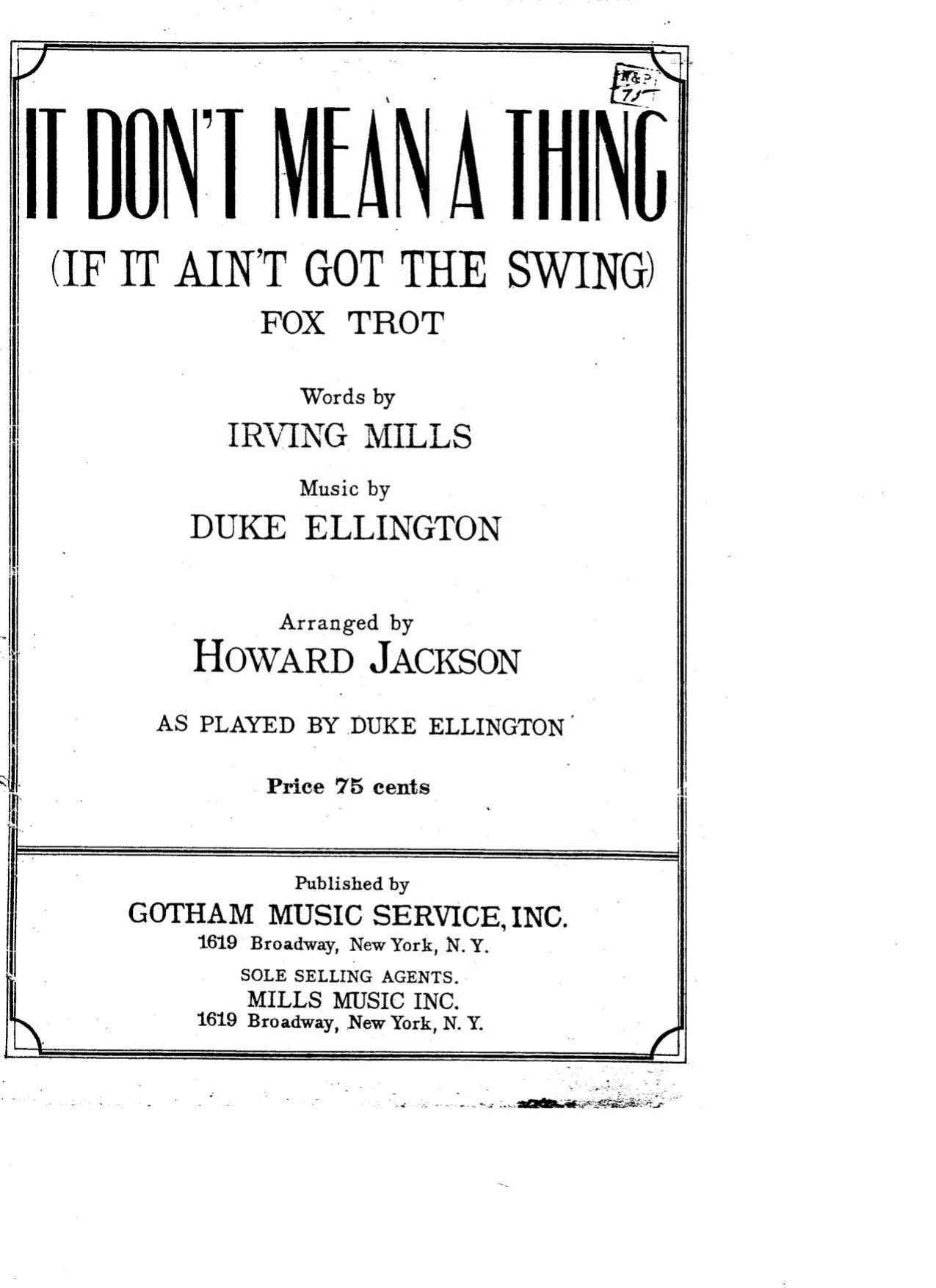
It Don't Mean A Thing (H.Jackson)
Composed by Duke Ellington
Arranged by H. Jackson
- Ensemble: Big Band Dance
- Style: Big Band Dance
- Pages: 27
- Instruments (13): 1st Eb Alto Saxophone, 2nd Bb Tenor Saxophone, 3rd Saxophone (Eb ALTO), 1st Bb Trumpet, 2nd Bb Trumpet, 3rd Bb Trumpet, 1st Trombone, 2nd Trombone, Violins, Piano, Banjo, Bass, Drums
- Difficulty: medium
- Content: Individual Parts
- Format: PDF Download (Instant)
- Price: $24.99
Duke Ellington's immortal "It Don't Mean a Thing (If It Ain't Got That Swing)" stands as a cornerstone of the jazz repertoire, a declaration of the very essence of the genre. Composed in 1932, it became one of the earliest pieces to explicitly use the word "swing" in its title, solidifying its place as an anthem for the burgeoning Swing Era. Made famous by Ellington's orchestra, often featuring the vocal talents of Ivie Anderson, the tune's infectious energy and simple, direct message resonated deeply, cementing its status as an enduring jazz standard. Its call-and-response structure and driving rhythm embody the celebratory spirit of early big band jazz, making it a perennial favorite for dancers and listeners alike. H. Jackson's arrangement of this iconic tune is a vibrant homage to the "Big Band Dance" style, designed to capture the exhilarating feel of a classic swing era performance. Set at a bright, medium-up tempo, it immediately establishes a driving 4/4 swing groove that is both authentic and irresistible. The arrangement is primarily in the key of G minor, providing a rich, slightly melancholic yet undeniably propulsive harmonic foundation. Jackson's approach emphasizes clear, articulate voicings that allow the individual sections to shine, creating a full and dynamic sound with a smaller ensemble. The mood is one of joyous exuberance, evoking the energy of a bustling dance hall from the 1930s or 40s. This particular treatment by H. Jackson is notable for its intelligent use of a compact seven-instrument lineup (Alto Sax, Tenor Sax, Trumpet, Trombone, Piano, Bass, Drums) while still delivering a robust big band sound. The melody is skillfully passed between the alto sax and trumpet, often supported by tight, harmonized figures in the other horns, creating a rich texture without requiring a full complement of sections. A significant feature is the inclusion of a dedicated solo section over the standard changes, providing ample opportunity for improvisation, typically featuring the alto saxophone and trumpet, allowing for individual expression within the ensemble context. The arrangement builds effectively towards a spirited shout chorus, where the full ensemble unites for a powerful, harmonically dense statement that is both thrilling and climactic. Performing this arrangement is a rewarding experience for a variety of ensembles. While technically accessible, it demands precision in articulation, a unified swing feel, and strong rhythmic conviction from all players. The brass section will benefit from attention to blend and dynamic contrasts, particularly in the call-and-response passages. The rhythm section is crucial for maintaining the consistent, driving pulse that defines the piece. Its compact instrumentation makes it particularly suitable for high school, community, or smaller college jazz ensembles seeking to perform authentic big band dance music without the need for a full 17-piece orchestra. The arrangement's clarity and infectious energy make it an excellent choice for concert programs, dance events, or educational settings focused on the Swing Era. This arrangement thrives on a consistent, driving medium-up swing feel, ideally around 180-200 BPM. The rhythm section must establish a rock-solid 4/4 pulse from the outset, with the bass walking purposefully and the drums providing a crisp, swinging ride cymbal pattern. Articulation is paramount; encourage brass players to use short, precise staccatos and clear, sustained notes as indicated, avoiding overly legato phrasing that can diminish the swing. Saxophone soli sections require careful attention to blend and intonation, ensuring a unified sound. The trumpet and trombone parts include occasional falls and scoops, which should be executed with stylistic flair but without exaggeration. Rehearsal time should focus on rhythmic precision in tutti sections, dynamic shaping, and ensuring the soloists feel comfortable and supported by the rhythm section. Emphasize the call-and-response interplay between sections to bring out the authentic big band character. Q: What instruments are included in this arrangement? A: This arrangement is scored for a compact 7-instrument big band lineup: Alto Saxophone, Tenor Saxophone, Trumpet, Trombone, Piano, Bass, and Drums. Q: What is the difficulty level of "It Don't Mean A Thing (H.Jackson)"? A: This arrangement is rated as medium difficulty, suitable for high school, community, and smaller college jazz ensembles. It requires solid rhythmic precision and a good understanding of swing articulation. Q: What musical style and historical context does this arrangement represent? A: It embodies the "Big Band Dance" style of the Swing Era, specifically referencing Duke Ellington's iconic 1932 composition, which helped define the sound of swing jazz. Q: What makes H. Jackson's arrangement of this piece unique? A: H. Jackson's arrangement uniquely captures a full big band sound with only seven instruments, featuring intelligent voicings, clear melodic statements passed between horns, and a dynamic shout chorus, making it accessible for smaller ensembles. Q: What is the typical performance duration and tempo for this arrangement? A: The performance duration typically ranges from 3:00 to 3:30 minutes, played at a bright, medium-up swing tempo, ideally between 180-200 beats per minute.
Questions and answers
- What is included in the It Don't Mean A Thing (H.Jackson) PDF?
- The verified current file contains individual parts across 27 pages.
- How many instruments or parts are listed for It Don't Mean A Thing (H.Jackson)?
- The verified instrumentation list contains 13 entries for this Big Band Dance arrangement.
- Who is credited for It Don't Mean A Thing (H.Jackson)?
- Composer: Duke Ellington. Arranger: H. Jackson.
- What difficulty is listed for It Don't Mean A Thing (H.Jackson)?
- The verified difficulty level is medium.
- What style is listed for It Don't Mean A Thing (H.Jackson)?
- The catalog lists the style as Big Band Dance.
- Can I preview It Don't Mean A Thing (H.Jackson) before buying?
- Yes. The product page provides a preview generated from the current PDF file.
- How is It Don't Mean A Thing (H.Jackson) delivered?
- After successful payment, the digital PDF is made available for download. The displayed price is $24.99.
Musicians Also Search For
It Don't Mean A Thing H. Jackson PDF • It Don't Mean A Thing H. Jackson sheet music • It Don't Mean A Thing arranged by H. Jackson • H. Jackson big band dance charts • H. Jackson jazz arrangements PDF • It Don't Mean A Thing Duke Ellington sheet music • It Don't Mean A Thing Duke Ellington big band dance arrangements • Duke Ellington big band dance charts • It Don't Mean A Thing big band dance arrangements • It Don't Mean A Thing big band dance PDF download • It Don't Mean A Thing jazz sheet music • big band dance sheet music download • It Don't Mean A Thing individual parts download • It Don't Mean A Thing sheet music PDF • It Don't Mean A Thing Big Band Dance charts • Big Band Dance big band dance arrangements • buy It Don't Mean A Thing sheet music • download It Don't Mean A Thing PDF • It Don't Mean A Thing jazz charts • best H. Jackson big band dance arrangements • Duke Ellington arranged by H. Jackson • It Don't Mean A Thing printable sheet music • big band dance repertoire PDF