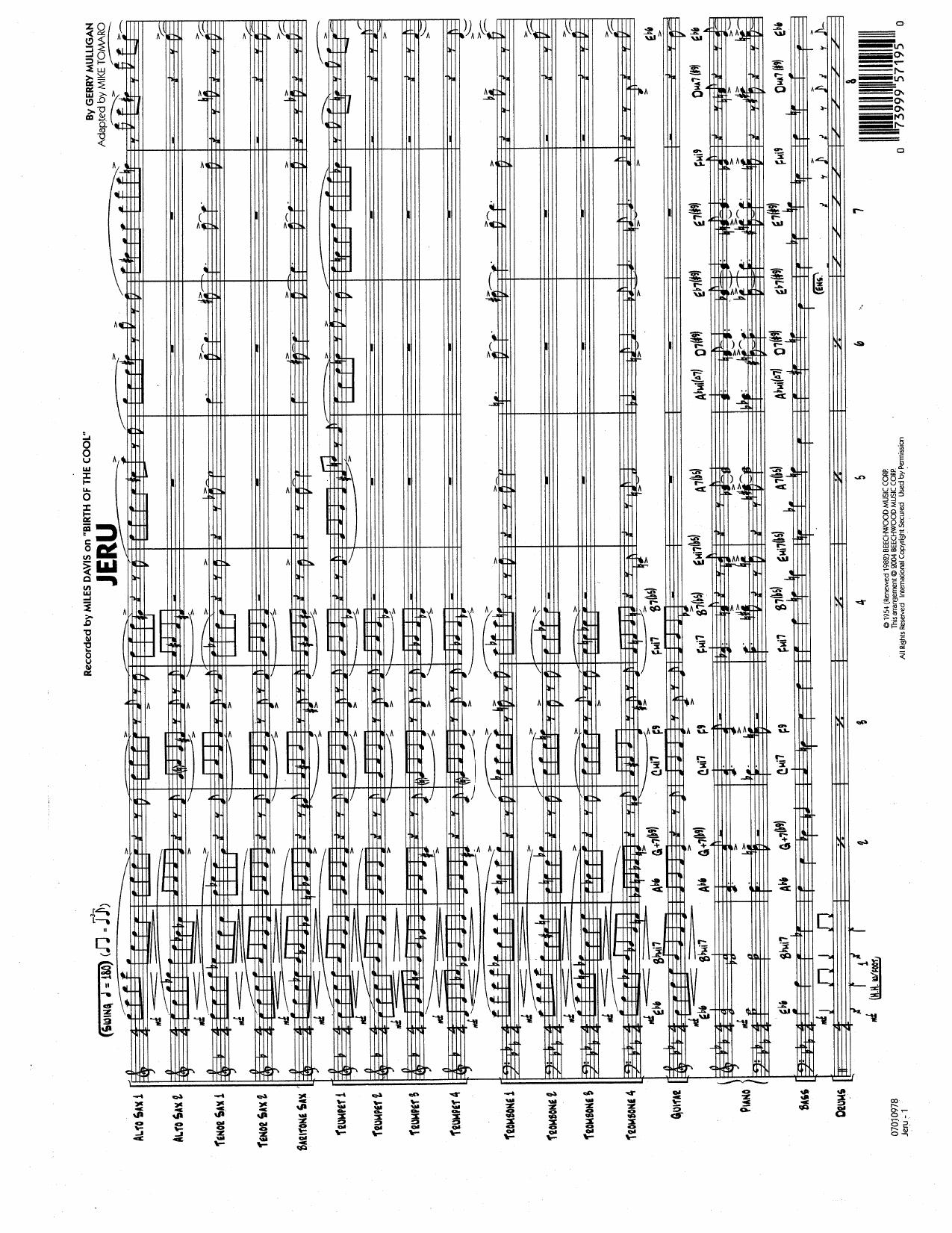
Jeru (M.Tomaro)
Composed by Gerry Mulligan
Arranged by Gerry Mulligan
- Ensemble: Big Band
- Pages: 55
- Instruments (17): Alto Sax 1, Alto Sax 2, Tenor Sax 1, Tenor Sax 2, Baritone Sax, Trumpet 1, Trumpet 2, Trumpet 3, Trumpet 4, Trombone 1, Trombone 2, Trombone 3, Trombone 4, Guitar, Piano, Bass, Drums
- Difficulty: advanced
- Content: Individual Parts
- Format: PDF Download (Instant)
- Price: $24.99
Originally composed by baritone saxophone master Gerry Mulligan and immortalized on Miles Davis's landmark 1949–1950 nonet recordings compiled in *Birth of the Cool*, "Jeru" stands as a cornerstone of cool jazz composition and linear counterpoint. Mulligan originally wrote the tune as a playful yet sophisticated vehicle showcasing the light, buoyant textures and unique tonal blend characteristic of the birth-of-the-cool movement. Evolving far beyond its nonet origins, this sophisticated big band adaptation translates the intimate, horizontal writing style of the original recording into a rich, full-ensemble palette while maintaining the intellectual depth and relaxed sophistication that defined Mulligan’s writing. Mike Tomaro’s masterful arrangement frames the iconic thematic material within a steady, infectious medium swing feel. Built on cool-jazz harmonic sensibilities, the chart evokes an atmosphere of urbane elegance, balancing breezy, conversational horn lines with driving rhythmic momentum. Rather than relying on heavy, dense vertical block chords, the scoring honors Mulligan's compositional philosophy by favoring linear transparency, nimble counterpoint, and clean sectional interplay. The mood shifts effortlessly from laid-back cool to high-energy swing, offering an engaging journey for both performers and listeners. Tomaro expertly distributes the melodic weight across the ensemble, ensuring that sectional transparency mirrors the conversational nature of a small jazz combo. The primary thematic statements are carried with lightness and precision, requiring immaculate articulation and stylistic cohesion from the entire horn section. Featured solo space is allocated to trumpet and baritone saxophone (with an optional tenor saxophone part provided), allowing featured improvisers to stretch out over traditional changes. Technical challenges center around maintaining a relaxed, buoyant eighth-note feel at a moderate tempo rather than executing extreme finger gymnastics, making crisp articulation and uniform phrasing the primary benchmarks for success. Advanced high school, college, and community big bands will find this chart to be an exceptional vehicle for developing stylistic versatility, stylistic historical awareness, and section balance. Because the difficulty lies primarily in ensemble blend and stylistic nuance rather than sheer endurance or altissimo range, it serves as an ideal bridge for younger groups stepping into sophisticated West Coast jazz idioms. Performing this arrangement offers ensembles a direct connection to the foundational history of modern jazz orchestration, rewarding meticulous preparation with timeless musical charm. Achieving the authentic cool-jazz aesthetic of this arrangement requires strict attention to a relaxed, horizontal eighth-note feel. Avoid heavy accents on downbeats; instead, emphasize a smooth, legato-tongued approach where notes are sustained and gently connected. The tempo should remain a steady medium swing, avoiding any tendency to rush during ensemble shout choruses. The brass section should utilize a warm, open tone, keeping vibrato controlled and subtle in the manner of the Miles Davis nonet tradition. Mutes are generally not required, keeping the ensemble sound transparent and cohesive. Rehearsal time should be heavily invested in balancing the inner voices; because Tomaro's counterpoint relies on linear independence, the accompanying horns must dynamically support the primary melody without overpowering it. Pay close attention to articulation markings—detached notes should be crisp rather than clipped, and long notes should have a continuous vocal quality. Soloists should be encouraged to approach their improvisations with a lyrical, melodic mindset, mirroring the conversational phrasing established in the head arrangements. Q: What instruments and parts are included in this arrangement? A: This chart is scored for a standard big band instrumentation featuring 8 essential instruments/sections (Alto Saxophones 1-2, Tenor Saxophones 1-2, Baritone Saxophone, Trumpets 1-4, Trombones 1-3, Bass Trombone, Guitar, Piano, Bass, and Drums), plus a full conductor score and individual parts spanning 55 pages. Q: What is the difficulty level of this chart? A: It is graded as a Medium (Level 4) arrangement, making it highly accessible for advanced high school, collegiate, and community jazz orchestras. Q: What musical style and historical era does "Jeru" represent? A: "Jeru" is a defining composition of the cool jazz movement, originally written by Gerry Mulligan and popularized through the historic *Birth of the Cool* recordings. Q: What makes this specific arrangement by Mike Tomaro unique? A: Tomaro successfully scales down the intricate, linear, and pianoless-sounding counterpoint of Mulligan's original small-group concept into a dynamic full big-band setting without losing its trademark transparency and breezy charm. Q: Does the arrangement feature improvised solos and what is the tempo feel? A: Yes, the chart features designated solo space for trumpet and baritone saxophone (with an optional tenor saxophone substitute), performed over a steady, relaxed medium swing groove.
Questions and answers
- What is included in the Jeru (M.Tomaro) PDF?
- The verified current file contains a conductor score and individual parts across 55 pages.
- How many instruments or parts are listed for Jeru (M.Tomaro)?
- The verified instrumentation list contains 17 entries for this Big Band arrangement.
- Who is credited for Jeru (M.Tomaro)?
- Composer: Gerry Mulligan. Arranger: Gerry Mulligan.
- What difficulty is listed for Jeru (M.Tomaro)?
- The verified difficulty level is advanced.
- Can I preview Jeru (M.Tomaro) before buying?
- Yes. The product page provides a preview generated from the current PDF file.
- How is Jeru (M.Tomaro) delivered?
- After successful payment, the digital PDF is made available for download. The displayed price is $24.99.
Musicians Also Search For
Jeru Gerry Mulligan PDF • Jeru Gerry Mulligan sheet music • Jeru arranged by Gerry Mulligan • Gerry Mulligan big band charts • Gerry Mulligan jazz arrangements PDF • Jeru Gerry Mulligan big band arrangements • Jeru big band arrangements • Jeru big band PDF download • Jeru jazz sheet music • big band sheet music download • Jeru conductor score PDF • Jeru individual parts download • Jeru sheet music PDF • buy Jeru sheet music • download Jeru PDF • Jeru jazz charts • best Gerry Mulligan big band arrangements • Jeru printable sheet music • big band repertoire PDF