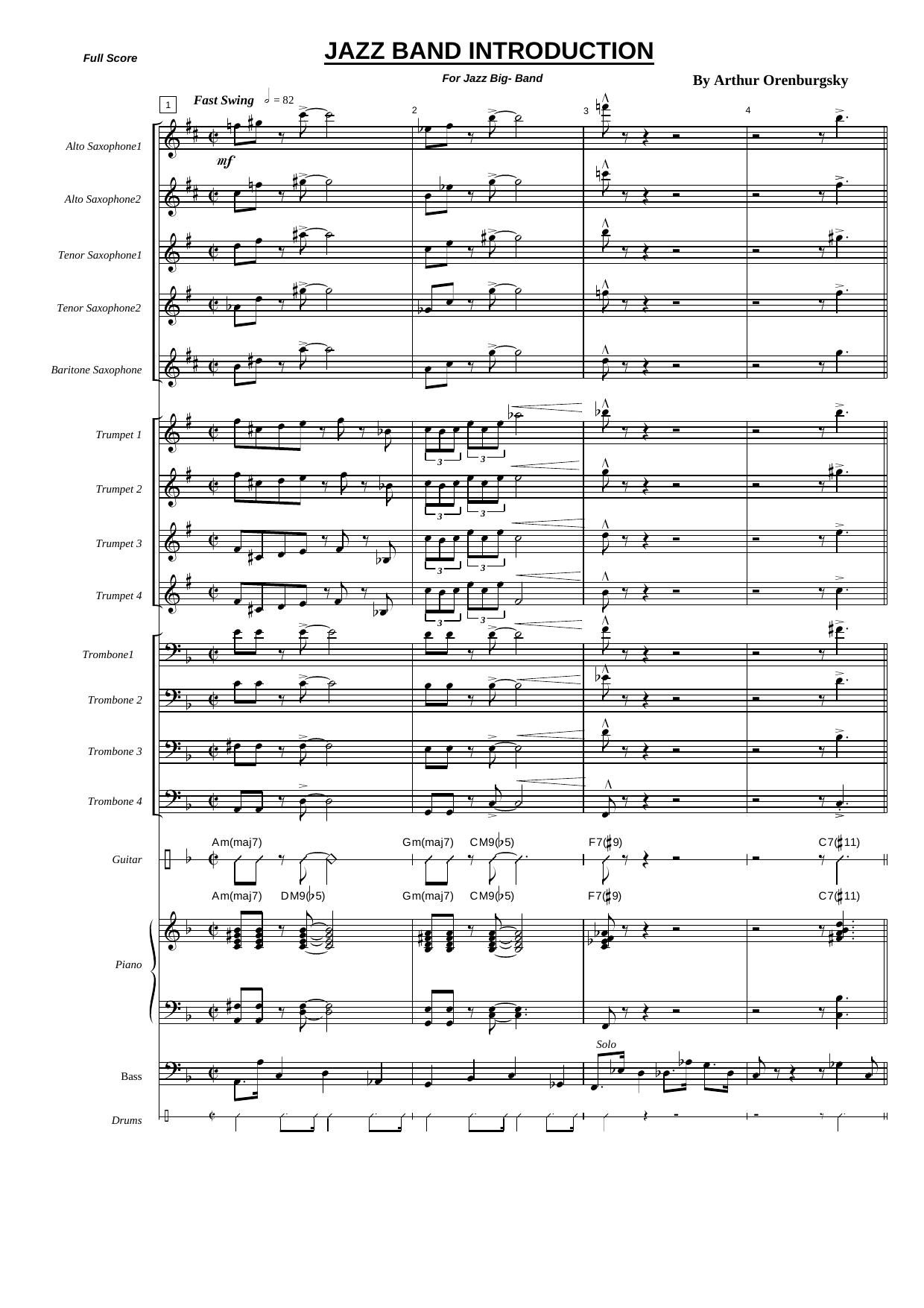
Jazz Band Introductrion (A.Orenburgsky)
Composed by A. Orenburgsky
Arranged by A.Orenburgsky
- Ensemble: Big Band
- Style: Jazz Standard
- Pages: 32
- Instruments (17): Alto Saxophone 1, Alto Saxophone 2, Tenor Saxophone 1, Tenor Saxophone 2, Baritone Saxophone, Trumpet 1, Trumpet 2, Trumpet 3, Trumpet 4, Trombone 1, Trombone 2, Trombone 3, Trombone 4, Guitar, Piano, Bass, Drums
- Difficulty: medium
- Content: Individual Parts
- Format: PDF Download (Instant)
- Price: $24.99
Rooted in the rich tradition of mid-century big band literature, "Jazz Band Introduction" by composer and arranger A. Orenburgsky captures the sophisticated harmonic palette and driving momentum of modern straight-ahead jazz. While paying homage to the classic, brass-heavy architectures pioneered by architects of the swing and post-bop eras, Orenburgsky infuses the composition with contemporary modal colors and crisp rhythmic interjections. This piece functions brilliantly as an overture or a high-impact concert opener, immediately commanding the listener’s attention through a blend of swaggering thematic statements and intricate counterpoint. Driving the composition is a muscular medium-up swing groove set in 4/4 time, propelled by an assertive walking bassline and crisp ride-cymbal ornamentation. The mood shifts fluidly between sultry, muted brass passages and explosive, wide-open ensemble tutti sections. Orenburgsky employs lush, extended chord voicings—frequently utilizing major sevenths, sharp-elevated elevenths, and altered dominants—that give the harmony a sophisticated, urban edge. The arrangement builds tension methodically through cyclical harmonic sequences before resolving into a triumphant, high-energy shout chorus designed to showcase the power and dynamic range of a fully realized seventeen-piece jazz orchestra. The thematic material is distributed democratically across the ensemble, though the saxophone section carries the primary weight of the head, characterized by tight, chromatic voice-leading and interwoven soli lines. Interspersed throughout the chart are dynamic call-and-response figures between the trumpets and trombones that require immaculate articulation and breath control. Solo opportunities are strategically integrated into the middle form, providing a flexible canvas for featured improvisers over accessible yet stimulating harmonic changes. Technical challenges center primarily on maintaining stylistic uniformity during rapid articulated passages and balancing the dense chordal textures in the lower reeds and brass. Advanced high school ensembles, collegiate jazz orchestras, and professional community big bands will find this arrangement to be a rewarding centerpiece for festival repertoires or formal concert programs. The chart demands a mature rhythm section capable of subtle dynamic shifts and steady time-keeping, alongside a horn section comfortable with modern swing phrasing. Ultimately, Orenburgsky has crafted a structurally sound, highly engaging work that rewards meticulous rehearsal and leaves a lasting impression on any audience. Conductors should approach "Jazz Band Introduction" with a strict focus on articulation clarity and section balance. The tempo should sit firmly in a comfortable medium-up swing pocket (approx. quarter note = 180 BPM), ensuring that the eighth-note swing feels relaxed rather than rushed. Key technical challenges involve the execution of syncopated rhythm figures that cross the bar line; players must avoid clipping short notes and ensure proper tongue-stops where indicated. The brass section should utilize cup or bucket mutes during the designated background figures to maintain dynamic separation behind the featured soloists. Rehearsal time is best allocated by section first—specifically drilling the saxophones on their unison and harmonized soli lines to lock in intonation. The rhythm section must lock in early; the drummer should treat the chart with interactive, conversational comping while maintaining a rock-solid time feel on the ride cymbal, avoiding overplaying during the dense ensemble climaxes. Q: What specific instrumentation and parts are included in this package? A: The arrangement is scored for a standard 17-piece big band instrumentation, featuring 2 alto saxophones, 2 tenor saxophones, 1 baritone saxophone, 4 trumpets, 4 trombones, guitar, piano, bass, drums, and a comprehensive conductor score. Q: What is the overall difficulty level of this arrangement? A: This piece is graded as advanced (suitable for upper-level high school, collegiate, and professional big bands), primarily due to its dense extended harmonies, fast-moving ensemble lines, and the requirement for tight section articulation at a brisk tempo. Q: What is the musical style and historical context of the piece? A: Composed by A. Orenburgsky, the piece is written in a modern straight-ahead jazz standard style that bridges the gap between classic mid-century swing architecture and contemporary modal harmonic concepts. Q: What makes this specific arrangement unique within big band literature? A: Orenburgsky’s distinct approach merges traditional swing momentum with sophisticated, altered chord voicings and intricate cross-section counterpoint, giving it a fresh, cinematic quality ideal for opening a concert. Q: What is the approximate performance duration and tempo feel of the work? A: The arrangement runs for approximately 4 to 5 minutes and is anchored by a driving medium-up swing groove in 4/4 time designed to showcase both ensemble power and improvisational flexibility.
Questions and answers
- What is included in the Jazz Band Introductrion (A.Orenburgsky) PDF?
- The verified current file contains a conductor score and individual parts across 32 pages.
- How many instruments or parts are listed for Jazz Band Introductrion (A.Orenburgsky)?
- The verified instrumentation list contains 17 entries for this Big Band arrangement.
- Who is credited for Jazz Band Introductrion (A.Orenburgsky)?
- Composer: A. Orenburgsky. Arranger: A.Orenburgsky.
- What difficulty is listed for Jazz Band Introductrion (A.Orenburgsky)?
- The verified difficulty level is medium.
- What style is listed for Jazz Band Introductrion (A.Orenburgsky)?
- The catalog lists the style as Jazz Standard.
- Can I preview Jazz Band Introductrion (A.Orenburgsky) before buying?
- Yes. The product page provides a preview generated from the current PDF file.
- How is Jazz Band Introductrion (A.Orenburgsky) delivered?
- After successful payment, the digital PDF is made available for download. The displayed price is $24.99.
Musicians Also Search For
Jazz Band Introductrion A.Orenburgsky PDF • Jazz Band Introductrion A.Orenburgsky sheet music • Jazz Band Introductrion arranged by A.Orenburgsky • A.Orenburgsky big band charts • A.Orenburgsky jazz arrangements PDF • Jazz Band Introductrion A. Orenburgsky sheet music • Jazz Band Introductrion A. Orenburgsky big band arrangements • A. Orenburgsky big band charts • Jazz Band Introductrion big band arrangements • Jazz Band Introductrion big band PDF download • Jazz Band Introductrion jazz sheet music • big band sheet music download • Jazz Band Introductrion conductor score PDF • Jazz Band Introductrion individual parts download • Jazz Band Introductrion sheet music PDF • Jazz Band Introductrion Jazz Standard charts • Jazz Standard big band arrangements • buy Jazz Band Introductrion sheet music • download Jazz Band Introductrion PDF • Jazz Band Introductrion jazz charts • best A.Orenburgsky big band arrangements • A. Orenburgsky arranged by A.Orenburgsky • Jazz Band Introductrion printable sheet music • big band repertoire PDF