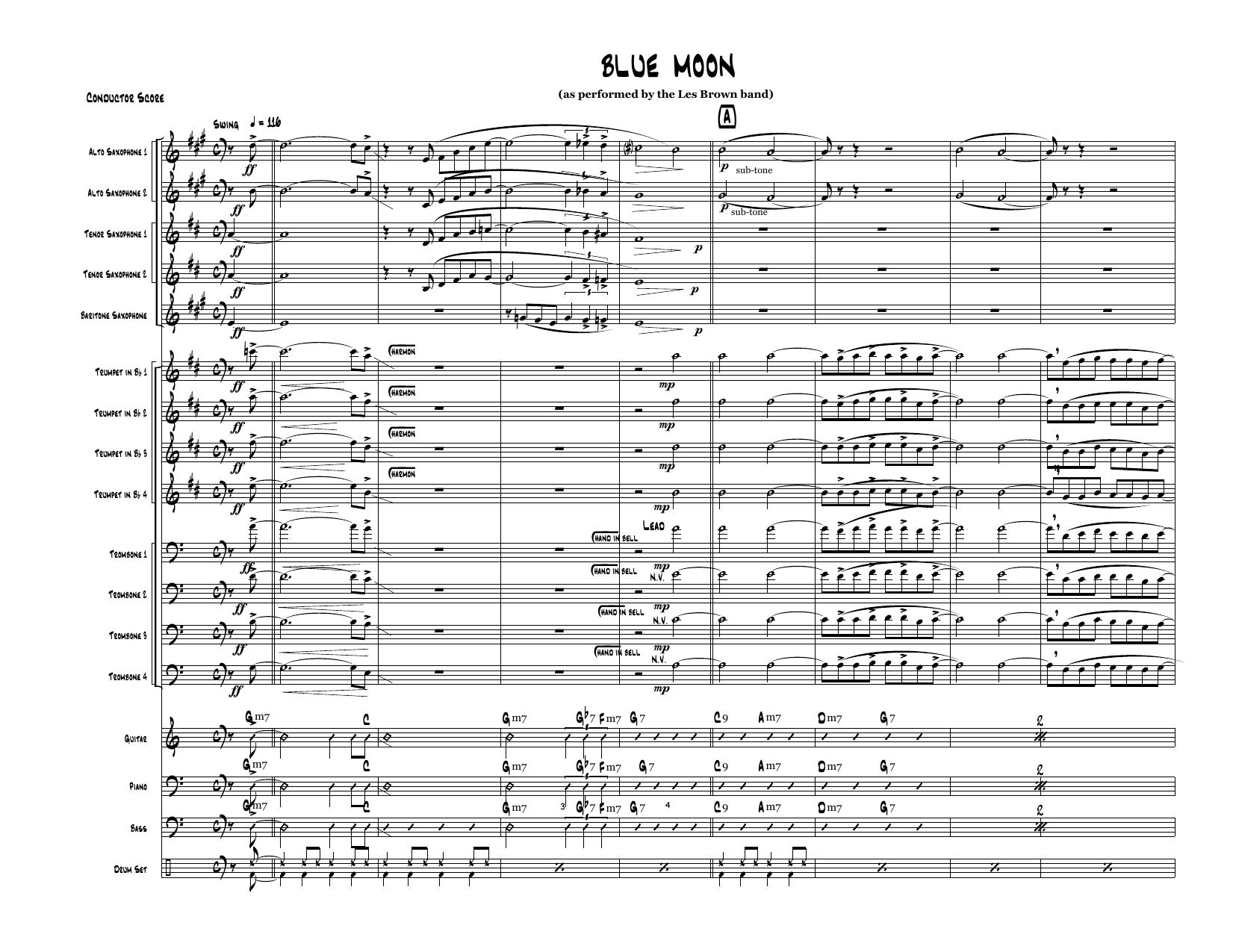
Blue Moon (L.Brown-A.Remington) sheet music preview

Blue Moon (L.Brown-A.Remington)

Composed by Richard Rodgers

Arranged by Les Brown

  • Ensemble: Big Band
  • Pages: 43
  • Instruments (17): Alto Saxophone 1, Alto Saxophone 2, Tenor Saxophone 1, Tenor Saxophone 2, Baritone Saxophone, Trumpet 1, Trumpet 2, Trumpet 3, Trumpet 4, Trombone 1, Trombone 2, Trombone 3, Trombone 4 (Bass Bone), Guitar, Piano, Bass, Drum Set
  • Difficulty: medium
  • Content: Individual Parts
  • Format: PDF Download (Instant)
  • Price: $24.99

Richard Rodgers and Lorenz Hart crafted one of the most enduring gems of the Great American Songbook when they penned "Blue Moon" in 1934, transforming a rejected Hollywood film tune into a melancholic pop-standard masterpiece. While countless vocalists and instrumentalists have interpreted its haunting AABA ballad form, the swing era adaptation by legendary bandleader Les Brown injects a sophisticated, orchestral jazz vitality into the material. Famously associated with Les Brown and His Band of Renown—the powerhouse ensemble that launched Doris Day's career and defined the sound of mid-century campus dances and radio broadcasts—this chart recontextualizes a familiar melody through the lens of West Coast precision, lush harmonic depth, and subtle swing sophistication. Rooted in a relaxed, medium-tempo swing feel (approx. quarter note = 116 BPM), this arrangement opens with a characteristic atmospheric introduction before settling into an effortless, flowing groove. The mood shifts masterfully between nostalgic introspection and warm, driving momentum. Les Brown’s signature arranging style relies heavily on immaculate section balance, crystal-clear counterpoint, and rich, polished brass voicings that avoid overcrowding the soloist. Rather than relying on frantic speed, the emotional weight of the performance is carried by expressive phrasing, dynamic shading, and a sophisticated harmonic palette that adds subtle chromatic extensions to Rodgers' original changes without ever obscuring the core melody. The arrangement distributes thematic material democratically across the 17-piece big band, utilizing lush saxophone solis and tight brass interleaving to maintain textural variety. The reeds—featuring double alto and tenor deployment alongside a anchoring baritone saxophone—frequently carry the primary thematic statements in rich block-chord harmony, while the muted brass provide a warm, textural cushion. Solo opportunities are integrated seamlessly into the form, allowing a featured horn player to stretch out over standard changes while the rhythm section lays down an understated, conversational foundation. The chart builds toward a tasteful ensemble culmination, prioritizing ensemble blend and stylistic unity over sheer volume, making every phrase feel purposeful and deeply swinging. Advanced high school ensembles with strong section players, as well as collegiate and professional community big bands, will find this arrangement an ideal vehicle for developing stylistic maturity. Because the technical demands lie less in extreme fingerbuster passages and more in blend, intonation, swing subdivision, and dynamic control, it serves as an exceptional pedagogical tool for teaching ensemble listening. Directors will appreciate how naturally the chart sits under the fingers of experienced players, rewarding careful attention to articulation markings and yielding a sophisticated, professional sound that resonates powerfully with any audience. Success with this Les Brown chart hinges on maintaining a relaxed, buoyant medium-swing feel that never bogs down or rushes. The tempo should sit comfortably in the pocket around 116 BPM, driven by an articulate, feather-light ride cymbal pattern from the drummer and a steady, pulsing walking bass line. Technically, the primary challenge lies in achieving absolute rhythmic unanimity across the saxophone and brass sections during intricate soli passages. Pay meticulous attention to short-long articulation markings; eighth notes must be properly swung with natural horn accents on beats two and four, avoiding a stiff, overly dotted interpretation. Muted brass sections should balance their dynamic output so that cup and straight mutes blend cohesively with the open reeds without pinching the tone. Rehearsal should begin by isolating the rhythm section to lock in the foundational groove before layering in the horns section by section. Directors should demand transparent inner voices during the chordal harmonies to ensure the rich harmonic movement is fully articulated. Q: What instruments and parts are included in this big band arrangement? A: Scored for a standard 17-piece jazz orchestra, the instrumentation includes Alto Sax 1, Alto Sax 2, Tenor Sax 1, Tenor Sax 2, Baritone Sax, 4 Trumpets, 4 Trombones, Piano, Guitar, Bass, and Drums, spread across a comprehensive 43-page score and parts set. Q: What is the difficulty level of this arrangement? A: This chart is graded as medium-advanced, making it exceptionally well-suited for advanced high school, collegiate, and professional community big bands looking to refine their swing ensemble skills. Q: What musical style and historical context does this chart represent? A: Arranged in the classic mid-century big band style associated with Les Brown and His Band of Renown, it transforms the 1934 Richard Rodgers and Lorenz Hart standard into a polished, medium-tempo swing chart. Q: What makes this specific Les Brown arrangement unique? A: It distinguishes itself through Les Brown's signature West Coast transparency, featuring lush saxophone block-chord solis, sophisticated harmonic extensions, and a focus on impeccable ensemble balance rather than sheer volume. Q: What is the performance duration and recommended tempo? A: The arrangement is designed for a performance duration of approximately 3 to 4 minutes, anchored by a relaxed, driving medium-swing tempo around 116 beats per minute.

Questions and answers

What is included in the Blue Moon (L.Brown-A.Remington) PDF?
The verified current file contains a conductor score and individual parts across 43 pages.
How many instruments or parts are listed for Blue Moon (L.Brown-A.Remington)?
The verified instrumentation list contains 17 entries for this Big Band arrangement.
Who is credited for Blue Moon (L.Brown-A.Remington)?
Composer: Richard Rodgers. Arranger: Les Brown.
What difficulty is listed for Blue Moon (L.Brown-A.Remington)?
The verified difficulty level is medium.
Can I preview Blue Moon (L.Brown-A.Remington) before buying?
Yes. The product page provides a preview generated from the current PDF file.
How is Blue Moon (L.Brown-A.Remington) delivered?
After successful payment, the digital PDF is made available for download. The displayed price is $24.99.

Musicians Also Search For

Blue Moon Les Brown PDFBlue Moon Les Brown sheet musicBlue Moon arranged by Les BrownLes Brown big band chartsLes Brown jazz arrangements PDFBlue Moon Richard Rodgers sheet musicBlue Moon Richard Rodgers big band arrangementsRichard Rodgers big band chartsBlue Moon big band arrangementsBlue Moon big band PDF downloadBlue Moon jazz sheet musicbig band sheet music downloadBlue Moon conductor score PDFBlue Moon individual parts downloadBlue Moon sheet music PDFbuy Blue Moon sheet musicdownload Blue Moon PDFBlue Moon jazz chartsbest Les Brown big band arrangementsRichard Rodgers arranged by Les BrownBlue Moon printable sheet musicbig band repertoire PDF

All arrangements by Les Brown All Richard Rodgers sheet music