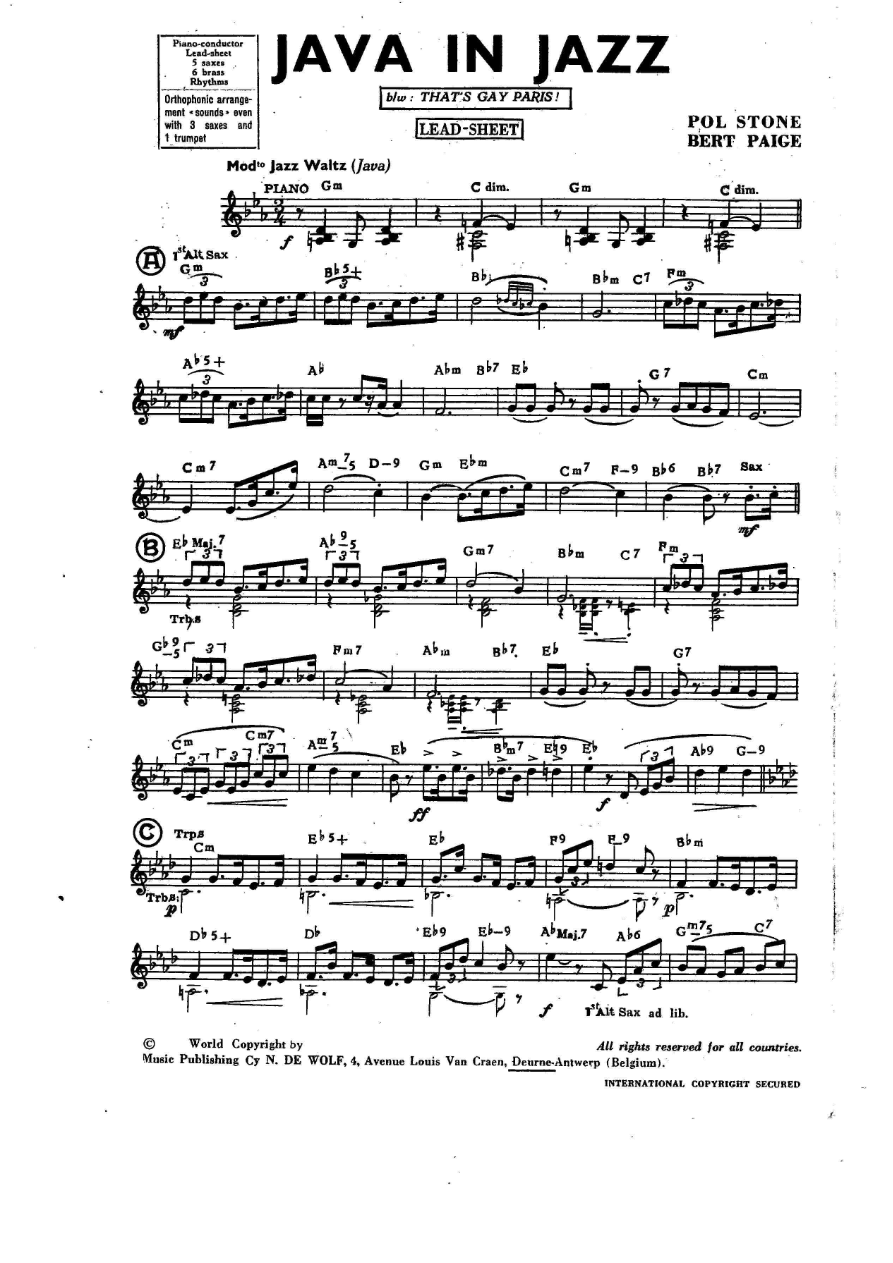
Java In Jazz (B.Paige) sheet music preview

Java In Jazz (B.Paige)

Composed by Bert Paige

Arranged by B.Paige

  • Ensemble: Big Band
  • Style: Jazz Standard
  • Pages: 23
  • Instruments (17): Alto Saxophone 1, Alto Saxophone 2, Tenor Saxophone 1, Tenor Saxophone 2, Baritone Saxophone, Trumpet 1, Trumpet 2, Trumpet 3, Trumpet 4, Trombone 1, Trombone 2, Trombone 3, Bass Trombone, Guitar, Piano, Bass, Drums
  • Difficulty: medium
  • Content: Individual Parts
  • Format: PDF Download (Instant)
  • Price: $24.99

The vibrant legacy of the mid-20th century jazz era is beautifully encapsulated in "Java In Jazz," a piece that, while not a traditional jazz standard in the vein of Gershwin or Porter, gained considerable traction through its evocative melody and rhythmic drive. Originally composed by Bert Paige, a prolific Belgian composer and arranger known for his work in light music and film scores, the piece emerged during a period when exotic rhythms and accessible melodies found a broad audience, blending popular appeal with sophisticated harmonic textures. Its initial popularity stemmed from its catchy, almost cinematic quality, making it a memorable tune that resonated across various musical landscapes, often appearing in radio broadcasts and instrumental compilations of the era. This particular arrangement by B.Paige reimagines the original's charm through the powerful lens of the big band, elevating its inherent swing and melodic contour. B.Paige's treatment of "Java In Jazz" is a masterclass in medium-swing big band writing, set primarily in the key of F major, offering a bright yet grounded sonic landscape. The mood is one of sophisticated exuberance, evoking the golden age of big band dance halls and sophisticated supper clubs. The arrangement opens with a classic big band flourish, immediately establishing a relaxed, infectious 4/4 swing feel that underpins the entire piece. B.Paige's signature approach often involves meticulously crafted voicings that maximize the warmth and blend of the saxophone section, frequently featuring rich, close-position harmonies that sing with clarity. Expect a dynamic journey, moving from smoothly articulated ensemble passages to powerful, brass-driven shout choruses that build excitement and energy, characteristic of the arranger's ability to create compelling narrative arcs within a musical piece. The arrangement features the melody gracefully passed between sections, often starting with the saxophones before being picked up and embellished by the brass. There are ample opportunities for featured soloists, typically allocated to the tenor saxophone and trumpet, allowing for improvisational creativity within the established harmonic framework. These solo sections are supported by well-crafted ensemble backgrounds, providing both harmonic interest and rhythmic drive without overpowering the soloist. A particularly rewarding aspect for performers is the interplay between the sections during the soli passages, where intricate lines are woven together, demanding precision and blend. The piece culminates in a powerful, full-ensemble shout chorus, showcasing the band's collective strength and delivering a thrilling conclusion. This arrangement is ideally suited for college-level jazz ensembles, advanced community bands, and professional groups looking for a polished, engaging, and historically informed big band chart that offers both musical depth and audience appeal. Its technical demands, while substantial, are designed to be achievable with focused rehearsal, making the performance highly rewarding. Conductors should emphasize a consistent, relaxed medium-swing feel from the outset, ensuring the rhythm section lays down a solid, unhurried groove. Articulation is paramount; pay close attention to the nuanced phrasing, distinguishing between legato lines in the saxophones and the crisp, precise attacks required from the brass. The intricate soli sections demand meticulous attention to balance and blend, particularly in the inner voices; consider isolating these passages in rehearsal. Trumpet players should be prepared for controlled upper register work, especially during the shout choruses, while maintaining a rich tone. There are no specific extended techniques (like plungers or doits) explicitly notated, but tasteful use of falls and scoops in appropriate stylistic contexts can enhance the authenticity. Encourage soloists to embrace the melodic and harmonic language of the mid-century swing era, focusing on strong melodic statements and rhythmic clarity over purely technical display. Q: What instruments and parts are included in this arrangement? A: This arrangement is scored for a standard 17-piece big band: Alto Saxophone 1, Alto Saxophone 2, Tenor Saxophone 1, Tenor Saxophone 2, Baritone Saxophone, Trumpet 1, Trumpet 2, Trumpet 3, Trumpet 4, Trombone 1, Trombone 2, Trombone 3, Bass Trombone, Piano, Bass, Drums, and Guitar. Q: What is the difficulty level of "Java In Jazz (B.Paige)"? A: This arrangement is rated as advanced intermediate to advanced, making it suitable for college jazz ensembles, skilled community bands, and professional groups. It requires solid ensemble playing, good sight-reading skills, and capable soloists. Q: What is the musical style and historical context of this piece? A: "Java In Jazz" is presented as a medium-swing big band chart, reflecting the sophisticated and accessible jazz popular in the mid-20th century. While the original composer Bert Paige was known for light music, this arrangement reimagines the tune with a classic big band swing aesthetic. Q: What makes B.Paige's arrangement of "Java In Jazz" unique? A: B.Paige's arrangement is characterized by its rich, carefully crafted voicings, particularly in the saxophone section, and dynamic interplay between sections. It features well-structured soli passages, compelling shout choruses, and provides excellent opportunities for improvising soloists within a classic big band framework. Q: What is the typical performance duration and tempo for this arrangement? A: The performance duration typically ranges from 3:30 to 4:30 minutes, depending on the length of the improvised solos. The piece is intended to be performed at a consistent medium-swing tempo, generally around 120-130 BPM.

Musicians Also Search For

Java In Jazz B.Paige PDFJava In Jazz B.Paige sheet musicJava In Jazz arranged by B.PaigeB.Paige big band chartsB.Paige jazz arrangements PDFJava In Jazz Bert Paige sheet musicJava In Jazz Bert Paige big band arrangementBert Paige big band chartsJava In Jazz big band arrangementJava In Jazz big band PDF downloadJava In Jazz jazz ensemble sheet musicbig band sheet music instant downloadJava In Jazz individual parts downloadJava In Jazz sheet music with partsJava In Jazz Jazz Standard chartJazz Standard big band arrangementsbuy Java In Jazz sheet music onlinedownload Java In Jazz PDFJava In Jazz jazz chartbest B.Paige big band arrangementsBert Paige songs arranged by B.PaigeJava In Jazz printable sheet musicbig band repertoire PDF

All arrangements by B.Paige All Bert Paige sheet music