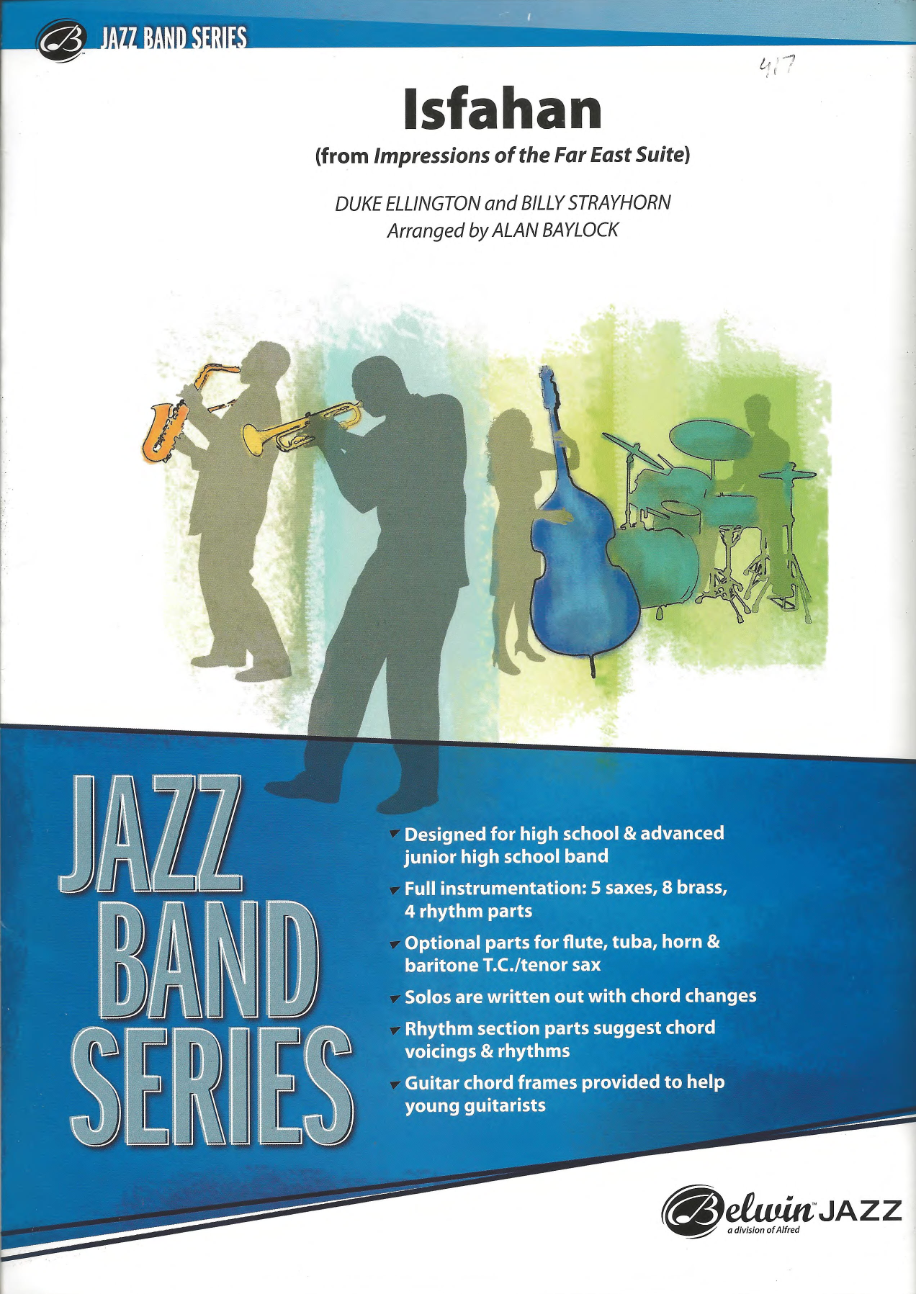
Isfahan (A.Baylock)
Composed by Billy Strayhorn, Edward Kennedy Ellington
Arranged by Alan Baylock
- Ensemble: Big Band
- Style: Jazz Standard
- Pages: 67
- Instruments (23): 1st Eb Alto Saxophone, 2nd Eb Alto Saxophone, 1st Bb Tenor Saxophone, 2nd Bb Tenor Saxophone, Eb Baritone Saxophone, 1st Bb Trumpet, 2nd Bb Trumpet, 3rd Bb Trumpet, 4th Bb Trumpet, 1st Trombone, 2nd Trombone, 3rd Trombone, Bass Trombone, Guitar, Piano, Bass, Drum Set, C Flute, Horn in F, 1st Baritone T.C./Bb Tenor Saxophone, 2nd Baritone T.C./Bb Tenor Saxophone, 3rd Baritone T.C./Bb Tenor Saxophone, Tuba
- Difficulty: advanced
- Content: Individual Parts
- Format: PDF Download (Instant)
- Price: $24.99
"Isfahan," a jewel from Duke Ellington and Billy Strayhorn's groundbreaking *Far East Suite* (1966), stands as a testament to their unparalleled collaborative genius. This evocative composition, inspired by the ancient Persian city, transcends mere travelogue, offering a profound musical meditation on beauty, history, and exoticism through the lens of the jazz orchestra. Originally conceived as a feature for Johnny Hodges' alto saxophone, the piece became synonymous with his lyrical, soulful sound, solidifying its place as a quintessential jazz standard. Its enduring appeal lies in its sophisticated harmonic language, haunting melody, and the seamless blend of Ellingtonian orchestral colors with Strayhorn's signature elegance. This era, the mid-1960s, saw Ellington's orchestra continue to push boundaries, integrating global influences while retaining its core identity as a beacon of American jazz. Alan Baylock’s arrangement of "Isfahan" masterfully reimagines this classic for the modern big band, preserving its melancholic beauty while infusing it with his characteristic clarity and dynamic range. The piece unfolds as a slow, expressive ballad, typically around quarter note = 60-70 bpm, maintaining the original's reflective and poignant mood. Baylock's treatment immediately establishes a rich, warm harmonic tapestry, often utilizing dense, yet transparent, voicings that allow individual lines to sing through. The arrangement is primarily in the key of D-flat major, lending itself to the lush, expansive sound that defines the piece. The overall energy is one of controlled intensity, building through carefully crafted swells and releases, rather than overt power. Baylock’s distinctive approach shines through in his orchestration and harmonic choices. While honoring the original's iconic alto saxophone melody, he extends the harmonic palette with modern voicings and subtle reharmonizations that add depth without sacrificing authenticity. The melody is predominantly carried by the Alto Saxophone 1, echoing Hodges' legacy, but Baylock also cleverly weaves in counter-melodies and supportive lines from other sections, particularly the trombones and trumpets, creating a dialogue that enriches the texture. There are no extended improvised solos in this arrangement; instead, the focus remains on the ensemble's collective interpretation of the melody and Baylock's intricate voicings. The technical challenges lie less in blistering finger work and more in achieving precise intonation, balanced blend, and a unified, expressive phrasing, particularly within the slow tempo. Rewarding moments include the soaring ensemble passages and the delicate interplay between sections, demanding a high level of musical maturity. This arrangement is ideally suited for advanced high school, college, community, and professional big bands. Its demands for nuanced phrasing, excellent intonation, and sophisticated ensemble blend make it an exceptional vehicle for developing musicality and expressive performance. While individual parts are not overly technically demanding, the collective requirement for sensitivity and unified interpretation elevates its difficulty, making it a truly rewarding experience for a band capable of conveying deep emotion and refined orchestral sound. "Isfahan" requires a deeply expressive and unified approach from the entire ensemble. The primary technical challenge lies in achieving precise intonation and a seamless blend, especially in the sustained chords and slow-moving melodic lines. Encourage musicians to listen across sections, tuning carefully to the ensemble rather than just their individual pitch. The tempo should be a slow ballad, around quarter note = 60-70 bpm, maintaining a gentle, flowing feel without dragging. Emphasize long, singing phrases and a rich, warm tone quality throughout. Dynamics are crucial; ensure a wide dynamic range, from delicate pianissimos to full, resonant fortissimos, always with control. Specific techniques like subtle vibrato on sustained notes and careful articulation (legato where marked) will enhance the piece's lyrical quality. Rehearsal time should focus on ensemble balance, consistent phrasing, and the emotional arc of the piece, paying particular attention to the blend of the alto saxophone lead with the accompanying voices. Q: What instruments and parts are included in this arrangement? A: This big band arrangement includes parts for 17 instruments: Alto Saxophone 1, Alto Saxophone 2, Tenor Saxophone 1, Tenor Saxophone 2, Baritone Saxophone, Trumpet 1, Trumpet 2, Trumpet 3, Trumpet 4, Trombone 1, Trombone 2, Trombone 3, Trombone 4, Piano, Bass, Drums, and Guitar. Q: What is the difficulty level of Alan Baylock's "Isfahan" arrangement? A: This arrangement is considered advanced, suitable for college, community, and professional big bands. Its difficulty stems from the demands for precise intonation, sophisticated ensemble blend, and expressive musicality, rather than extreme technical speed. Q: What is the musical style and historical context of "Isfahan"? A: "Isfahan" is a jazz standard in the slow ballad style, originating from Duke Ellington and Billy Strayhorn's 1966 *Far East Suite*. It embodies the sophisticated orchestral jazz of the mid-20th century, known for its rich harmonies and evocative melodies. Q: What makes Alan Baylock's arrangement of "Isfahan" unique? A: Baylock's arrangement honors the original's melancholic beauty while infusing it with modern, dense yet transparent voicings and subtle reharmonizations. It emphasizes collective ensemble interpretation and refined orchestral color over individual improvisation. Q: What is the typical performance duration and tempo for this arrangement? A: The typical performance duration for "Isfahan" is approximately 4-5 minutes. It should be performed as a slow, expressive ballad, generally at a tempo of quarter note = 60-70 bpm.
Musicians Also Search For
Isfahan Alan Baylock PDF • Isfahan Alan Baylock sheet music • Isfahan arranged by Alan Baylock • Alan Baylock big band charts • Alan Baylock jazz arrangements PDF • Isfahan Billy Strayhorn, Edward Kennedy Ellington sheet music • Isfahan Billy Strayhorn, Edward Kennedy Ellington big band arrangement • Billy Strayhorn, Edward Kennedy Ellington big band charts • Isfahan big band arrangement • Isfahan big band PDF download • Isfahan jazz ensemble sheet music • big band sheet music instant download • Isfahan conductor score PDF • Isfahan individual parts download • Isfahan sheet music with parts • Isfahan Jazz Standard chart • Jazz Standard big band arrangements • buy Isfahan sheet music online • download Isfahan PDF • Isfahan jazz chart • best Alan Baylock big band arrangements • Billy Strayhorn, Edward Kennedy Ellington songs arranged by Alan Baylock • Isfahan printable sheet music • big band repertoire PDF