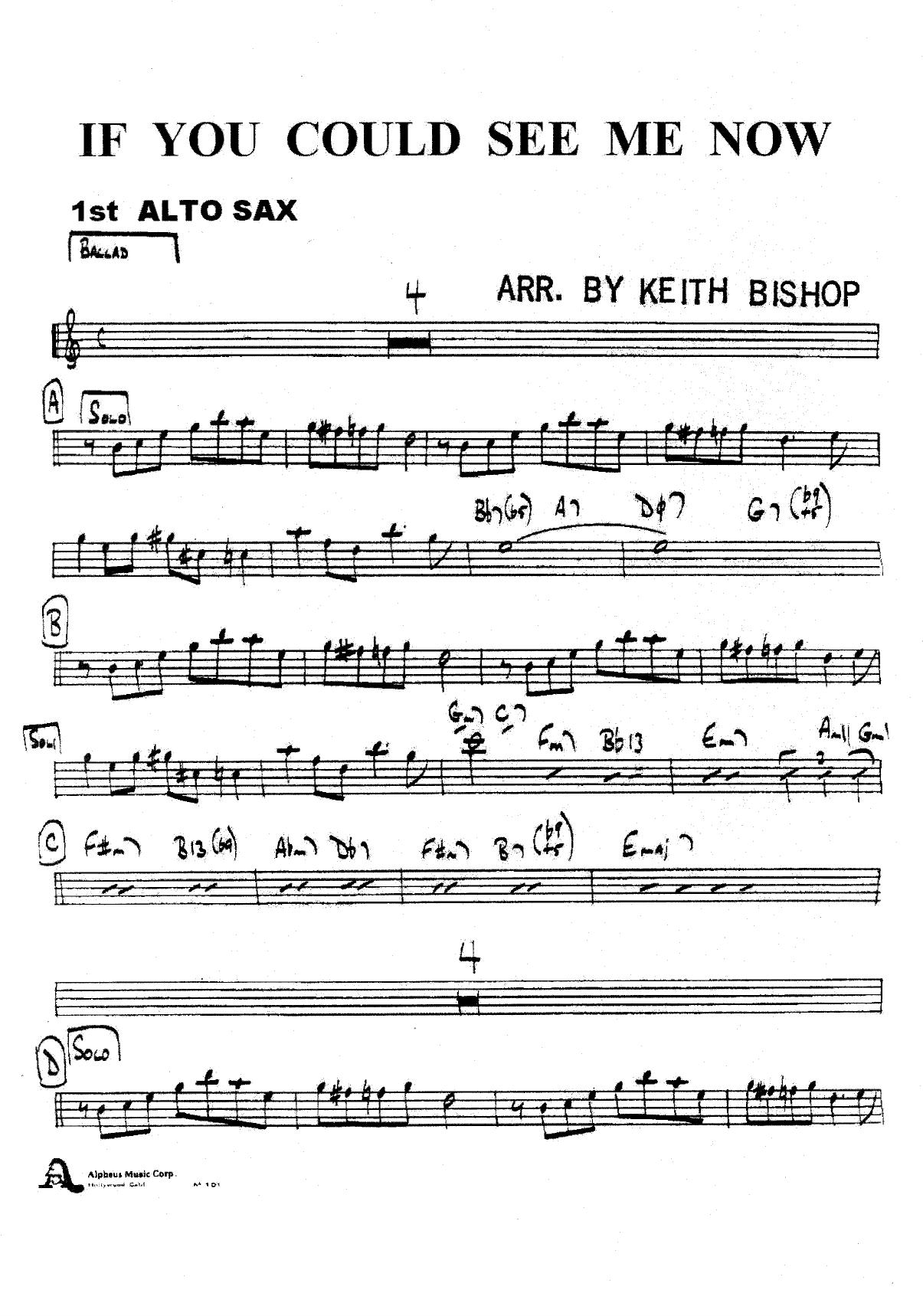
If You Could See Me Now (K.Bishop) sheet music preview

If You Could See Me Now (K.Bishop)

Composed by Tadd Dameron

Arranged by K.Bishop

  • Ensemble: Big Band
  • Style: Jazz Standard
  • Pages: 34
  • Instruments (17): 1st Alto Sax, 2nd Alto Sax, 1st Tenor Sax, 2nd Tenor Sax, Baritone Sax, Trumpet 1, Trumpet 2, Trumpet 3, Trumpet 4, Trombone 1, Trombone 2, Trombone 3, Trombone 4, Piano, Bass, Drums, Guitar
  • Difficulty: medium
  • Content: Individual Parts
  • Format: PDF Download (Instant)
  • Price: $24.99

Tadd Dameron's timeless ballad, "If You Could See Me Now," stands as a cornerstone of the jazz standard repertoire, embodying the sophisticated harmonic and melodic advancements of the bebop era. Composed in 1946, Dameron penned this lyrical masterpiece specifically for vocalist Sarah Vaughan, who, with lyrics by Carl Sigman, transformed it into one of her signature songs, later inducted into the Grammy Hall of Fame in 1998. The original piece, typically performed as a slow ballad, showcases Dameron's genius for blending bebop complexity with profound emotional depth, utilizing lush, impressionistic harmonies rich with extended chords and ii-V substitutions rather than the angular lines often associated with the style. Its enduring appeal lies in its exquisite melodic contour and harmonic richness, making it a favorite among instrumentalists and vocalists alike, with notable recordings by artists such as Bill Evans, Chet Baker, and Wes Montgomery. This arrangement by K.Bishop reimagines Dameron's classic for the full power and expressive palette of a big band, maintaining the original's melancholic beauty while infusing it with contemporary big band sensibilities. The musical character remains that of a slow, emotive ballad, likely in the original key of Eb major, allowing for maximum harmonic color and sustained melodic lines. K.Bishop's approach is characterized by a deep respect for the source material, enhancing its inherent beauty through thoughtful orchestration. Expect rich, layered voicings in the brass and saxophone sections, creating a warm and enveloping soundscape that supports the poignant melody. The arrangement likely features a prominent melody statement by a lead instrument, possibly a tenor or alto saxophone, followed by meticulously crafted soli sections that weave Dameron's intricate harmonies through the ensemble. Performance of this arrangement offers both technical challenge and immense artistic reward. The melody is typically carried by the lead alto saxophone, requiring a strong, expressive tone and precise intonation to convey the song's emotional core. Featured solos are strategically placed, providing opportunities for improvisation over Dameron's sophisticated chord changes, demanding harmonic awareness and melodic invention from the soloist. K.Bishop's arrangements often include nuanced dynamic shifts and carefully constructed counter-melodies, adding depth and interest throughout the piece. The technical demands lie primarily in achieving a cohesive ensemble sound, balancing intricate voicings, and maintaining the delicate slow ballad tempo with unwavering rhythmic precision. The reward comes from delivering a performance that honors the original's emotional resonance while showcasing the big band's collective artistry. This arrangement is ideally suited for college, community, and professional big bands seeking to perform a classic jazz standard with a fresh, yet authentic, interpretation. Its detailed scoring and harmonic sophistication make it an excellent vehicle for developing advanced ensemble skills, particularly in blend, balance, and expressive phrasing. While challenging, the clear notation and thoughtful orchestration provide a framework for bands to achieve a truly moving and memorable performance, making it a valuable addition to any serious jazz ensemble's repertoire. Conductors should emphasize a unified, sustained sound throughout, focusing on blend and balance, particularly within the saxophone and brass sections during voicings. The tempo should be a very slow ballad, allowing ample space for melodic expression and harmonic resonance, avoiding any rush. Pay close attention to dynamic contrasts, using them to build and release tension, especially during the soli sections. Encourage soloists to approach their improvisations with a melodic and lyrical sensibility, drawing from the rich harmonic landscape. Articulation should be smooth and legato, with careful attention to phrase endings to maintain the melancholic mood. Rehearsal time should be dedicated to intonation within the complex harmonies and ensuring a consistent, warm tone from all sections. Q: What instruments are included in this arrangement? A: This big band arrangement is scored for 16 instruments, including Alto Saxophone 1, Alto Saxophone 2, Tenor Saxophone 1, Tenor Saxophone 2, Baritone Saxophone, Trumpet 1, Trumpet 2, Trumpet 3, Trumpet 4, Trombone 1, Trombone 2, Trombone 3, Trombone 4, Piano, Bass, and Drums. Q: What is the difficulty level of this arrangement? A: This arrangement is considered advanced, suitable for college, community, and professional big bands. It requires strong technical proficiency, advanced harmonic understanding, and mature musicality from all sections. Q: What is the musical style and historical context of "If You Could See Me Now"? A: "If You Could See Me Now" is a classic jazz standard composed by Tadd Dameron in 1946. It represents the sophisticated ballad style of the bebop era, known for its rich harmonies and lyrical melodies. Q: What makes K.Bishop's arrangement of this standard unique? A: K.Bishop's arrangement is distinguished by its rich, layered voicings, meticulously crafted soli sections, and thoughtful orchestration that enhances the original's emotional depth while adapting it for the full expressive range of a big band. Q: What is the typical performance duration or tempo for this piece? A: As a slow ballad, "If You Could See Me Now" is performed at a very deliberate tempo, typically resulting in a performance duration of approximately 5-7 minutes, depending on the improvisational sections.

Questions and answers

What is included in the If You Could See Me Now (K.Bishop) PDF?
The verified current file contains individual parts across 34 pages.
How many instruments or parts are listed for If You Could See Me Now (K.Bishop)?
The verified instrumentation list contains 17 entries for this Big Band arrangement.
Who is credited for If You Could See Me Now (K.Bishop)?
Composer: Tadd Dameron. Arranger: K.Bishop.
What difficulty is listed for If You Could See Me Now (K.Bishop)?
The verified difficulty level is medium.
What style is listed for If You Could See Me Now (K.Bishop)?
The catalog lists the style as Jazz Standard.
Can I preview If You Could See Me Now (K.Bishop) before buying?
Yes. The product page provides a preview generated from the current PDF file.
How is If You Could See Me Now (K.Bishop) delivered?
After successful payment, the digital PDF is made available for download. The displayed price is $24.99.

Musicians Also Search For

If You Could See Me Now K.Bishop PDFIf You Could See Me Now K.Bishop sheet musicIf You Could See Me Now arranged by K.BishopK.Bishop big band chartsK.Bishop jazz arrangements PDFIf You Could See Me Now Tadd Dameron sheet musicIf You Could See Me Now Tadd Dameron big band arrangementsTadd Dameron big band chartsIf You Could See Me Now big band arrangementsIf You Could See Me Now big band PDF downloadIf You Could See Me Now jazz sheet musicbig band sheet music downloadIf You Could See Me Now individual parts downloadIf You Could See Me Now sheet music PDFIf You Could See Me Now Jazz Standard chartsJazz Standard big band arrangementsbuy If You Could See Me Now sheet musicdownload If You Could See Me Now PDFIf You Could See Me Now jazz chartsbest K.Bishop big band arrangementsTadd Dameron arranged by K.BishopIf You Could See Me Now printable sheet musicbig band repertoire PDF

All arrangements by K.Bishop All Tadd Dameron sheet music