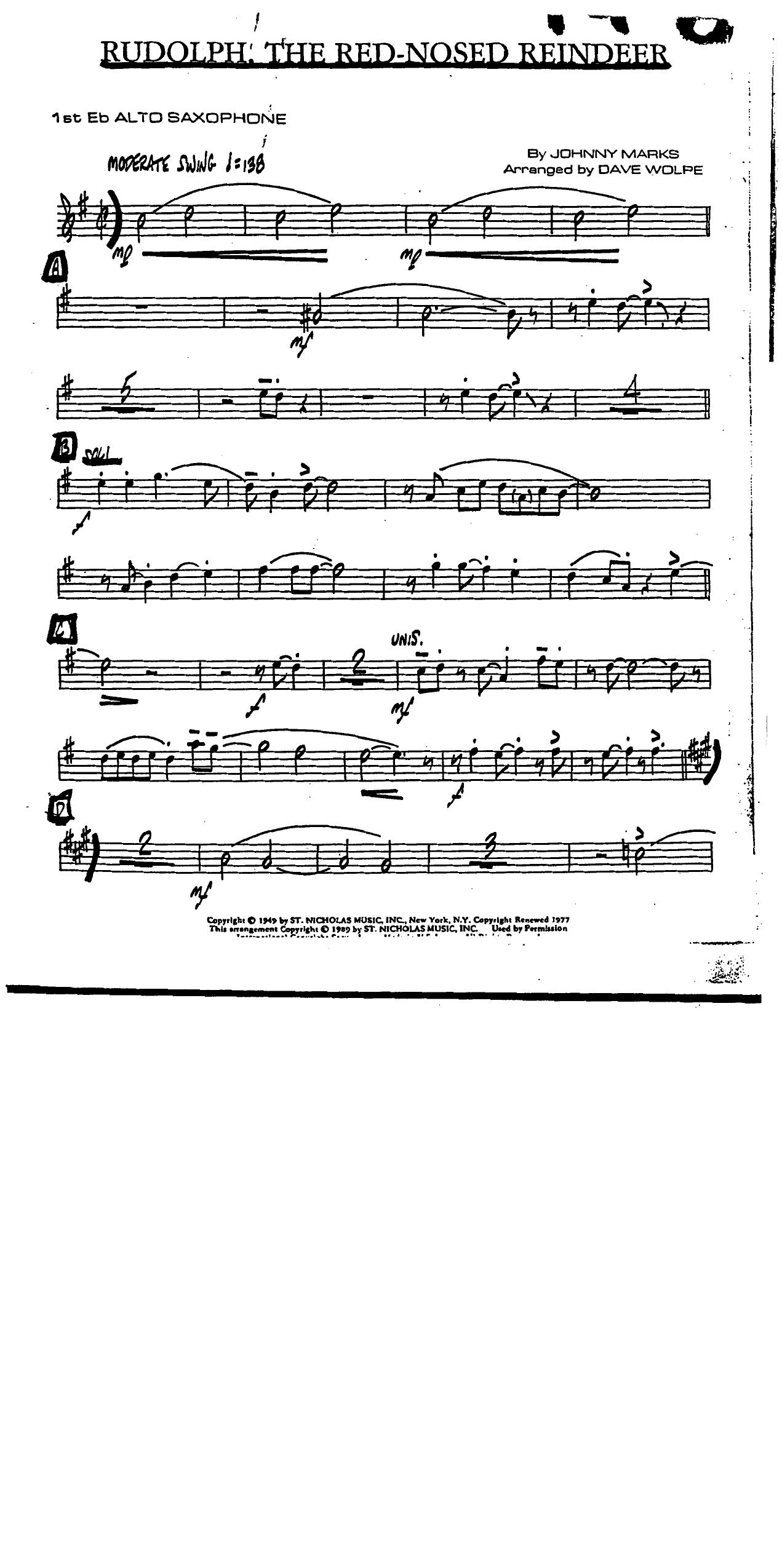
Rudolph The Red-Nosed Reindeer (D.Wolpe) sheet music preview

Rudolph The Red-Nosed Reindeer (D.Wolpe)

Composed by Johnny Marks

Arranged by Dave Wolpe

  • Ensemble: Big Band
  • Pages: 48
  • Instruments (19): 1st Eb Alto Saxophone, 2nd Eb Alto Saxophone, 1st Bb Tenor Saxophone, 2nd Bb Tenor Saxophone, Eb Baritone Saxophone, 1st Bb Trumpet, 2nd Bb Trumpet, 3rd Bb Trumpet, 4th Bb Trumpet, 1st Trombone, 2nd Trombone, 3rd Trombone, 4th Trombone, Piano, Bass, Drums, Guitar, Flute (doubles Alto Sax 2), F Horn 1 (doubles Trombone 1)
  • Difficulty: medium
  • Content: Individual Parts
  • Format: PDF Download (Instant)
  • Price: $24.99

Johnny Marks’s timeless holiday classic, originally made famous by Gene Autry in 1949 and subsequently embraced by the jazz pantheon through recordings like Ella Fitzgerald’s and the Count Basie Orchestra’s festive interpretations, occupies a unique space in the American songbook. Transcending its origins as a children's Christmas staple, the melody offers a surprisingly flexible framework for jazz reharmonization and driving big band swing. This enduring appeal stems from its sturdy AABA song form and memorable, diatonic head, which invites clever chromatic counterlines and sophisticated harmonic extensions. Dave Wolpe’s masterful big band adaptation reimagines the beloved tune as a high-energy, swinging chart driven by an infectious medium-up swing groove. Opening with a playful, teasing intro that sets a toe-tapping mood, the arrangement quickly locks into a robust pocket featuring crisp section interplay and rich, brass-heavy voicings. The emotional arc transitions seamlessly from whimsical and nostalgic to jubilant and roaring, capturing the sparkling excitement of a mid-century holiday party. Wolpe utilizes lush, Ellingtonian chord clusters in the saxophones contrasted with sharp, punctuation-heavy stabs from the trumpets and trombones, creating a dynamic landscape that feels both classic and refreshingly vibrant. The melodic heavy lifting is shared dynamically across the ensemble, highlighted by a lush sax soli that showcases tight sectional blend and subtle harmonic shifts before building toward an explosive, high-octane shout chorus. Solos are designated for featured performers, providing an open framework for improvisers to stretch out over standard blues-infused changes derived from the underlying tune. Technically, the arrangement demands crisp articulation, accurate section intonation, and a steady, driving swing eighth-note feel. The brass parts include occasional upper-register demands and stylistic embellishments like doits and falls, while the rhythm section—anchored by an active walking bassline and crisp ride cymbal pattern—must maintain an effortless, buoyant drive throughout. Advanced high school, collegiate, and community big bands will find this chart to be an absolute crowd-pleaser that simultaneously rewards focused rehearsal with substantive educational value. It provides an ideal vehicle for teaching stylistic consistency, dynamic contrast, and ensemble listening, making it a standout selection for any seasonal jazz concert program. To capture the authentic big band sparkle of Dave Wolpe’s writing, the ensemble must prioritize a relaxed yet driving medium-up swing tempo, avoiding any tendency to rush the eighth notes. The rhythm section serves as the engine: the drummer should maintain a feather-light touch on the hi-hat on beats 2 and 4, while the bass player locks in a solid, acoustic-style walking quarter-note line. Brass players should focus on clean, precise articulation, treating short notes with crisp, dry staccatos and longer lines with a warm, supportive legato. Pay special attention to the dynamic markings during the saxophone soli; the horns must project clearly over a subdued rhythm section accompaniment without forcing their tone. Rehearsal time should be dedicated to balancing the ensemble during the shout chorus, ensuring that the lead trumpet cuts through the texture while the lower brass maintain a rich, resonant foundation. Stylistic unity in swing phrasing between the reed and brass sections will make or break the chart's overall impact. Q: What instruments and parts are included in this big band arrangement? A: The chart is scored for a standard 17-piece big band instrumentation, comprising 5 saxophones (2 altos, 2 tenors, 1 baritone), 4 trumpets, 4 trombones, and a full 4-piece rhythm section (piano, guitar, bass, drums), complete with a full 48-page score and individual parts. Q: What is the difficulty level of this Dave Wolpe arrangement? A: This arrangement is graded as medium-advanced (Level 4), making it well-suited for proficient high school jazz ensembles, college bands, and community big bands looking for a rewarding seasonal challenge. Q: What is the musical style and historical background of this piece? A: Written in a swinging, mid-century big band style, this arrangement transforms Johnny Marks's 1949 holiday classic into a sophisticated jazz chart that echoes the swinging traditions of arrangers like Sammy Nestico and Frank Comstock. Q: What makes this specific arrangement by Dave Wolpe unique? A: Wolpe’s chart stands out due to its clever reharmonizations, a brilliantly crafted saxophone soli, and a powerhouse shout chorus that injects fresh, sophisticated jazz vocabulary into a universally recognized melody. Q: What is the performance duration and recommended tempo for this chart? A: While performance time varies slightly based on the length of improvised solos, the piece typically runs around 3 to 4 minutes and is designed to be performed at a comfortable, driving medium-up swing tempo.

Questions and answers

What is included in the Rudolph The Red-Nosed Reindeer (D.Wolpe) PDF?
The verified current file contains individual parts across 48 pages.
How many instruments or parts are listed for Rudolph The Red-Nosed Reindeer (D.Wolpe)?
The verified instrumentation list contains 19 entries for this Big Band arrangement.
Who is credited for Rudolph The Red-Nosed Reindeer (D.Wolpe)?
Composer: Johnny Marks. Arranger: Dave Wolpe.
What difficulty is listed for Rudolph The Red-Nosed Reindeer (D.Wolpe)?
The verified difficulty level is medium.
Can I preview Rudolph The Red-Nosed Reindeer (D.Wolpe) before buying?
Yes. The product page provides a preview generated from the current PDF file.
How is Rudolph The Red-Nosed Reindeer (D.Wolpe) delivered?
After successful payment, the digital PDF is made available for download. The displayed price is $24.99.

Musicians Also Search For

Rudolph The Red-Nosed Reindeer Dave Wolpe PDFRudolph The Red-Nosed Reindeer Dave Wolpe sheet musicRudolph The Red-Nosed Reindeer arranged by Dave WolpeDave Wolpe big band chartsDave Wolpe jazz arrangements PDFRudolph The Red-Nosed Reindeer Johnny Marks sheet musicRudolph The Red-Nosed Reindeer Johnny Marks big band arrangementsJohnny Marks big band chartsRudolph The Red-Nosed Reindeer big band arrangementsRudolph The Red-Nosed Reindeer big band PDF downloadRudolph The Red-Nosed Reindeer jazz sheet musicbig band sheet music downloadRudolph The Red-Nosed Reindeer individual parts downloadRudolph The Red-Nosed Reindeer sheet music PDFbuy Rudolph The Red-Nosed Reindeer sheet musicdownload Rudolph The Red-Nosed Reindeer PDFRudolph The Red-Nosed Reindeer jazz chartsbest Dave Wolpe big band arrangementsJohnny Marks arranged by Dave WolpeRudolph The Red-Nosed Reindeer printable sheet musicbig band repertoire PDF

All arrangements by Dave Wolpe All Johnny Marks sheet music