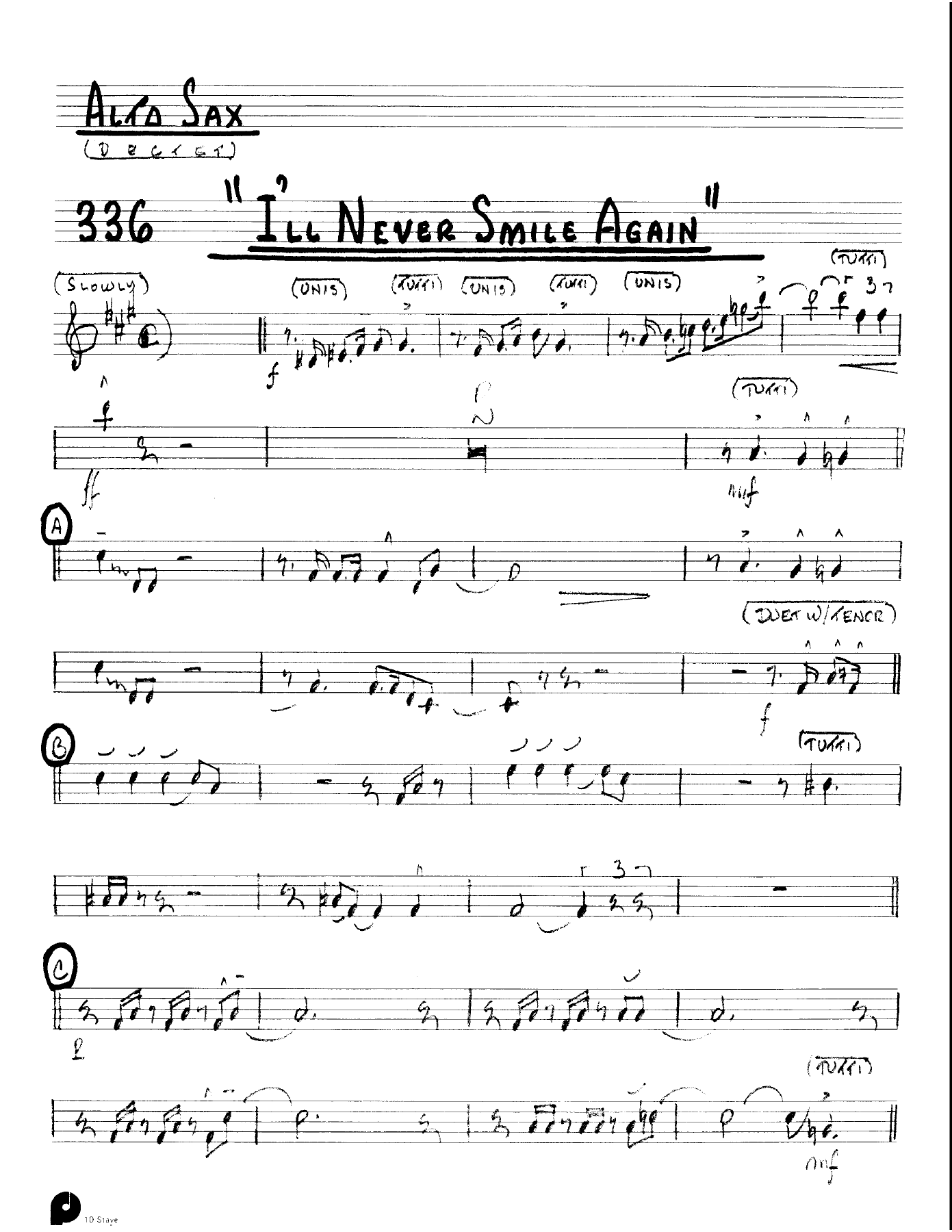
I'll Never Smile Again (Kenton Dectet #336) sheet music preview

I'll Never Smile Again (Kenton Dectet #336)

Composed by Ruth Lowe

Arranged by Stan Kenton Dected 176

  • Ensemble: Small Ensemble
  • Style: Jazz Standard
  • Pages: 18
  • Difficulty: easy
  • Content: Sheet Music
  • Format: PDF Download (Instant)
  • Price: $12.99

Penned by Canadian songwriter Ruth Lowe in 1939, "I'll Never Smile Again" emerged from a place of profound personal grief, following the untimely death of her first husband. This poignant ballad quickly resonated with a world on the brink of war, becoming an anthem for separation and longing, particularly for those separated from loved ones during World War II. The song achieved monumental success in 1940 as the first number-one hit on Billboard's inaugural national chart, famously recorded by Tommy Dorsey's Orchestra with a young Frank Sinatra on vocals, launching Sinatra's career into superstardom. Its enduring melodic beauty and deeply felt lyrics have solidified its status as a jazz and pop standard, covered by over 100 artists including Sarah Vaughan, Billie Holiday, and Michael Bublé. This arrangement, designated Kenton Dectet #336, reimagines the classic ballad through the distinctive lens of Stan Kenton's small ensemble approach. While the original is a slow, melancholic ballad, Kenton's Dectet arrangements often infuse a sophisticated, often driving, harmonic and rhythmic complexity, even within a ballad context. Expect a medium-slow, reflective swing feel, likely in a minor key or with significant minor harmonic inflections, enhancing the song's inherent melancholy. The mood will be one of introspective longing, balanced by moments of rich, layered harmonies that are a hallmark of the Kenton sound. The energy, though subdued, will possess a controlled intensity, building through carefully crafted ensemble passages. Stan Kenton's arranging philosophy, even for his smaller Dectet, emphasized progressive jazz concepts, often incorporating modern classical influences, complex harmonic structures, and a distinctive layering technique. This arrangement will showcase Kenton's signature voicings, characterized by dense, often dissonant, brass and saxophone harmonies that create a unique textural depth. Expect intricate counterpoint and interplay between the horns, rather than simple block voicings. There may be a featured soli section, allowing the horn players to shine collectively, and potentially a subtle reharmonization of the original melody, adding a fresh, sophisticated perspective without losing the song's emotional core. Kenton's small ensemble writing, though less bombastic than his full orchestra, retains his intellectual rigor and commitment to innovative soundscapes. The melody is typically carried by a lead horn, likely an alto saxophone or trumpet, offering a lyrical and expressive interpretation. This arrangement will almost certainly feature an improvised solo, providing an opportunity for a skilled soloist to explore the harmonic landscape. Technical challenges will include precise articulation, demanding dynamic control, and navigating Kenton's often extended harmonic progressions and intricate rhythmic figures. The reward lies in performing a piece that is both historically significant and musically rich, offering a chance to delve into the sophisticated world of mid-20th-century jazz arranging. This arrangement is ideally suited for college-level jazz ensembles, advanced community big bands, or professional small groups seeking a challenging yet deeply rewarding addition to their repertoire. Its complexity and nuanced demands make it less suitable for most high school bands, but an exceptional high school ensemble with strong sight-reading and improvisation skills could tackle it. Approaching this Kenton Dectet arrangement requires a keen focus on blend, balance, and harmonic clarity. The primary technical challenge lies in executing the dense voicings and intricate counterpoint with precision; ensure each player understands their role within the chord and melodic lines. Maintain a consistent medium-slow swing tempo, emphasizing a relaxed yet forward-moving pulse, avoiding any tendency to drag. The emotional depth of the piece relies on careful dynamic shading, from hushed pianissimos to controlled crescendos. Articulation should be precise but never harsh, aiming for a warm, legato feel in melodic passages and crispness in rhythmic figures. There are no specific extended techniques like plunger mutes or falls indicated for this ballad, but expressive vibrato and careful note releases are crucial. Rehearsal should prioritize slow, sectional work on challenging harmonic passages, ensuring intonation is impeccable within the close voicings. Encourage soloists to embrace the melancholic mood, utilizing the provided chord changes for an expressive, lyrical improvisation. **Q: What instruments are included in this Stan Kenton Dectet arrangement?** A: This arrangement is for a small ensemble, typically consisting of a horn section (such as alto saxophone, tenor saxophone, baritone saxophone, two trumpets, and trombone) plus a standard rhythm section (piano, bass, and drums). The term "Dectet" implies ten players, including the rhythm section. **Q: What is the difficulty level of "I'll Never Smile Again (Kenton Dectet #336)"?** A: This arrangement is considered advanced, suitable for college-level, advanced community, or professional jazz ensembles. It features complex harmonies, intricate voicings, and requires strong technical proficiency and musicality from all players. **Q: What is the musical style and historical context of this arrangement?** A: The original song, "I'll Never Smile Again," is a jazz standard and poignant ballad from 1939, made famous by Frank Sinatra and Tommy Dorsey during the wartime era. This arrangement by Stan Kenton Dectet reinterprets it within Kenton's progressive jazz style for small ensembles. **Q: What makes this Stan Kenton Dectet arrangement unique?** A: This arrangement stands out due to Kenton's signature use of sophisticated voicings, often dense and harmonically rich, intricate interplay between the horns, and a nuanced approach to a classic ballad that maintains its emotional core while adding a layer of intellectual complexity typical of Kenton's progressive jazz. **Q: What is the approximate performance duration and tempo of this piece?** A: As a medium-slow swing ballad, the performance duration will typically range from 4 to 6 minutes, depending on the tempo chosen and the length of any improvised solos. The tempo should be reflective and unhurried to convey the song's melancholic mood.

Musicians Also Search For

I'll Never Smile Again Stan Kenton Dected 176 PDFI'll Never Smile Again Stan Kenton Dected 176 sheet musicI'll Never Smile Again arranged by Stan Kenton Dected 176Stan Kenton Dected 176 small ensemble chartsStan Kenton Dected 176 jazz arrangements PDFI'll Never Smile Again Ruth Lowe sheet musicI'll Never Smile Again Ruth Lowe small ensemble arrangementRuth Lowe small ensemble chartsI'll Never Smile Again small ensemble arrangementI'll Never Smile Again small ensemble PDF downloadI'll Never Smile Again jazz ensemble sheet musicsmall ensemble sheet music instant downloadI'll Never Smile Again sheet music with partsI'll Never Smile Again Jazz Standard chartJazz Standard small ensemble arrangementsbuy I'll Never Smile Again sheet music onlinedownload I'll Never Smile Again PDFI'll Never Smile Again jazz chartbest Stan Kenton Dected 176 small ensemble arrangementsRuth Lowe songs arranged by Stan Kenton Dected 176I'll Never Smile Again printable sheet musicsmall ensemble repertoire PDF

All arrangements by Stan Kenton Dected 176 All Ruth Lowe sheet music