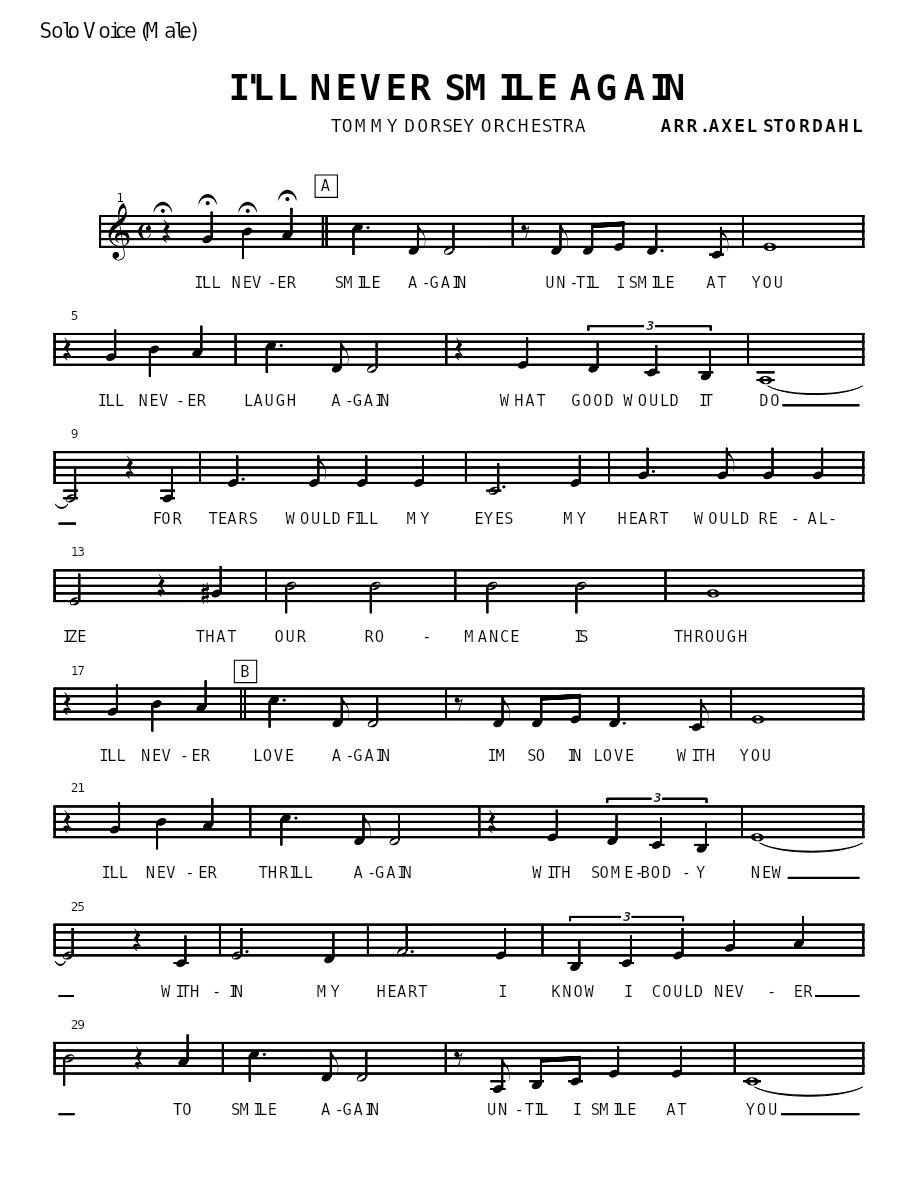
I'll Never Smile Again (A.Stordahl)
Composed by Ruth Lowe
Arranged by Frank Sinatra & Nelson Riddle
- Ensemble: Big Band
- Pages: 38
- Instruments (21): Solo Voice (Male), Vocals 1, Vocals 2, Vocals 3, Clarinet 1, Clarinet 2, Clarinet 3, Clarinet 4, Bass Clarinet, Trumpet in Bb 1, Trumpet in Bb 2, Trumpet in Bb 3, Trumpet in Bb 4, Trombone 1, Trombone 2, Trombone 3, Trombone 4, Piano, Guitar, Bass, Drum Set
- Difficulty: medium
- Content: Individual Parts
- Format: PDF Download (Instant)
- Price: $24.99
Ruth Lowe’s poignant 1939 ballad "I'll Never Smile Again" holds a permanent place in vocal jazz history, forever immortalized as the signature theme song of Frank Sinatra's breakthrough era with the Tommy Dorsey Orchestra. While originally introduced as a melancholy pop-torch song, the tune achieved its ultimate sophisticated transformation when paired with the lush, cinematic arranging genius of Nelson Riddle. This timeless standard represents the pinnacle of the mid-century Capitol Records aesthetic, where big band orchestration merged seamlessly with intimate vocal storytelling, creating a moody, evocative landscape defined by rich, extended harmonies and deep emotional resonance. Rooted in a slow, breath-suspended 4/4 ballad tempo, this arrangement exudes an atmosphere of elegant heartache and retrospective longing. The musical character is defined by a delicate balance between sparse, melancholic accompaniment and sweeping, romantic harmonic swells. Nelson Riddle’s signature arranging fingerprints are woven throughout the chart, utilizing warm, low-register saxophone voicings, shimmering muted brass counter-lines, and cascading string-substitution figures adapted brilliantly for the big band idiom. The harmonies lean heavily on diminished passing chords and suspended resolutions, giving the progression a bittersweet tension that underscores the lyric's themes of loss and fidelity. The vocal delivery commands the foreground, supported delicately by subtle woodwind and brass punctuation that never overpowers the soloist. The 11-instrument instrumentation provides a transparent yet full-bodied texture, allowing individual sections—particularly the alto and tenor saxophones—to interweave countermelodies that converse directly with the vocal line. Rather than relying on a high-energy shout chorus, the arrangement builds tension through dynamic expansion, moving from an introspective opening verse into a lush, full-ensemble chorus that swells with emotional weight before receding into a quiet, unresolved, and haunting final cadence. Advanced high school, collegiate, and professional ensembles will find this arrangement an exceptional vehicle for developing ballad control, ensemble blending, and rubato phrasing. The primary challenge lies not in blazing technical fingerwork, but in the extreme discipline required to maintain flawless intonation, subtle dynamic shading, and a unified emotional pulse at a very slow tempo. Conducting this chart demands a steady hand and a deep sensitivity to vocal rubato, making it a profoundly rewarding centerpiece for any concert program or jazz festival set focused on classic vocal accompaniment. Navigating this arrangement successfully requires supreme breath support and exceptional listening skills across all 11 players, as slow ballads expose intonation flaws instantly. The tempo must remain fluid yet anchored, avoiding a rigid, metronomic feel while preventing any dragging in the rhythm section. Conductors should emphasize horizontal linear phrasing over vertical chord punching; every note must have a distinct beginning, middle, and decay. The horn sections must treat their background figures as vocal extensions, utilizing warm, vibrato-controlled tones and careful dynamic restraint (keeping everything strictly under a *mezzo-forte* ceiling during vocal phrases). Muted brass should focus on a velvety, dark timbre rather than a bright, cutting edge. During rehearsal, isolate the rhythm section to ensure the piano and guitar voicings support the harmonic movement without cluttering the texture. Pay meticulous attention to the balance of the inner voices, as Riddle's sophisticated chordal motion relies heavily on the movement of the middle register to achieve its signature emotional impact. Q: What specific instruments and parts are included in this 38-page arrangement? A: This 11-instrument arrangement features a lead Vocal part alongside a concise, powerful big band instrumentation consisting of Trumpet, Trombone, Alto Saxophone, Tenor Saxophone, and a complete rhythm section framework. Q: What is the difficulty level of this Nelson Riddle chart? A: This chart is graded as intermediate-advanced (suitable for proficient high school, collegiate, and professional ensembles), primarily due to the intense demands of intonation, balance, and sustained breath control required at a slow ballad tempo. Q: What is the historical style and context of this piece? A: Composed by Ruth Lowe in 1939 and famously associated with Frank Sinatra, this chart reflects the sophisticated, lush ballad style pioneered by arranger Nelson Riddle during the golden era of vocal jazz. Q: What makes this specific arrangement unique compared to standard stock charts? A: It features Nelson Riddle’s signature sophisticated harmonic substitutions, warm low-register woodwind voicings, and delicate counter-lines that frame the vocal soloist with cinematic elegance rather than standard big band backing. Q: What is the performance duration and tempo feel of this arrangement? A: The piece is set as a slow, expressive ballad in 4/4 time, typically lasting around 3 to 4 minutes depending on the expressive rubato taken by the vocalist and conductor.
Questions and answers
- What is included in the I'll Never Smile Again (A.Stordahl) PDF?
- The verified current file contains a conductor score and individual parts across 38 pages.
- How many instruments or parts are listed for I'll Never Smile Again (A.Stordahl)?
- The verified instrumentation list contains 21 entries for this Big Band arrangement.
- Who is credited for I'll Never Smile Again (A.Stordahl)?
- Composer: Ruth Lowe. Arranger: Frank Sinatra & Nelson Riddle.
- What difficulty is listed for I'll Never Smile Again (A.Stordahl)?
- The verified difficulty level is medium.
- Can I preview I'll Never Smile Again (A.Stordahl) before buying?
- Yes. The product page provides a preview generated from the current PDF file.
- How is I'll Never Smile Again (A.Stordahl) delivered?
- After successful payment, the digital PDF is made available for download. The displayed price is $24.99.
Musicians Also Search For
I'll Never Smile Again Frank Sinatra & Nelson Riddle PDF • I'll Never Smile Again Frank Sinatra & Nelson Riddle sheet music • I'll Never Smile Again arranged by Frank Sinatra & Nelson Riddle • Frank Sinatra & Nelson Riddle big band charts • Frank Sinatra & Nelson Riddle jazz arrangements PDF • I'll Never Smile Again Ruth Lowe sheet music • I'll Never Smile Again Ruth Lowe big band arrangements • Ruth Lowe big band charts • I'll Never Smile Again big band arrangements • I'll Never Smile Again big band PDF download • I'll Never Smile Again jazz sheet music • big band sheet music download • I'll Never Smile Again conductor score PDF • I'll Never Smile Again individual parts download • I'll Never Smile Again sheet music PDF • buy I'll Never Smile Again sheet music • download I'll Never Smile Again PDF • I'll Never Smile Again jazz charts • best Frank Sinatra & Nelson Riddle big band arrangements • Ruth Lowe arranged by Frank Sinatra & Nelson Riddle • I'll Never Smile Again printable sheet music • big band repertoire PDF