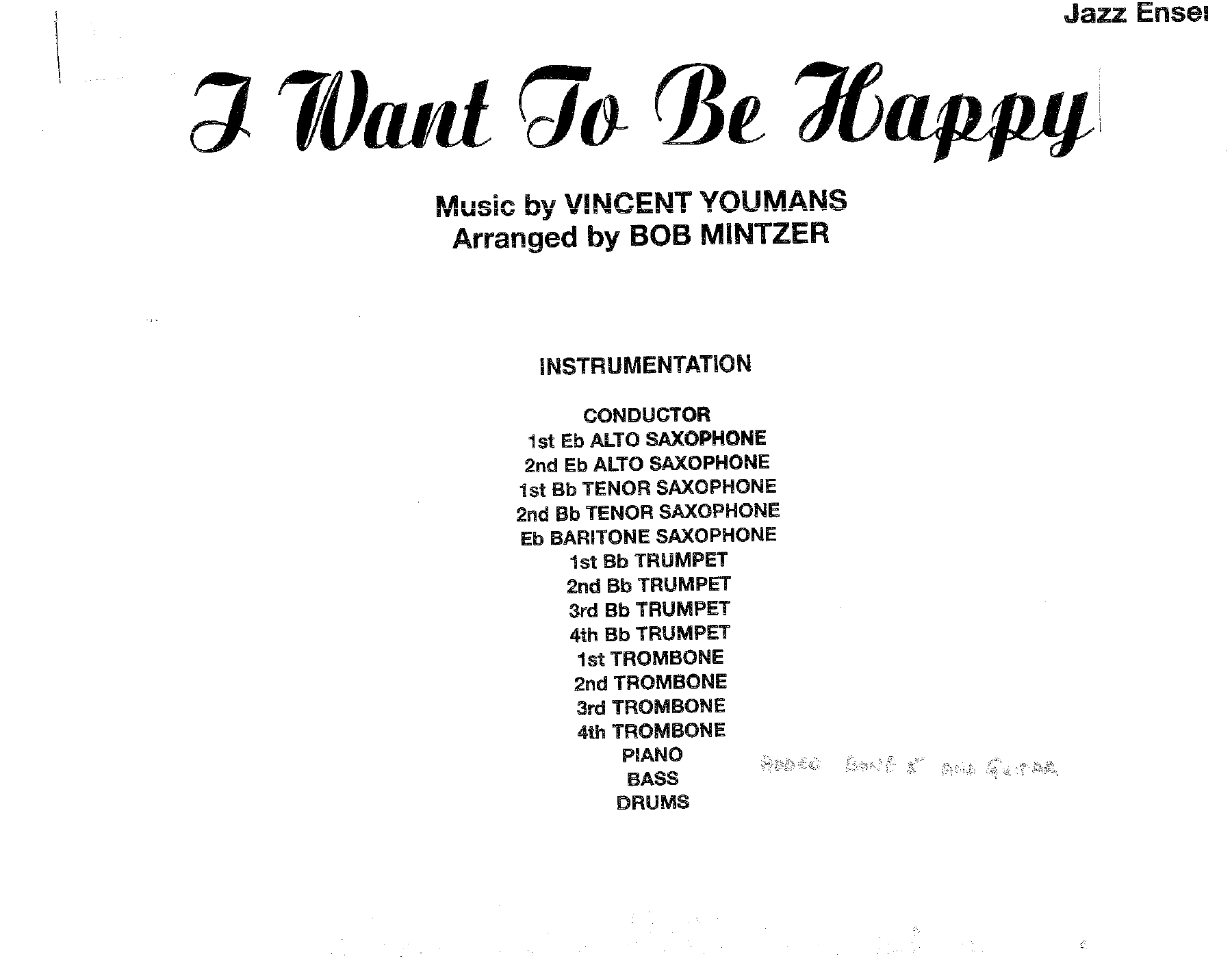
I Want To Be Happy (B.Mintzer) sheet music preview

I Want To Be Happy (B.Mintzer)

Composed by Vincent Youmans

Arranged by Bob Mintzer

  • Ensemble: Big Band
  • Style: Jazz Standard
  • Pages: 79
  • Instruments (19): Conductor, 1st Eb Alto Saxophone, 2nd Eb Alto Saxophone, 1st Bb Tenor Saxophone, 2nd Bb Tenor Saxophone, Eb Baritone Saxophone, 1st Bb Trumpet, 2nd Bb Trumpet, 3rd Bb Trumpet, 4th Bb Trumpet, 1st Trombone, 2nd Trombone, 3rd Trombone, 4th Trombone, 5th Trombone, Piano, Guitar, Bass, Drums
  • Difficulty: advanced
  • Content: Individual Parts
  • Format: PDF Download (Instant)
  • Price: $24.99

"I Want To Be Happy," composed by Vincent Youmans with lyrics by Irving Caesar, debuted in 1925 as a standout number in the Broadway musical *No, No, Nanette*. Emerging during the vibrant Roaring Twenties, an era defined by post-World War I prosperity and the rise of jazz, the song quickly became a symbol of the period's light-hearted spirit and optimistic outlook. Its straightforward phrasing, subtle syncopation, and limited melodic range, combined with an emphasis on mutual joy, contributed to its enduring appeal and rapid ascent to jazz standard status. Early recordings by orchestras like Carl Fenton and Vincent Lopez propelled its popularity, with countless jazz luminaries from Benny Goodman and Ella Fitzgerald to Stan Getz and Thelonious Monk later offering their interpretations, solidifying its place in the jazz canon. Bob Mintzer’s big band arrangement of this classic standard transforms the original's buoyant charm into a sophisticated, driving medium-up swing chart, typically in the key of F major. Mintzer, renowned for his work with the Yellowjackets and his own Grammy-winning big band, brings his signature blend of contemporary jazz sensibilities and traditional big band power to this piece. His arrangements are characterized by intricate horn voicings, often featuring dense, layered counterpoint and challenging rhythmic figures that demand precision from each section. Expect a dynamic journey through the form, with Mintzer expertly crafting soli sections that showcase the full ensemble's technical prowess and powerful shout choruses that build to exhilarating climaxes. His approach often involves unexpected harmonic twists and rhythmic displacements, injecting fresh energy into familiar melodies while maintaining a clear connection to the tune's historical roots. This arrangement is a masterclass in modern big band writing, designed to challenge and reward advanced ensembles. The melody is typically presented with a full, harmonized sound, often passed between sections, creating a rich textural tapestry. Featured solo opportunities are strategically placed, allowing accomplished improvisers to shine over Mintzer's sophisticated harmonic framework. Technical challenges include demanding ensemble passages requiring precise articulation, complex rhythmic interplay, and a strong command of dynamics across the band. The rewarding aspect lies in the sheer excitement generated by Mintzer's inventive scoring and the opportunity for a mature ensemble to execute a truly exhilarating and contemporary take on a beloved standard. Given its complexity and the stylistic demands, this arrangement is most appropriate for college, conservatory, or professional-level big bands. High school bands with exceptionally strong lead players and a dedicated rhythm section might attempt it, but the intricacies of Mintzer's voicings and rhythmic figures require a high degree of musical maturity and technical proficiency. The piece offers an excellent vehicle for developing advanced ensemble precision, navigating modern jazz harmonies, and interpreting a complex, driving swing feel, making it a valuable addition to any serious jazz program's repertoire. This arrangement demands a cohesive and rhythmically precise ensemble. Conductors should emphasize a strong, driving medium-up swing feel from the outset, ensuring the rhythm section locks into a consistent groove. The key technical challenges lie in the intricate ensemble figures and layered voicings, particularly within the saxophone and brass soli sections. Rehearsal should focus on isolating these passages, practicing them slowly with a metronome to ensure rhythmic accuracy and clean articulation before gradually increasing tempo. Pay close attention to dynamic contrasts, as Mintzer often uses sudden shifts to create dramatic effect. Brass players should be prepared for extended ranges and robust attacks, while saxophones need to execute complex melodic lines with precision and blend. Special techniques such as controlled falls and precise cut-offs will enhance the authenticity of the jazz idiom. Encourage soloists to engage with the modern harmonic language while maintaining the energetic swing feel. Q: What instruments and parts are included in this arrangement? A: This big band arrangement includes parts for 17 instruments: 1st Eb Alto Saxophone, 2nd Eb Alto Saxophone, 1st Bb Tenor Saxophone, 2nd Bb Tenor Saxophone, Eb Baritone Saxophone, 1st Bb Trumpet, 2nd Bb Trumpet, 3rd Bb Trumpet, 4th Bb Trumpet, 1st Trombone, 2nd Trombone, 3rd Trombone, 4th Trombone, Piano, Bass, Drums, and Guitar. It also includes a full conductor score. Q: What is the difficulty level of this arrangement? A: This arrangement is considered advanced, suitable for college, conservatory, or professional-level big bands. It features complex harmonies, intricate rhythmic figures, and demanding ensemble passages that require a high degree of technical proficiency and musical maturity. Q: What musical style and historical context does this arrangement represent? A: This is a contemporary big band jazz arrangement of "I Want To Be Happy," a jazz standard originally composed by Vincent Youmans in 1925 for the Broadway musical *No, No, Nanette*. The arrangement blends the original's classic Tin Pan Alley charm with modern jazz harmonies and a driving medium-up swing feel. Q: What makes Bob Mintzer's treatment of "I Want To Be Happy" unique? A: Bob Mintzer's arrangement is distinctive for its sophisticated, layered voicings, challenging soli sections, and powerful shout choruses. He infuses the classic standard with contemporary harmonic and rhythmic complexity, showcasing his signature approach to big band writing which often includes intricate counterpoint and dynamic contrasts. Q: What is the typical tempo and feel for this arrangement? A: This arrangement is typically performed at a medium-up swing tempo, emphasizing a driving, energetic feel. While specific BPM may vary, it generally falls within the range of a brisk swing, often around 180 BPM or higher, as seen in some jazz interpretations.

Questions and answers

What is included in the I Want To Be Happy (B.Mintzer) PDF?
The verified current file contains a conductor score and individual parts across 79 pages.
How many instruments or parts are listed for I Want To Be Happy (B.Mintzer)?
The verified instrumentation list contains 19 entries for this Big Band arrangement.
Who is credited for I Want To Be Happy (B.Mintzer)?
Composer: Vincent Youmans. Arranger: Bob Mintzer.
What difficulty is listed for I Want To Be Happy (B.Mintzer)?
The verified difficulty level is advanced.
What style is listed for I Want To Be Happy (B.Mintzer)?
The catalog lists the style as Jazz Standard.
Can I preview I Want To Be Happy (B.Mintzer) before buying?
Yes. The product page provides a preview generated from the current PDF file.
How is I Want To Be Happy (B.Mintzer) delivered?
After successful payment, the digital PDF is made available for download. The displayed price is $24.99.

Musicians Also Search For

I Want To Be Happy Bob Mintzer PDFI Want To Be Happy Bob Mintzer sheet musicI Want To Be Happy arranged by Bob MintzerBob Mintzer big band chartsBob Mintzer jazz arrangements PDFI Want To Be Happy Vincent Youmans sheet musicI Want To Be Happy Vincent Youmans big band arrangementsVincent Youmans big band chartsI Want To Be Happy big band arrangementsI Want To Be Happy big band PDF downloadI Want To Be Happy jazz sheet musicbig band sheet music downloadI Want To Be Happy conductor score PDFI Want To Be Happy individual parts downloadI Want To Be Happy sheet music PDFI Want To Be Happy Jazz Standard chartsJazz Standard big band arrangementsbuy I Want To Be Happy sheet musicdownload I Want To Be Happy PDFI Want To Be Happy jazz chartsbest Bob Mintzer big band arrangementsVincent Youmans arranged by Bob MintzerI Want To Be Happy printable sheet musicbig band repertoire PDF

All arrangements by Bob Mintzer All Vincent Youmans sheet music