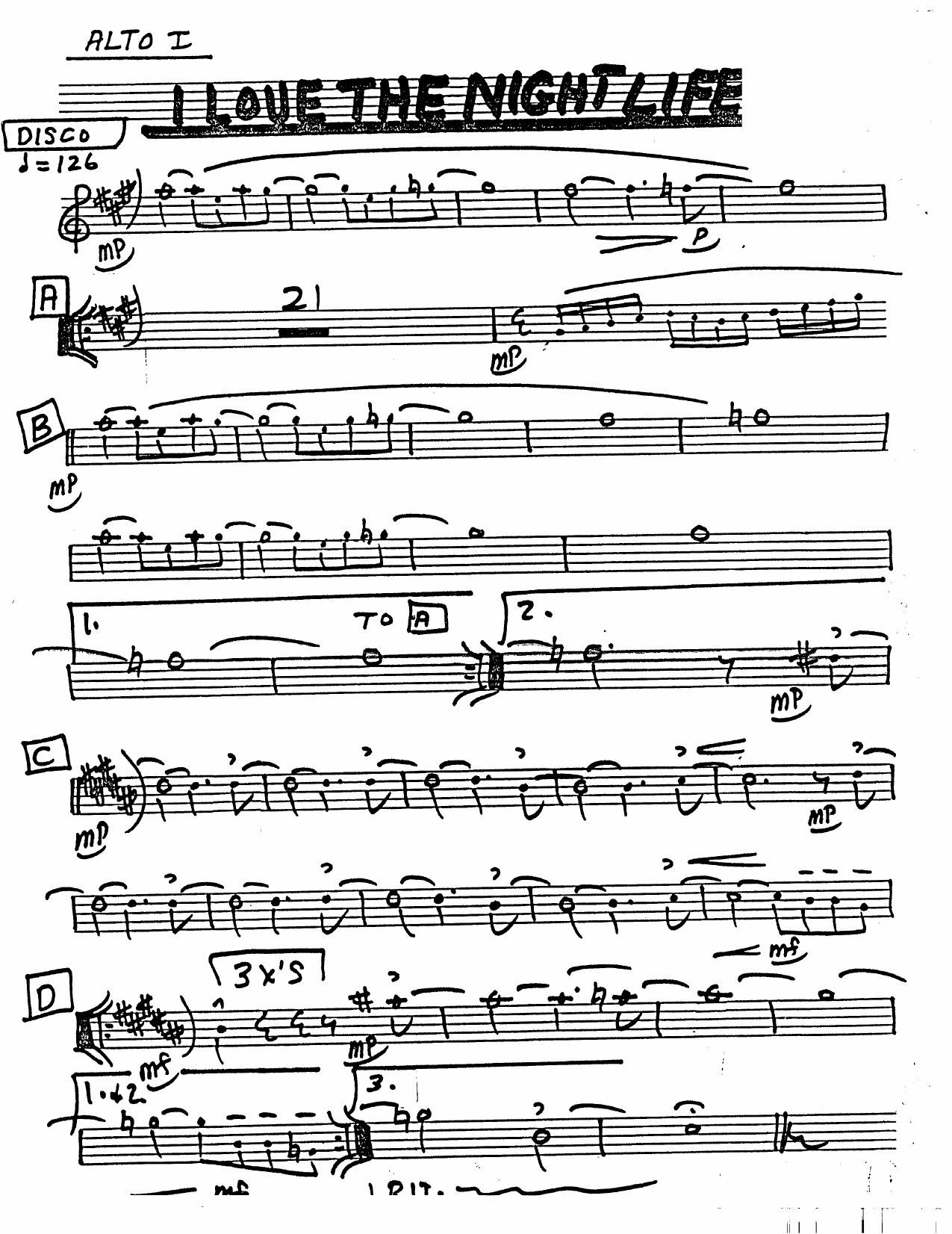
I Love The Nightlife
Composed by Frederick Knight
Arranged by unknown
- Ensemble: Big Band
- Style: Jazz Standard
- Pages: 35
- Instruments (16): Alto I, Alto II, Tenor I, Tenor II, Baritone, Trumpet I, Trumpet II, Trumpet III, Trumpet IV, Trombone I, Trombone II, Trombone III, Trombone IV, Piano-Voice, Bass, Drums
- Difficulty: medium
- Content: Individual Parts
- Format: PDF Download (Instant)
- Price: $24.99
Frederick Knight's "I Love The Nightlife (Disco 'Round)", originally composed in 1978, emerged as a quintessential anthem of the disco era, famously popularized by Alicia Bridges. While not initially conceived as a jazz standard, its infectious groove, memorable melody, and enduring popularity have made it a compelling candidate for reinterpretation across various genres. This big band arrangement reimagines the disco classic through a sophisticated jazz lens, transforming its dancefloor energy into a vibrant, swinging showcase for a full jazz orchestra. The original's upbeat, celebratory spirit is preserved, but recontextualized within the harmonic and rhythmic vocabulary of a contemporary jazz big band, offering a fresh perspective on a beloved tune. This arrangement establishes a medium-up swing feel, typically around 144-152 BPM, in the key of F major. The mood is undeniably exuberant and energetic, evoking the joy and freedom of a lively night out, but with the added depth and complexity inherent in a jazz treatment. The rhythmic foundation is driven by a propulsive swing groove in the rhythm section, providing a solid yet flexible bedrock for the horn lines. Expect bright, full-bodied voicings that emphasize the brass and saxophone sections, creating a rich sonic tapestry. The arrangement balances moments of tight ensemble precision with opportunities for individual expression, maintaining a consistently uplifting and engaging energy throughout. The unknown arranger's approach to "I Love The Nightlife" is characterized by clever harmonic substitutions and dynamic orchestration that elevate the original's pop sensibility to a sophisticated jazz idiom. The melody is initially presented by the alto saxophone section, often doubled or harmonized by trumpets, providing a clear and engaging statement. Soli sections for both saxophones and brass are prominent, featuring intricate lines that weave through the harmonic progression. A particularly striking feature is the development of a powerful shout chorus that builds in intensity, employing layered brass figures and driving saxophone riffs to create a climactic moment. The arrangement also incorporates subtle rhythmic variations and syncopated figures that enhance the swing feel, demonstrating a thoughtful understanding of big band writing. Performance of this arrangement offers numerous rewards and engaging challenges. The melody is shared effectively, primarily by the alto saxophones and lead trumpet, ensuring melodic interest across the ensemble. There are featured solo opportunities for tenor saxophone and trumpet, allowing skilled improvisers to stretch out over the familiar changes, reharmonized for jazz context. Technical demands include precise articulation in the soli sections, dynamic control during the build-ups, and maintaining a consistent, driving swing feel. The rhythm section requires a tight groove, particularly the bass and drums, to underpin the horn lines. The rewarding aspect lies in transforming a recognizable pop tune into a sophisticated big band piece that audiences will instantly connect with, while musicians will appreciate its well-crafted jazz elements and opportunities for dynamic interplay. This arrangement is ideally suited for college and community big bands, as well as professional ensembles seeking a fresh, audience-pleasing addition to their repertoire. Conductors should emphasize a consistent, medium-up swing feel, aiming for a tempo between 144-152 BPM, ensuring the rhythm section lays down a solid, driving groove from the outset. Key technical challenges include the precise articulation and blend required in the saxophone and brass soli sections; encourage musicians to listen across sections for harmonic clarity and rhythmic unison. Dynamic contrasts are crucial, particularly in the build-up to the shout chorus, where a controlled crescendo will maximize impact. Trumpets should pay attention to lead trumpet range and endurance, while saxophones need to execute quick, clean fingerings in their melodic passages. Encourage soloists to embrace the tune's joyful spirit while exploring modern harmonic possibilities. Q: What instruments are included in this arrangement? A: This arrangement is scored for a standard 16-instrument big band, including Alto Saxophone 1, Alto Saxophone 2, Tenor Saxophone 1, Tenor Saxophone 2, Baritone Saxophone, Trumpet 1, Trumpet 2, Trumpet 3, Trumpet 4, Trombone 1, Trombone 2, Trombone 3, Trombone 4, Piano, Bass, and Drums. Q: What is the difficulty level of this arrangement? A: This arrangement is rated as medium-advanced. It requires proficient instrumentalists capable of navigating intricate soli passages, maintaining a consistent swing feel, and executing dynamic contrasts, making it suitable for college, advanced community, or professional big bands. Q: What is the musical style and historical context of this piece? A: This arrangement transforms Frederick Knight's 1978 disco hit "I Love The Nightlife" into a vibrant jazz big band piece. While the original is a disco anthem, this version reinterprets it with sophisticated jazz harmonies, rhythms, and orchestration, firmly placing it in the realm of contemporary big band jazz. Q: What makes this arrangement unique compared to other versions of "I Love The Nightlife"? A: This arrangement stands out by reharmonizing and recontextualizing a well-known disco track into a swinging big band chart. Its unique features include intricate saxophone and brass soli sections, a powerful shout chorus, and clever rhythmic variations that elevate the original's pop sensibility into a sophisticated jazz idiom. Q: What is the typical performance duration and tempo for this arrangement? A: The typical performance duration for this arrangement is approximately 4-5 minutes, depending on the length of improvised solos. It is designed to be performed at a medium-up swing tempo, generally ranging from 144 to 152 beats per minute.
Questions and answers
- What is included in the I Love The Nightlife PDF?
- The verified current file contains individual parts across 35 pages.
- How many instruments or parts are listed for I Love The Nightlife?
- The verified instrumentation list contains 16 entries for this Big Band arrangement.
- Who is credited for I Love The Nightlife?
- Composer: Frederick Knight. Arranger: unknown.
- What difficulty is listed for I Love The Nightlife?
- The verified difficulty level is medium.
- What style is listed for I Love The Nightlife?
- The catalog lists the style as Jazz Standard.
- Can I preview I Love The Nightlife before buying?
- Yes. The product page provides a preview generated from the current PDF file.
- How is I Love The Nightlife delivered?
- After successful payment, the digital PDF is made available for download. The displayed price is $24.99.
Musicians Also Search For
I Love The Nightlife unknown PDF • I Love The Nightlife unknown sheet music • I Love The Nightlife arranged by unknown • unknown big band charts • unknown jazz arrangements PDF • I Love The Nightlife Frederick Knight sheet music • I Love The Nightlife Frederick Knight big band arrangements • Frederick Knight big band charts • I Love The Nightlife big band arrangements • I Love The Nightlife big band PDF download • I Love The Nightlife jazz sheet music • big band sheet music download • I Love The Nightlife individual parts download • I Love The Nightlife sheet music PDF • I Love The Nightlife Jazz Standard charts • Jazz Standard big band arrangements • buy I Love The Nightlife sheet music • download I Love The Nightlife PDF • I Love The Nightlife jazz charts • best unknown big band arrangements • Frederick Knight arranged by unknown • I Love The Nightlife printable sheet music • big band repertoire PDF