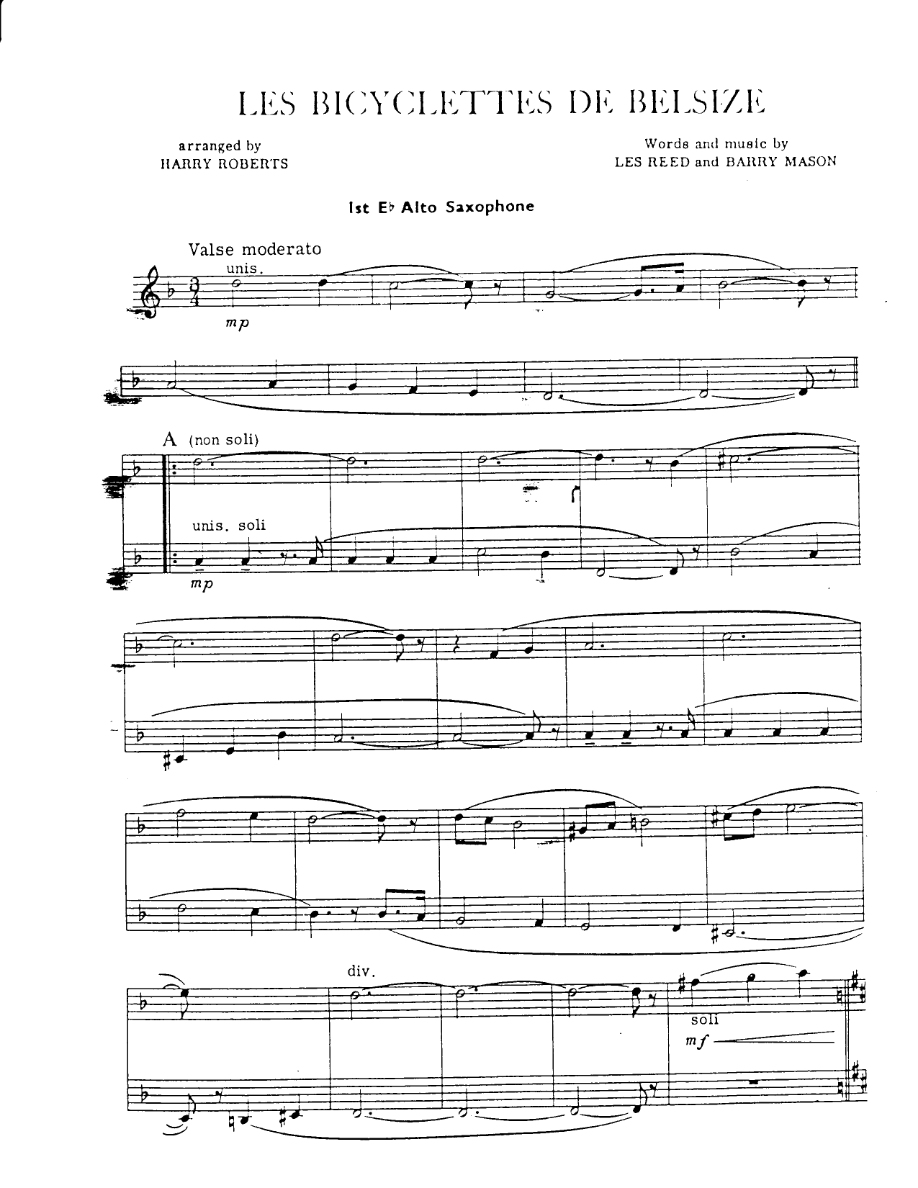
Les Bicyclettes De Belsize (H.Roberts)
Composed by Les Reed
Arranged by H. Roberts
- Ensemble: Big Band
- Style: Waltz
- Pages: 34
- Instruments (17): Alto Saxophone 1, Alto Saxophone 2, Tenor Saxophone 1, Tenor Saxophone 2, Baritone Saxophone, Trumpet 1, Trumpet 2, Trumpet 3, Trumpet 4, Trombone 1, Trombone 2, Trombone 3, Bass Trombone, Piano, Bass, Drums, Guitar
- Difficulty: medium
- Content: Individual Parts
- Format: PDF Download (Instant)
- Price: $18.99
## SECTION 1: Description The enchanting melody of "Les Bicyclettes De Belsize" emerged in 1968, a quintessential example of the sophisticated pop and easy-listening sound that defined the late 1960s. Composed by the prolific British songwriter Les Reed, whose pen also gifted the world hits like "Delilah" and "It's Not Unusual," this tune gained international fame through Engelbert Humperdinck's iconic vocal rendition. Its gentle, romantic waltz feel, often characterized by lush string arrangements and a memorable, soaring melody, quickly cemented its place in the popular music lexicon. While not a traditional jazz standard in its original form, its strong melodic structure and harmonic richness make it a compelling canvas for jazz interpretation, inviting arrangers to explore its inherent beauty through a different lens. H. Roberts' big band arrangement masterfully re-imagines this classic, transforming its popular origins into a sophisticated jazz waltz. The piece maintains its original 3/4 time signature, but Roberts infuses it with a refined, medium-tempo jazz waltz groove, emphasizing a delicate yet propulsive swing feel. The overall mood is one of nostalgic elegance and understated joy, evoking the charm of a bygone era. The arrangement opens with a beautifully voiced saxophone soli, immediately establishing the piece's harmonic depth and the arranger's characteristic attention to detail. Roberts' signature approach often involves intricate counterpoint and rich, extended harmonies that elevate the source material without sacrificing its melodic integrity. Expect lush brass voicings that provide warmth and support, contrasting with the agile saxophone lines. Performance-wise, the melody is initially carried by the alto saxophone, offering a lyrical and expressive feature before being passed to other sections. There are ample opportunities for featured soloists, notably a written-out or improvisational solo for tenor saxophone, allowing for individual expression within the waltz framework. The arrangement builds through dynamic contrasts, culminating in a powerful yet controlled shout chorus that showcases the full ensemble's capabilities. Technical challenges include maintaining a consistent, flowing jazz waltz feel, precise articulation in the soli sections, and achieving balanced dynamics across the full big band instrumentation. The rewarding aspect lies in the opportunity to perform a beautiful, well-crafted piece that resonates with audiences while offering significant musical depth for the players. This arrangement is ideally suited for advanced high school, college, community, and professional big bands seeking a sophisticated and engaging piece that offers both musical challenge and audience appeal. ## SECTION 2: Performance Notes Conductors should emphasize a flowing, medium jazz waltz feel, ensuring the 3/4 meter swings rather than feels rigid. A metronome marking of quarter note = 132-140 is a good starting point. Articulation is paramount, particularly in the saxophone soli sections; encourage light, connected phrasing to maintain the lyrical quality. Brass players should focus on warm, blended tones, avoiding overly aggressive attacks, especially in the background figures. Dynamics are crucial for shaping the narrative of the piece; rehearse the crescendos and decrescendos carefully to build and release tension effectively. The tenor saxophone solo can be either played as written or opened up for improvisation, depending on the soloist's ability. Ensure the rhythm section establishes a solid, consistent waltz groove from the outset, with the bass providing a strong foundation and drums offering tasteful, swinging embellishments. ## SECTION 3: FAQ Q: What instruments are included in this arrangement? A: This arrangement is scored for a standard 17-instrument big band lineup, including Alto Saxophone 1 & 2, Tenor Saxophone 1 & 2, Baritone Saxophone, Trumpet 1-4, Trombone 1-4, Piano, Bass, Guitar, and Drums. Q: What is the difficulty level of "Les Bicyclettes De Belsize (H.Roberts)"? A: This arrangement is rated as medium-advanced, suitable for advanced high school, college, community, and professional big bands. It requires strong ensemble playing, precise articulation, and a solid understanding of jazz waltz feel. Q: What is the musical style and historical context of this piece? A: This is a jazz big band arrangement of Les Reed's 1968 pop hit "Les Bicyclettes De Belsize," re-imagined as a sophisticated medium jazz waltz, blending its original romantic charm with a refined jazz sensibility. Q: What makes H. Roberts' arrangement of this piece unique? A: H. Roberts' approach is characterized by lush, extended harmonies, intricate saxophone soli voicings, and a sophisticated jazz waltz groove, transforming the popular original into a rich and engaging big band showcase. Q: What is the approximate performance duration and tempo for this arrangement? A: The approximate performance duration is 3:30-4:00 minutes. It should be performed at a medium jazz waltz tempo, typically around quarter note = 132-140.