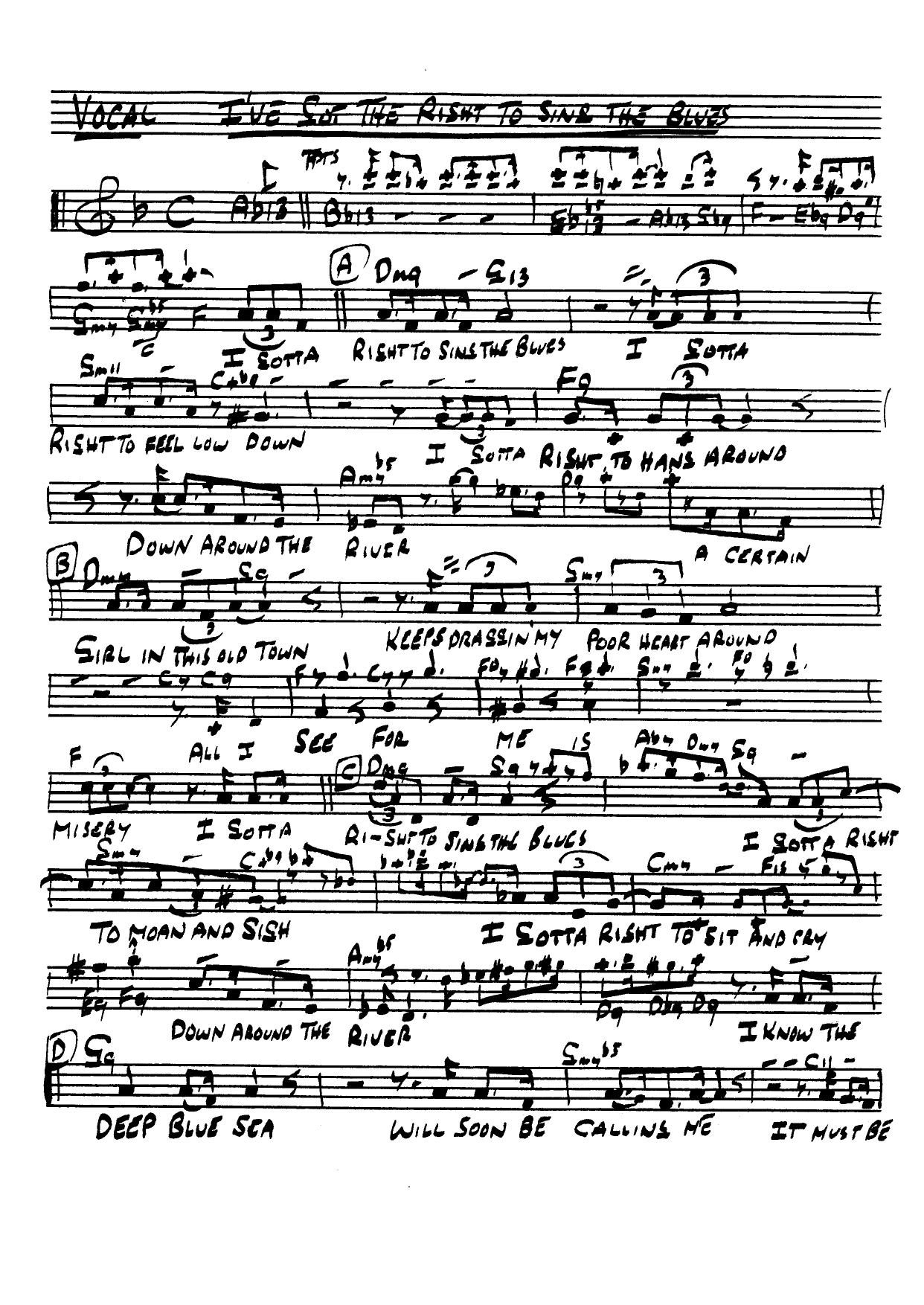
I Gotta Right To Sing The Blues (J.Farley)
Composed by Harold Arlen
Arranged by Frank Sinatra & Nelson Riddle
- Ensemble: Big Band
- Pages: 18
- Instruments (17): Vocal, 1st Alto Saxophone, 2nd Alto Saxophone, 1st Tenor Saxophone, 2nd Tenor Saxophone, Baritone Saxophone, 1st Trumpet, 2nd Trumpet, 3rd Trumpet, 4th Trumpet, 1st Trombone, 2nd Trombone, 3rd Trombone, 4th Trombone, Bass, Drums, Piano
- Difficulty: easy
- Content: Individual Parts
- Format: PDF Download (Instant)
- Price: $24.99
Harold Arlen and Ted Koehler’s 1932 masterpiece "I Gotta Right to Sing the Blues" occupies a hallowed space in the Great American Songbook, transitioning seamlessly from Depression-era torch song to an essential vehicle for jazz expression. While originally introduced on Broadway and famously recorded by icons like Louis Armstrong and Billie Holiday, the definitive mid-century treatment of the tune was cemented when Frank Sinatra collaborated with master arranger Nelson Riddle. Riddle’s approach to the Sinatra canon redefined vocal jazz orchestration, balancing lush, cinematic string-inspired voicings for horns with a driving, sophisticated swing cadence that turned melancholy introspection into an empowering musical statement. Brimming with sophisticated tension, this arrangement adopts a smoldering, medium-slow swing feel in 4/4 time, anchored by a rich harmonic palette characteristic of Riddle's golden-era writing. The mood shifts masterfully between dark, blues-infused introspection and soaring, brass-heavy optimism. Riddle utilizes extended chord voicings—frequently incorporating sharp-11s and minor-major seventh textures in the saxophones—to evoke a smoky, late-night atmosphere. The underlying rhythmic momentum never drags; instead, it simmers with a controlled intensity, allowing the heavy-hearted blues sentiment of Arlen's melody to build into moments of profound catharsis. The structural blueprint of the chart showcases Riddle's genius for dynamic contrast and textural variety. The ten-instrument ensemble (featuring a robust horn section of Alto Sax, Tenor Sax, Baritone Sax, Trumpet, and Trombone alongside rhythm) is utilized with maximum economy and color. The woodwinds frequently carry interlocking, contrapuntal counter-melodies beneath the primary thematic statements, while the brass interject with warm, muted sighs and potent, punchy stabs. Featured solo space allows individual horn players to stretch out within the blues idiom, emulating the conversational interplay of a small combo inside a big band framework. Technical demands center less on raw velocity and more on immaculate blend, intonation across altered dominant sonorities, and precise control over dynamic swells. Advanced high school, collegiate, and professional jazz ensembles will find this arrangement an exceptional vehicle for developing stylistic maturity. Because the chart relies heavily on nuanced swing phrasing, subtle rubato-esque pacing, and deep-pocket groove rather than sheer technical speed, it serves as an uncompromising test of a band's internal clock and listening skills. Performing this Nelson Riddle-inspired chart rewards the ensemble with a masterclass in mid-century jazz orchestration, offering audiences an unforgettable journey through one of the most compelling emotional landscapes in vocal and instrumental jazz history. Executing this arrangement successfully demands absolute synchronization between the rhythm section and the horn players, particularly regarding the laid-back, behind-the-beat swing feel. The tempo should remain a steady, confident medium-slow swing; avoid rushing the triplet subdivisions, as the chart's swagger relies on a heavy, relaxed anchor. Conductors should pay meticulous attention to dynamic markings, ensuring that background figures never obscure featured soloists or primary melodic lines. Saxophones must blend tightly on the dense chord clusters, using a warm, vibrato-less tone that gradually blooms into the ensemble peaks. Brass players should employ subtle cup or harmon mutes where indicated to achieve that authentic Riddle-esque cinematic texture. Rehearsals should initially focus on isolated section work to lock in the articulation—specifically the precise execution of accented dits and long-short legato phrasing—before integrating the rhythm section's foundational walking bass and comping patterns. Q: What instruments and parts are included in this 18-page arrangement? A: This 18-page chart is scored for a 10-instrument ensemble featuring Alto Saxophone, Tenor Saxophone, Baritone Saxophone, Trumpet, and Trombone parts, alongside a full rhythm section framework. Q: What is the difficulty level of this arrangement? A: This piece is best suited for advanced high school, collegiate, and professional jazz ensembles due to its heavy reliance on precise swing phrasing, mature intonation, and subtle dynamic control. Q: What is the historical style and context of this chart? A: The arrangement mirrors the sophisticated, mid-century swinging vocal jazz style popularized by Frank Sinatra through the iconic arranging genius of Nelson Riddle. Q: What makes this Nelson Riddle arrangement unique? A: It distinguishes itself through lush, cinematic horn voicings, dense extended harmonies, and a brilliant balance between smoky, blues-infused introspection and powerful brass interludes. Q: What is the performance duration and tempo feel of the piece? A: The chart is performed at a confident, medium-slow swing tempo in 4/4 time, typically running between 3.5 to 4.5 minutes depending on the length of the improvised solos.
Questions and answers
- What is included in the I Gotta Right To Sing The Blues (J.Farley) PDF?
- The verified current file contains individual parts across 18 pages.
- How many instruments or parts are listed for I Gotta Right To Sing The Blues (J.Farley)?
- The verified instrumentation list contains 17 entries for this Big Band arrangement.
- Who is credited for I Gotta Right To Sing The Blues (J.Farley)?
- Composer: Harold Arlen. Arranger: Frank Sinatra & Nelson Riddle.
- What difficulty is listed for I Gotta Right To Sing The Blues (J.Farley)?
- The verified difficulty level is easy.
- Can I preview I Gotta Right To Sing The Blues (J.Farley) before buying?
- Yes. The product page provides a preview generated from the current PDF file.
- How is I Gotta Right To Sing The Blues (J.Farley) delivered?
- After successful payment, the digital PDF is made available for download. The displayed price is $24.99.
Musicians Also Search For
I Gotta Right To Sing The Blues Frank Sinatra & Nelson Riddle PDF • I Gotta Right To Sing The Blues Frank Sinatra & Nelson Riddle sheet music • I Gotta Right To Sing The Blues arranged by Frank Sinatra & Nelson Riddle • Frank Sinatra & Nelson Riddle big band charts • Frank Sinatra & Nelson Riddle jazz arrangements PDF • I Gotta Right To Sing The Blues Harold Arlen sheet music • I Gotta Right To Sing The Blues Harold Arlen big band arrangements • Harold Arlen big band charts • I Gotta Right To Sing The Blues big band arrangements • I Gotta Right To Sing The Blues big band PDF download • I Gotta Right To Sing The Blues jazz sheet music • big band sheet music download • I Gotta Right To Sing The Blues individual parts download • I Gotta Right To Sing The Blues sheet music PDF • buy I Gotta Right To Sing The Blues sheet music • download I Gotta Right To Sing The Blues PDF • I Gotta Right To Sing The Blues jazz charts • best Frank Sinatra & Nelson Riddle big band arrangements • Harold Arlen arranged by Frank Sinatra & Nelson Riddle • I Gotta Right To Sing The Blues printable sheet music • big band repertoire PDF