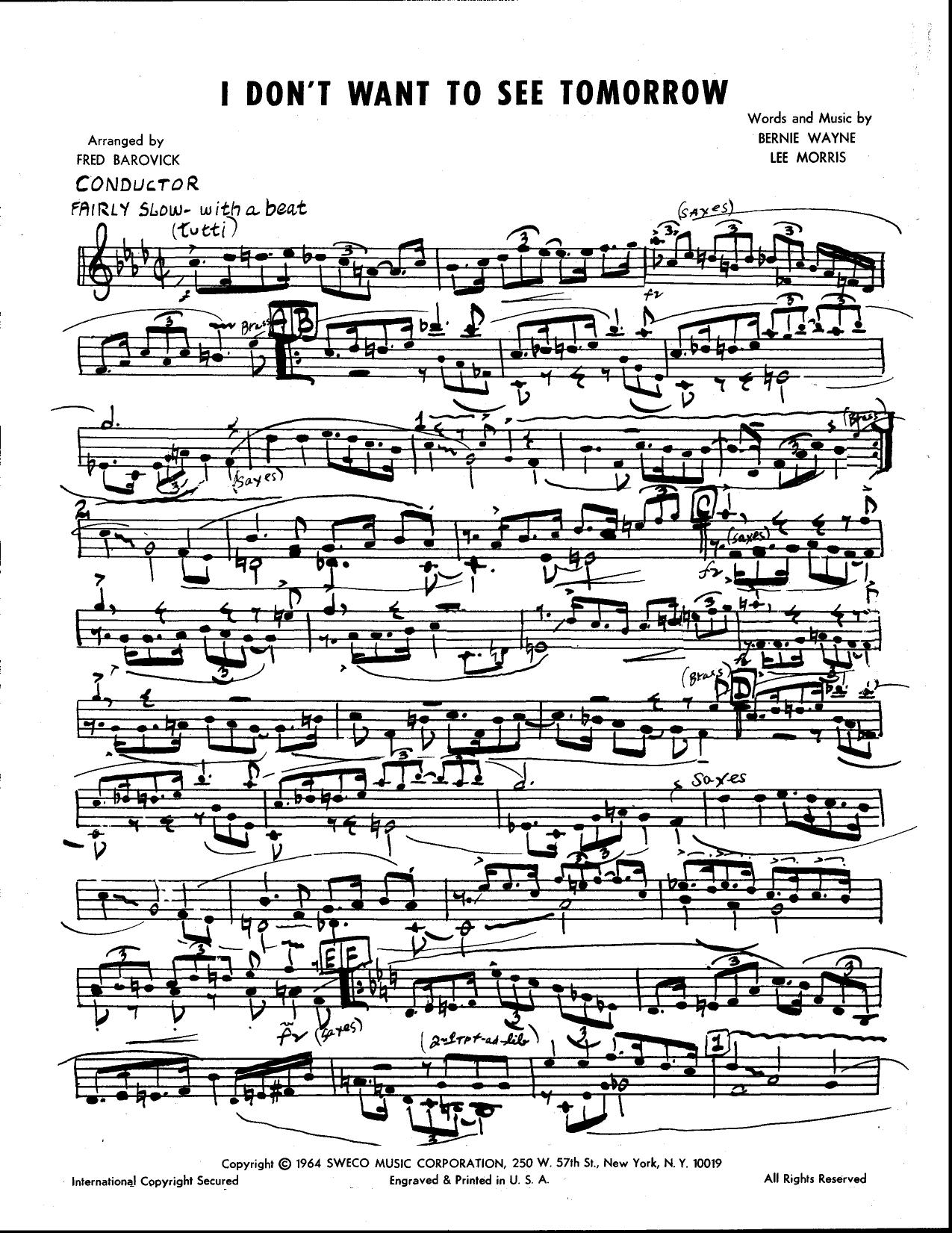
I Don't Want To See Tomorrow (F.Barovick) sheet music preview

I Don't Want To See Tomorrow (F.Barovick)

Composed by Fred Barovick

Arranged by Fred Barovick

  • Ensemble: Big Band
  • Pages: 38
  • Instruments (17): 1st Eb Alto Saxophone, 2nd Bb Tenor Saxophone, 3rd Eb Alto Saxophone, 4th Bb Tenor Saxophone, 5th Eb Baritone Saxophone, 1st Bb Trumpet, 2nd Bb Trumpet, 3rd Bb Trumpet, 4th Bb Trumpet, 1st Trombone, 2nd Trombone, 3rd Trombone, 4th Trombone, Bass, Drums, Piano, Guitar
  • Difficulty: medium
  • Content: Individual Parts
  • Format: PDF Download (Instant)
  • Price: $24.99

Fred Barovick’s “I Don’t Want To See Tomorrow” captures the sophisticated essence of mid-century jazz composition, echoing the lush harmonic vocabulary and sophisticated writing popularized by the great studio orchestras of the post-swing and cool jazz eras. Emerging from a tradition where melodic lyricism met clever, extended chord structures, this composition stands out for its moody introspection and subtle rhythmic drive. Barovick crafted a work that balances melancholy with an underlying forward momentum, creating a narrative arc that moves from quiet reflection to rich, cinematic peaks. The musical character of the arrangement unfolds at a relaxed, flowing medium-swing tempo that demands exceptional internal time and subdivision from the rhythm section. Set in a warm, expressive key, the mood is deeply atmospheric, invoking the sophisticated ambiance of late-night metropolitan jazz clubs. The harmony utilizes sophisticated upper-structure extensions, maj7#11 sonorities, and chromatic voice-leading that give the brass and saxophone sections a dense, velvety texture. Rather than relying on aggressive, high-note pyrotechnics, the piece derives its power from nuanced dynamic contrasts, delicate ensemble blends, and a seamless integration of countermelodies weaving through the inner voices. Barovick’s structural approach showcases a masterclass in big band pacing. The arrangement opens with an evocative, rubato-tinged introduction before settling into an infectious, understated swing groove carried by the rhythm section. The saxophones frequently enjoy rich, harmonized soli sections that highlight intricate line-sharing across both altos and tenors, while the brass interject with warm, muted responses. A meticulously crafted shout chorus builds organically, layering section by section until the full ensemble opens up into a soaring, harmonically rich climax before gently receding into a haunting, quiet coda. Featured solo space allows a soloist—ideally on tenor saxophone or trumpet—to stretch out over sophisticated changes that mirror the moody elegance of the head. Advanced high school, collegiate, and professional community big bands will find this chart to be an exceptionally rewarding addition to their repertoire. While the individual technical demands on range are moderate, the true challenge lies in ensemble cohesion, intonation across extended chords, and maintaining a relaxed, driving swing feel at a medium tempo. It provides an ideal vehicle for developing sections to work on blend, dynamic subtlety, and stylistic maturity, offering audiences a refreshing departure from standard, high-octane-only shout charts. Conductors should approach "I Don’t Want To See Tomorrow" with an emphasis on horizontal line-reading rather than vertical chord-bashing. The medium-swing tempo must not drag; maintain a light, feather-touch ride cymbal and a pulsing, non-intrusive bass line to keep the groove buoyant. Intonation is the primary technical hurdle, particularly in the saxophone solis and muted brass passages where minor-second and tritone relationships color the harmony. Ensure that players executing cup or bucket mutes balance their volume carefully against open horns. Rehearsal should begin by isolating the rhythm section to lock in the understated pocket before layering in the horns section by section, paying strict attention to dynamic hairpin markings that shape the emotional contour of Barovick's writing. Q: What instruments and parts are included in this big band arrangement? A: The complete 38-page set is scored for a standard 18-instrument big band lineup, featuring a full Conductor score alongside parts for Alto Saxophone 1, Tenor Saxophone 2, Alto Saxophone 3, Tenor Saxophone 4, and the complete brass and rhythm sections. Q: What is the difficulty level of this arrangement? A: This chart is graded as medium-advanced, making it ideal for collegiate ensembles, advanced high school bands, and professional community jazz orchestras. The primary challenges lie in ensemble blend, intonation of extended harmonies, and maintaining a sophisticated medium-swing feel rather than extreme technical speed or high-register range. Q: What is the musical style and historical background of the piece? A: Written by Fred Barovick, the piece reflects the sophisticated, moody, and harmonically rich aesthetic of mid-century jazz composition and cool-era big band arranging, blending lush voicings with a relaxed swing groove. Q: What makes this specific arrangement unique? A: Barovick’s distinct approach relies on intricate inner-voice countermelodies, velvety section solis, and an organic dynamic build that avoids cheap high-note tricks in favor of deep, cinematic harmonic storytelling. Q: What is the performance duration and tempo of the piece? A: The arrangement is designed as a substantive feature piece lasting approximately 4 to 5 minutes, anchored by a relaxed, flowing medium-swing tempo.

Questions and answers

What is included in the I Don't Want To See Tomorrow (F.Barovick) PDF?
The verified current file contains a conductor score and individual parts across 38 pages.
How many instruments or parts are listed for I Don't Want To See Tomorrow (F.Barovick)?
The verified instrumentation list contains 17 entries for this Big Band arrangement.
Who is credited for I Don't Want To See Tomorrow (F.Barovick)?
Composer: Fred Barovick. Arranger: Fred Barovick.
What difficulty is listed for I Don't Want To See Tomorrow (F.Barovick)?
The verified difficulty level is medium.
Can I preview I Don't Want To See Tomorrow (F.Barovick) before buying?
Yes. The product page provides a preview generated from the current PDF file.
How is I Don't Want To See Tomorrow (F.Barovick) delivered?
After successful payment, the digital PDF is made available for download. The displayed price is $24.99.

Musicians Also Search For

I Don't Want To See Tomorrow Fred Barovick PDFI Don't Want To See Tomorrow Fred Barovick sheet musicI Don't Want To See Tomorrow arranged by Fred BarovickFred Barovick big band chartsFred Barovick jazz arrangements PDFI Don't Want To See Tomorrow Fred Barovick big band arrangementsI Don't Want To See Tomorrow big band arrangementsI Don't Want To See Tomorrow big band PDF downloadI Don't Want To See Tomorrow jazz sheet musicbig band sheet music downloadI Don't Want To See Tomorrow conductor score PDFI Don't Want To See Tomorrow individual parts downloadI Don't Want To See Tomorrow sheet music PDFbuy I Don't Want To See Tomorrow sheet musicdownload I Don't Want To See Tomorrow PDFI Don't Want To See Tomorrow jazz chartsbest Fred Barovick big band arrangementsI Don't Want To See Tomorrow printable sheet musicbig band repertoire PDF

All arrangements by Fred Barovick All Fred Barovick sheet music