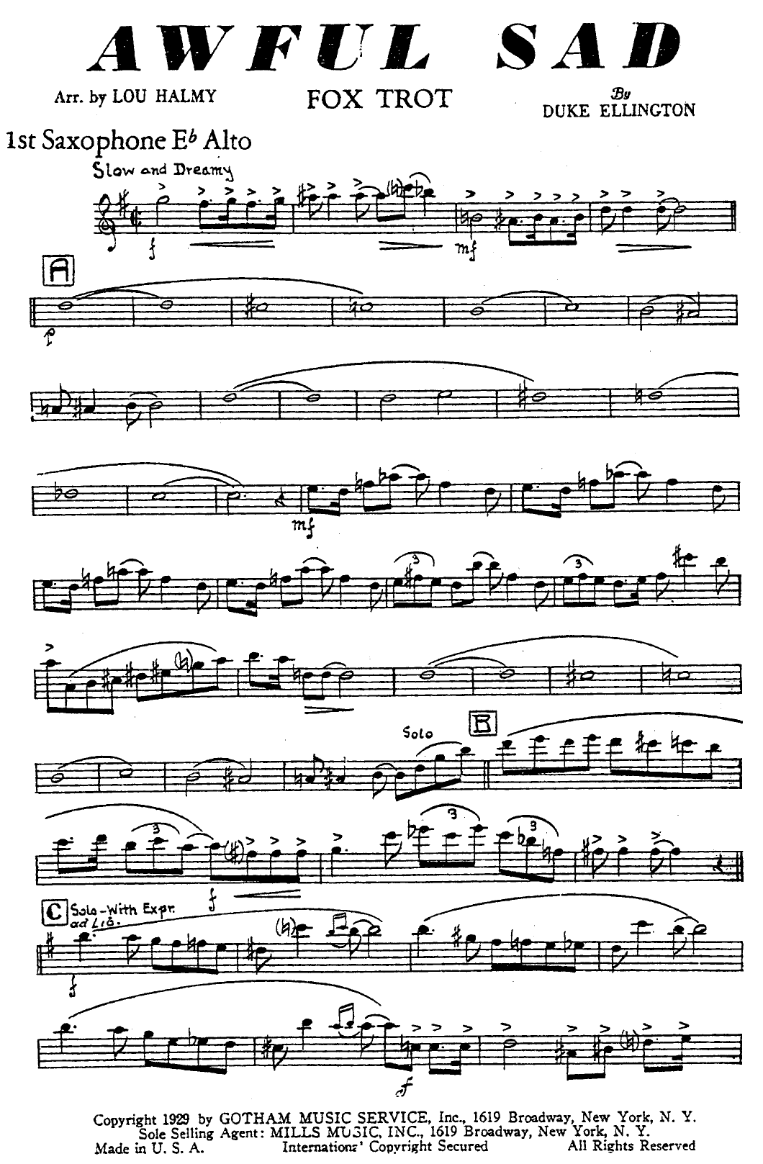
Awful Sad (D.Ellington)
Composed by Duke Ellington
Arranged by D. Ellington
- Ensemble: Big Band
- Style: Foxtrot
- Pages: 18
- Instruments (11): Alto Saxophone 1, Alto Saxophone 3, Bass, Drum Set, Piano, Guitar, Violin, Tenor Saxophone 2, Trombone 1, Trumpet 1, Trumpet 2
- Difficulty: easy
- Content: Individual Parts
- Format: PDF Download (Instant)
- Price: $24.99
"Awful Sad" emerges from the golden age of big band jazz, a poignant Foxtrot originally composed and recorded by the incomparable Duke Ellington. This piece is a quintessential example of Ellington's early mastery of orchestral jazz, showcasing his genius for melody, harmony, and texture during the 1920s and early 1930s, a period often characterized by the burgeoning "Jungle Style" and sophisticated dance music. While perhaps not as universally recognized as some of his later standards, "Awful Sad" holds a significant place in the Ellingtonian canon, reflecting the emotional depth and innovative harmonic language that would define his legendary career. It encapsulates the melancholic yet elegant spirit of the era, presenting a narrative through its melodic lines that is both introspective and deeply expressive. This arrangement, penned by Ellington himself, captures the original's medium-slow Foxtrot feel, maintaining a subtle yet insistent rhythmic pulse in 4/4 time. The predominant mood is one of wistful reflection, underscored by Ellington's characteristic use of blues-inflected harmonies and sophisticated voicings. The piece opens with a delicate, almost fragile melody, often carried by the brass or a featured saxophone, establishing a somber yet beautiful atmosphere. As it progresses, the arrangement builds through expertly crafted soli sections, particularly for the saxophones, which weave intricate counter-melodies and harmonies that are both lush and harmonically adventurous. The energy remains understated but deeply felt, allowing the emotional core of the composition to shine through its carefully constructed layers. Ellington's distinctive arranging approach is immediately apparent in "Awful Sad." He masterfully employs his signature "voicing across sections," creating rich, blended sonorities that blur the lines between brass and reeds. Expect to find close-voiced chords, often with extended harmonies (9ths, 11ths, 13ths), that contribute to the piece's melancholic beauty. While there isn't a traditional "shout chorus" in the explosive sense, the arrangement features moments of collective ensemble power, particularly in the brass, that provide dynamic contrast without disrupting the overall reflective mood. The melodic lines are distributed thoughtfully, often featuring the lead alto or trumpet for the primary theme, with subsequent sections offering opportunities for featured solos, typically in the trumpet or tenor saxophone, allowing for expressive improvisation over the rich harmonic progression. Performing "Awful Sad" is a deeply rewarding experience for a big band. The technical challenges lie less in blistering tempos or extreme ranges, and more in achieving precise ensemble blend, nuanced dynamics, and a cohesive interpretation of the Foxtrot feel. Articulation must be clean and unified, and the balance between the delicate melodic lines and the supportive ensemble textures is paramount. This arrangement is highly suitable for advanced high school, collegiate, community, and professional jazz ensembles seeking to explore the foundational repertoire of big band jazz. Its historical significance, combined with Ellington's brilliant compositional and arranging hand, makes it an invaluable addition to any ensemble's library, offering profound insights into the artistry of one of jazz's true giants. "Awful Sad" requires a medium-slow Foxtrot feel, emphasizing a smooth, legato swing rather than a hard-driving pulse. Aim for a tempo around quarter note = 100-110 BPM, ensuring the rhythmic foundation is steady but flexible enough to allow for expressive phrasing. The primary technical challenge lies in achieving unified articulation and precise blend, particularly in the saxophone soli sections where close voicings demand careful intonation. Brass players should focus on warm, controlled tones, avoiding harshness, especially in the background figures. Mutes, particularly cup and plunger mutes for trumpets and trombones, are essential for capturing the authentic Ellingtonian colors and should be used with sensitivity to dynamic markings. Rehearsal time should be dedicated to balancing the delicate melodic lines against the ensemble's harmonic support, ensuring the piece's melancholic mood is consistently conveyed without dragging. Pay close attention to dynamic contrasts, using subtle shifts to enhance the emotional narrative. Q: What instruments are included in this arrangement? A: This arrangement is scored for a standard 17-piece big band, including Alto Saxophone 1, Alto Saxophone 2, Tenor Saxophone 1, Tenor Saxophone 2, Baritone Saxophone, Trumpet 1-4, Trombone 1-3, Bass Trombone, Piano, Bass, Drums, and Guitar. Q: What is the difficulty level of "Awful Sad" by D. Ellington? A: This arrangement is considered advanced, suitable for collegiate, community, and professional jazz ensembles. Its demands lie in nuanced ensemble blend, precise articulation, and a sophisticated understanding of the Foxtrot style rather than extreme technical virtuosity. Q: What musical style and historical context does this arrangement represent? A: "Awful Sad" is a Foxtrot from the early period of Duke Ellington's career (1920s-1930s), showcasing his signature orchestral jazz style with sophisticated harmonies and a melancholic yet elegant mood. Q: What makes this arrangement unique compared to other big band pieces? A: This arrangement by Duke Ellington himself features his distinctive voicing across sections, blues-inflected harmonies, and a focus on textural depth, offering a profound insight into his early compositional and arranging genius. Q: What is the typical performance duration and recommended tempo for this piece? A: A typical performance of "Awful Sad" lasts approximately 3-4 minutes. It should be performed at a medium-slow Foxtrot tempo, ideally around quarter note = 100-110 BPM, maintaining a smooth, legato swing feel.
Musicians Also Search For
Awful Sad D. Ellington PDF • Awful Sad D. Ellington sheet music • Awful Sad arranged by D. Ellington • D. Ellington big band charts • D. Ellington jazz arrangements PDF • Awful Sad Duke Ellington sheet music • Awful Sad Duke Ellington big band arrangement • Duke Ellington big band charts • Awful Sad big band arrangement • Awful Sad big band PDF download • Awful Sad jazz ensemble sheet music • big band sheet music instant download • Awful Sad individual parts download • Awful Sad sheet music with parts • Awful Sad Foxtrot chart • Foxtrot big band arrangements • buy Awful Sad sheet music online • download Awful Sad PDF • Awful Sad jazz chart • best D. Ellington big band arrangements • Duke Ellington songs arranged by D. Ellington • Awful Sad printable sheet music • big band repertoire PDF